22/10/2019
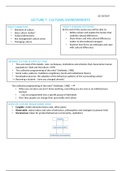
LECTURE 7: CULTURAL ENVIRONMENTS
TODAY’S OBJECTIVES TODAY’S LEARNING OUTCOMES
• Elements of culture By the end of this session you will be able to:
• Does culture matter? • Define culture and explain the factors that
• Cultural dimensions underlie cultural differences
• Key management culture areas • Show where and why cultural differences
• Managing culture matter to international managers
• Announcements • Examine how firms can anticipate and cope
with cultural differences
DEFINING CULTURE (A DIFFICULT TASK)
• “the sum total of the beliefs, rules, techniques, institutions and artefacts that characterize human
populations” (Ball and McCulloch, 1999)
• “the collective programming of the mind” (Hofstede, 1980)
• Social codes, patterns, traditions a legitimacy (Scott and institutional theory)
• Socialization process: the adoption of the behaviour patterns of the surrounding culture
Becoming a student – have you changed already?
“the collective programming of the mind” (Hofstede, 1980)
• When you are born you don’t know anything, everything you are now as an individual you
learned
• you are programmed into a specific group of individuals
• Over time people can change their personality and culture
LEVELS OF CULTURE: EDGAR SCHEIN (2004)
• Tangible: visible elements (dress code, office jokes)
• Observable: stated values and rules of behaviour, philosophies and strategies (customer first)
• Unconscious: taken for granted behaviours (community, capitalism)
, ELEMENTS OF CULTURE
LANGUAGE
• The primary means to transmit information and ideas
• Knowledge of local language can:
• Permit a clearer understanding of a situation
• Provide access to local people
• Allow the person to pick up nuances, implied meanings and other information that is not stated
LANGUAGE
• It is really important
• We communicate through it
• There are hidden messages in the different words you use
Video about Chicago Merc hand signals: Dying art
https://www.youtube.com/watch?v=M6mWd3EjtsQ
RELIGION
• Often affects how people see the world and behave
• Affects how people interact with each other
LECTURE 7: CULTURAL ENVIRONMENTS
TODAY’S OBJECTIVES TODAY’S LEARNING OUTCOMES
• Elements of culture By the end of this session you will be able to:
• Does culture matter? • Define culture and explain the factors that
• Cultural dimensions underlie cultural differences
• Key management culture areas • Show where and why cultural differences
• Managing culture matter to international managers
• Announcements • Examine how firms can anticipate and cope
with cultural differences
DEFINING CULTURE (A DIFFICULT TASK)
• “the sum total of the beliefs, rules, techniques, institutions and artefacts that characterize human
populations” (Ball and McCulloch, 1999)
• “the collective programming of the mind” (Hofstede, 1980)
• Social codes, patterns, traditions a legitimacy (Scott and institutional theory)
• Socialization process: the adoption of the behaviour patterns of the surrounding culture
Becoming a student – have you changed already?
“the collective programming of the mind” (Hofstede, 1980)
• When you are born you don’t know anything, everything you are now as an individual you
learned
• you are programmed into a specific group of individuals
• Over time people can change their personality and culture
LEVELS OF CULTURE: EDGAR SCHEIN (2004)
• Tangible: visible elements (dress code, office jokes)
• Observable: stated values and rules of behaviour, philosophies and strategies (customer first)
• Unconscious: taken for granted behaviours (community, capitalism)
, ELEMENTS OF CULTURE
LANGUAGE
• The primary means to transmit information and ideas
• Knowledge of local language can:
• Permit a clearer understanding of a situation
• Provide access to local people
• Allow the person to pick up nuances, implied meanings and other information that is not stated
LANGUAGE
• It is really important
• We communicate through it
• There are hidden messages in the different words you use
Video about Chicago Merc hand signals: Dying art
https://www.youtube.com/watch?v=M6mWd3EjtsQ
RELIGION
• Often affects how people see the world and behave
• Affects how people interact with each other