
PROBLEM 2 MIND & BODY 1
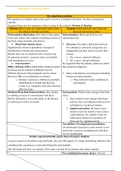
The mind body problem
The question on whether mind exists, and if so how it is related to the body. Are they connected or
separate.
In general there are two categories when it comes to the solution: Monism & Dualism
Monism (there is only one underlying reality either Dualism (mind and body exist, there are
the mind or the body not both) physical and mental events)
Materialism/reductionism: they believe that matter Interactionism: Mind and body have an
is the only reality; they explain everything in terms of interacting point.
the brain using chemistry and physics.
Mind-brain Identity theory Descartes: He made a distinction between
Supported the notion of possibility of empirical two substances, primarily saying they are
identification of brain and consciousness. independent and then tried to see how they
Mental states are not identical with a neural event interact.
In empirical research, conscious states can identify 1. Res extensa: material substance
with neurophysical events. 2. Res cogitas: thought substance
Functionalism He supported that the pituitary gland was where
Hilary Putnam (1961), functionally identical mental the interaction happened.
processes can be realized in different ways in
different physical or physiological systems where Many contemporary psychologists including
they have little or no properties in common. Freud were interactionists.
→ Multiple realization: effectively precludes → They referred to body conditions as
identification of mental and physical psychogenic.
events. E.g. computers with same function
different chips.
Idealism/Mentalism/Immaterialism: they explain Emergentism: Mental states emerge from brain
everything in terms of consciousness and ideas. states.
Reality ultimately exists in the mind; in the absence 1. Once mental events emerge from brain
of it physical world is irrelevant. activity, they can influence brain activity
and behavior. (reciprocal nature)
2. Epiphenomenalism: the brain causes
mental events but mental events cannot
cause behavior. So, mental events are
irrelevant to behavior by-products of
brain activity (epiphenomena)
Parrallelism/ Psychophysical parallelism:
Environmental experiences cause mental events
and bodily responses simultaneously and these
two are independent.
Double aspectism/Double aspect theory/Property dualism
A person cannot be divided in mind and body; they are both aspects of a single underlying substance that
simultaneously experiences events physiologically and mentally.
Just like heads and tails, two aspects of the same coin that do not interact and cannot separate.
Pre-established harmony theory: The two
, PROBLEM 2 MIND & BODY 2
types of events physical and mental are separate
but coordinated by an external agent e.g. God
Occasionalism: Desire occurs in mind,
God causes the body to act. When
something happens to the body, God causes
the corresponding mental experience
(Malebranche 17th century).
Linguistic behaviorism: Third view on the nature of mind proposed by Ryle and
Malcom.
Ryle opposed to the Cartesian myth of ghost on the mind.
The myth rests upon a conceptual confusion, a category mistake.
Linguistic behaviorism: mental concepts refer to behavior and behavioral
dispositions (inclinations to behave in a certain way in certain circumstances)
these words can lead to conceptual confusion.
→ The effort to explain outside behavior relying on an inner mental
mechanism is in vain. Since the mechanism is only accessible to the
owner, it makes it impossible to find an explanation.
Criticism of linguistic behavior: The theory of inner ghost seems plausible
therefore, the linguistic behaviorism does not apply to everyone. Additionally,
it is very common-sense knowledge theory that describes concepts.
The mind body problem
The question on whether mind exists, and if so how it is related to the body. Are they connected or
separate.
In general there are two categories when it comes to the solution: Monism & Dualism
Monism (there is only one underlying reality either Dualism (mind and body exist, there are
the mind or the body not both) physical and mental events)
Materialism/reductionism: they believe that matter Interactionism: Mind and body have an
is the only reality; they explain everything in terms of interacting point.
the brain using chemistry and physics.
Mind-brain Identity theory Descartes: He made a distinction between
Supported the notion of possibility of empirical two substances, primarily saying they are
identification of brain and consciousness. independent and then tried to see how they
Mental states are not identical with a neural event interact.
In empirical research, conscious states can identify 1. Res extensa: material substance
with neurophysical events. 2. Res cogitas: thought substance
Functionalism He supported that the pituitary gland was where
Hilary Putnam (1961), functionally identical mental the interaction happened.
processes can be realized in different ways in
different physical or physiological systems where Many contemporary psychologists including
they have little or no properties in common. Freud were interactionists.
→ Multiple realization: effectively precludes → They referred to body conditions as
identification of mental and physical psychogenic.
events. E.g. computers with same function
different chips.
Idealism/Mentalism/Immaterialism: they explain Emergentism: Mental states emerge from brain
everything in terms of consciousness and ideas. states.
Reality ultimately exists in the mind; in the absence 1. Once mental events emerge from brain
of it physical world is irrelevant. activity, they can influence brain activity
and behavior. (reciprocal nature)
2. Epiphenomenalism: the brain causes
mental events but mental events cannot
cause behavior. So, mental events are
irrelevant to behavior by-products of
brain activity (epiphenomena)
Parrallelism/ Psychophysical parallelism:
Environmental experiences cause mental events
and bodily responses simultaneously and these
two are independent.
Double aspectism/Double aspect theory/Property dualism
A person cannot be divided in mind and body; they are both aspects of a single underlying substance that
simultaneously experiences events physiologically and mentally.
Just like heads and tails, two aspects of the same coin that do not interact and cannot separate.
Pre-established harmony theory: The two
, PROBLEM 2 MIND & BODY 2
types of events physical and mental are separate
but coordinated by an external agent e.g. God
Occasionalism: Desire occurs in mind,
God causes the body to act. When
something happens to the body, God causes
the corresponding mental experience
(Malebranche 17th century).
Linguistic behaviorism: Third view on the nature of mind proposed by Ryle and
Malcom.
Ryle opposed to the Cartesian myth of ghost on the mind.
The myth rests upon a conceptual confusion, a category mistake.
Linguistic behaviorism: mental concepts refer to behavior and behavioral
dispositions (inclinations to behave in a certain way in certain circumstances)
these words can lead to conceptual confusion.
→ The effort to explain outside behavior relying on an inner mental
mechanism is in vain. Since the mechanism is only accessible to the
owner, it makes it impossible to find an explanation.
Criticism of linguistic behavior: The theory of inner ghost seems plausible
therefore, the linguistic behaviorism does not apply to everyone. Additionally,
it is very common-sense knowledge theory that describes concepts.



