UNIVERSITY OF Warwick Year 1
School of Engineering June 2016
ES183 Title of Examination: -
ENGINEERING MATHEMATICS AND SYSTEMS
MODELLING Page 1
Question 1-4 Mark
Allocation
Marks
**************************************** Begin (i) ****************************************** *** B (i) ***
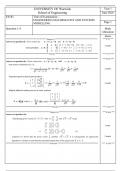
Answer to question (i): Give vectors are: a = 3i + 2 j − 4k and b = 1i − 6 j + 5k
j k i2 ⋅ 5 − (− 4 ) ⋅ (− 6 ) 10 − 24 − 14 3 marks
Cross product: 2 − 4 = (− 4 ) ⋅1 − 3 ⋅ 5 = − 4 − 15 = − 19
a×b = 3
1 −6 5 3 ⋅ (− 6 ) − 2 ⋅1 − 18 − 2 − 20
****************************************** End (i) ****************************************** *** E (1) ***
**************************************** Begin (ii) ****************************************** *** B (ii) ***
Answer to question (ii): Given vectors are: F = 4i + 3 j − 5k and s = 2i + 4 j − 1k
Unit vector in direction of s is:
^ 1 2 4 1
s= (2i + 4 j − 1k ) = i+ j− k 2 marks
2 2 + 4 2 + (− 1)2 21 21 21
Projection given by Dot (Scalar) product:
4 2 21
^
F ⋅s = 3 ⋅ 4 21 = 4 ⋅
2
+3⋅
4
+ (− 5) ⋅
(− 1) = 25 ≈ 25 ≈ 5.46 2 marks
21 21 21 21 4.58
− 5 − 1 21
(Slightly different looking version of same method:
4 2
3 ⋅ 4
F ⋅s − 5 −1 8 + 12 + 5 25
F ⋅ s = F ⋅ s ⋅ cos(α ) ⇒ = F ⋅ cos(α ) = = = )
s s 21 21
********************************************* End (ii) *************************************** *** E (ii) ***
******************************************* Begin (iii) *************************************** *** B (iii) ***
Answer to question (ix):
4 1
Introducing given vecotor p = 1 i + 1 j with A = into A X = λ X to get
3 2
4 1 1 5
= 1 mark
3 2 1 5
4 1 1 5 1
⇒ = =5 (1)
3 2 1 5 1
Equation (1) shows that the given vector p satisfies A X = λ X ; it is consequently an eigenvector. 2 marks
Equation (1) further reveals that the associated eigenvalue of the eigenvector p is λ = 5 .
******************************************* End (iii) **************************************** *** E (iii) ***
, ******************************************* Begin (iv) *************************************** *** B (iv) ***
Answer to question (iv):
x2 y2
Expression for given hyperbola is − = 1 . Need to rearrange to find asymptotes via taking limit
32 4 2
behaviour of expression when x → ±∞ :
x2 y2 y2 x2 x2
− =1 ⇒ − = 1− ⇒ y 2 = 42 −1
32 42 42 32 32
1 1 42 32
⇒ y 2 = 42 x 2 2
− 2
⇒ y2 = 2
x2 1 − 2 marks
3 x 3 x2
⇒
x → ±∞
( )
lim y 2 = lim
x → ±∞
42 2
3 2
32
x 1− 2
x
=
42 2
32
x
42
⇒ y2 = x2
32
2 marks
42 4
⇒ y=± x2 = ± x
32 3
******************************************* End (iv) **************************************** *** E (iv) ***
******************************************* Begin (v) *************************************** *** B (v) ***
Answer to question (v):
dy 1 mark
Given is y = 2 x − x 2 ⇒ = 2 − 2x
dx
dy 2 marks
For maximum and minimum need =0 ⇒ 0 = 2 − 2x
dx
Hence, max. or min. at x = 1
d2y
Now consider = −2 1 mark
dx 2
d 2 y (x = 1)
Since <0 ⇒ Maximum 1 mark
dx 2
******************************************* End (v) ***************************************** *** E (v) ***
****************************************** Begin (vi) **************************************** *** B (vi) ***
Answer to question (vi):
(a) (
f (x ) = 2 x 3 + 4 ) 5
⇒ (
f ' (x ) = 5 2 x 3 + 4 ) (6 x )
4 2
So, f ' (0.5) ⇒ (
f ' (0.5) = 5 2 ⋅ 0.5 3 + 4 ) (6 ⋅ 0.5 ) = 5 ⋅ (4.25) ⋅ (1.5) = 2446.9
4 2 4 3 marks
(b) y = sin ( cos(3 x ) ) use chain rule with u = cos(3 x )
du
= − 3 sin (3 x )
⇒
dx
dy d (sin (u )) du
⇒ = = cos(u ) ⋅ ( − 3 sin (3 x ) )
dx du dx
= cos(cos(3 x )) ⋅ ( − 3 sin (3 x ) ) = −3 sin (3 x ) cos(cos(3 x )) 3 marks
******************************************* End (vi) **************************************** *** E (vi) ***
School of Engineering June 2016
ES183 Title of Examination: -
ENGINEERING MATHEMATICS AND SYSTEMS
MODELLING Page 1
Question 1-4 Mark
Allocation
Marks
**************************************** Begin (i) ****************************************** *** B (i) ***
Answer to question (i): Give vectors are: a = 3i + 2 j − 4k and b = 1i − 6 j + 5k
j k i2 ⋅ 5 − (− 4 ) ⋅ (− 6 ) 10 − 24 − 14 3 marks
Cross product: 2 − 4 = (− 4 ) ⋅1 − 3 ⋅ 5 = − 4 − 15 = − 19
a×b = 3
1 −6 5 3 ⋅ (− 6 ) − 2 ⋅1 − 18 − 2 − 20
****************************************** End (i) ****************************************** *** E (1) ***
**************************************** Begin (ii) ****************************************** *** B (ii) ***
Answer to question (ii): Given vectors are: F = 4i + 3 j − 5k and s = 2i + 4 j − 1k
Unit vector in direction of s is:
^ 1 2 4 1
s= (2i + 4 j − 1k ) = i+ j− k 2 marks
2 2 + 4 2 + (− 1)2 21 21 21
Projection given by Dot (Scalar) product:
4 2 21
^
F ⋅s = 3 ⋅ 4 21 = 4 ⋅
2
+3⋅
4
+ (− 5) ⋅
(− 1) = 25 ≈ 25 ≈ 5.46 2 marks
21 21 21 21 4.58
− 5 − 1 21
(Slightly different looking version of same method:
4 2
3 ⋅ 4
F ⋅s − 5 −1 8 + 12 + 5 25
F ⋅ s = F ⋅ s ⋅ cos(α ) ⇒ = F ⋅ cos(α ) = = = )
s s 21 21
********************************************* End (ii) *************************************** *** E (ii) ***
******************************************* Begin (iii) *************************************** *** B (iii) ***
Answer to question (ix):
4 1
Introducing given vecotor p = 1 i + 1 j with A = into A X = λ X to get
3 2
4 1 1 5
= 1 mark
3 2 1 5
4 1 1 5 1
⇒ = =5 (1)
3 2 1 5 1
Equation (1) shows that the given vector p satisfies A X = λ X ; it is consequently an eigenvector. 2 marks
Equation (1) further reveals that the associated eigenvalue of the eigenvector p is λ = 5 .
******************************************* End (iii) **************************************** *** E (iii) ***
, ******************************************* Begin (iv) *************************************** *** B (iv) ***
Answer to question (iv):
x2 y2
Expression for given hyperbola is − = 1 . Need to rearrange to find asymptotes via taking limit
32 4 2
behaviour of expression when x → ±∞ :
x2 y2 y2 x2 x2
− =1 ⇒ − = 1− ⇒ y 2 = 42 −1
32 42 42 32 32
1 1 42 32
⇒ y 2 = 42 x 2 2
− 2
⇒ y2 = 2
x2 1 − 2 marks
3 x 3 x2
⇒
x → ±∞
( )
lim y 2 = lim
x → ±∞
42 2
3 2
32
x 1− 2
x
=
42 2
32
x
42
⇒ y2 = x2
32
2 marks
42 4
⇒ y=± x2 = ± x
32 3
******************************************* End (iv) **************************************** *** E (iv) ***
******************************************* Begin (v) *************************************** *** B (v) ***
Answer to question (v):
dy 1 mark
Given is y = 2 x − x 2 ⇒ = 2 − 2x
dx
dy 2 marks
For maximum and minimum need =0 ⇒ 0 = 2 − 2x
dx
Hence, max. or min. at x = 1
d2y
Now consider = −2 1 mark
dx 2
d 2 y (x = 1)
Since <0 ⇒ Maximum 1 mark
dx 2
******************************************* End (v) ***************************************** *** E (v) ***
****************************************** Begin (vi) **************************************** *** B (vi) ***
Answer to question (vi):
(a) (
f (x ) = 2 x 3 + 4 ) 5
⇒ (
f ' (x ) = 5 2 x 3 + 4 ) (6 x )
4 2
So, f ' (0.5) ⇒ (
f ' (0.5) = 5 2 ⋅ 0.5 3 + 4 ) (6 ⋅ 0.5 ) = 5 ⋅ (4.25) ⋅ (1.5) = 2446.9
4 2 4 3 marks
(b) y = sin ( cos(3 x ) ) use chain rule with u = cos(3 x )
du
= − 3 sin (3 x )
⇒
dx
dy d (sin (u )) du
⇒ = = cos(u ) ⋅ ( − 3 sin (3 x ) )
dx du dx
= cos(cos(3 x )) ⋅ ( − 3 sin (3 x ) ) = −3 sin (3 x ) cos(cos(3 x )) 3 marks
******************************************* End (vi) **************************************** *** E (vi) ***