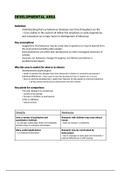
DEVELOPMENTAL AREA
Definition:
- Understanding that our behaviour develops over time throughout our life
↪ Core studies in this section all reflect this emphasis on early experiences
and maturation as a major factor in development of behaviour
Key assumptions:
- Suggestions that behaviour may be innate (due to genetics) or may be learned from
the environment (including other people)
- Early experiences can affect later development so often investigates behaviour of
children
- Assumes our behaviour changes throughout our lifetime (sometimes in
predetermined stages)
Why this area is useful (for what or to whom):
- Developmental psychologists
↪ seeks to explain the changes they have observed in relation to normative processes +
individual differences - often easier to describe development than to explain how it occurs
↪ have to optimise development + apply their theories to help people in practical situations
e.g help parents develop secure attachments with their children
Key points for comparison:
- The way research is carried out:
↪ usually small sample
↪ focuses in children as participants
- Links to debates:
↪ nature/nurture
Strengths Weaknesses
Uses a variety of qualitative and Research with children may raise ethical
quantitative methods issues
↪ so will gain useful data: both rich & detailed, ↪ Such as consent + protection
and also easy to compare and analyse
Many useful applications Research may be constrained by
↪ i.e childcare & education time/culture
↪ due to changes in early years environments +
cultural differences in child rearing
, CLASSIC: BANDURA - EXTERNAL INFLUENCES ON CHILDREN’S BEHAVIOUR
Link to Key theme:
- Demonstrates importance of the environment in which the child is brought up,
as these external factors will shape a person’s behaviour
↪ There is much evidence that children with aggressive role models (such as siblings &
parents) will become more aggressive
↪ BUT whether that is due to social learning theory or some other aspect of their environment
is difficult to isolate:
- obviously wouldn’t be ethical to bring up children in situation where they have little or no
contact with family or society, to isolate the effect of certain variables
Link to Area:
Investigates how the environment around a child (particularly in terms of the adult
behaviours they see and hear) can affect the behaviours they end up adopting
themselves → Also illustrates the behaviourist perspective: because Bandura believed all behaviour
is learned and Social learning theory (which he developed alongside his research)
Links to debates:
FREEWILL/DETERMINISM:
determined If we accept that testosterone levels are linked to aggression, then that means boys would
be more likely to show aggression than girls
freewill Physical aggression shown by female role models was not imitated to extent that
aggression shown by male role models was
↪ indicates some choices being made by children as to
what was an acceptable way to behave
USEFULNESS:
useful 9pm Watershed introduced in 1970s
↪ time where television divides between programmes that are suitable for children and programmes that are
unsuitable for children
Role models (e.g in sport/fashion)
↪ often castigated for displaying behaviour which we don’t want children to imitate
NATURE/NURTURE:
nature - Could be that boys are naturally more aggressive than girls
↪ biological explanation: presence on testosterone in boys, which from when they were in the womb,
is a higher exposure than girls
- Research has linked high levels of testosterone to higher levels of aggression in animals
and humans
nurture - Influence of environment can be seen quite obviously in all of the hypotheses
- Effect of society on those boys before they took part in the research?
Could society have unwittingly shown acceptance of aggression in boys as young as three years old?
↪ qualitative data included comments such as, ‘That ain’t no way for a lady to behave’ would indicate
this case
Definition:
- Understanding that our behaviour develops over time throughout our life
↪ Core studies in this section all reflect this emphasis on early experiences
and maturation as a major factor in development of behaviour
Key assumptions:
- Suggestions that behaviour may be innate (due to genetics) or may be learned from
the environment (including other people)
- Early experiences can affect later development so often investigates behaviour of
children
- Assumes our behaviour changes throughout our lifetime (sometimes in
predetermined stages)
Why this area is useful (for what or to whom):
- Developmental psychologists
↪ seeks to explain the changes they have observed in relation to normative processes +
individual differences - often easier to describe development than to explain how it occurs
↪ have to optimise development + apply their theories to help people in practical situations
e.g help parents develop secure attachments with their children
Key points for comparison:
- The way research is carried out:
↪ usually small sample
↪ focuses in children as participants
- Links to debates:
↪ nature/nurture
Strengths Weaknesses
Uses a variety of qualitative and Research with children may raise ethical
quantitative methods issues
↪ so will gain useful data: both rich & detailed, ↪ Such as consent + protection
and also easy to compare and analyse
Many useful applications Research may be constrained by
↪ i.e childcare & education time/culture
↪ due to changes in early years environments +
cultural differences in child rearing
, CLASSIC: BANDURA - EXTERNAL INFLUENCES ON CHILDREN’S BEHAVIOUR
Link to Key theme:
- Demonstrates importance of the environment in which the child is brought up,
as these external factors will shape a person’s behaviour
↪ There is much evidence that children with aggressive role models (such as siblings &
parents) will become more aggressive
↪ BUT whether that is due to social learning theory or some other aspect of their environment
is difficult to isolate:
- obviously wouldn’t be ethical to bring up children in situation where they have little or no
contact with family or society, to isolate the effect of certain variables
Link to Area:
Investigates how the environment around a child (particularly in terms of the adult
behaviours they see and hear) can affect the behaviours they end up adopting
themselves → Also illustrates the behaviourist perspective: because Bandura believed all behaviour
is learned and Social learning theory (which he developed alongside his research)
Links to debates:
FREEWILL/DETERMINISM:
determined If we accept that testosterone levels are linked to aggression, then that means boys would
be more likely to show aggression than girls
freewill Physical aggression shown by female role models was not imitated to extent that
aggression shown by male role models was
↪ indicates some choices being made by children as to
what was an acceptable way to behave
USEFULNESS:
useful 9pm Watershed introduced in 1970s
↪ time where television divides between programmes that are suitable for children and programmes that are
unsuitable for children
Role models (e.g in sport/fashion)
↪ often castigated for displaying behaviour which we don’t want children to imitate
NATURE/NURTURE:
nature - Could be that boys are naturally more aggressive than girls
↪ biological explanation: presence on testosterone in boys, which from when they were in the womb,
is a higher exposure than girls
- Research has linked high levels of testosterone to higher levels of aggression in animals
and humans
nurture - Influence of environment can be seen quite obviously in all of the hypotheses
- Effect of society on those boys before they took part in the research?
Could society have unwittingly shown acceptance of aggression in boys as young as three years old?
↪ qualitative data included comments such as, ‘That ain’t no way for a lady to behave’ would indicate
this case