

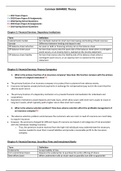
Common BAN4801 Theory
X = 2017 Exam Papers
X = 2018 Exam Papers & Assignments
X = 2018 Spring School Questions
X = 2019 Exam Papers & Assignments
X = 2019 Spring School Questions
Chapter 2: Financial Services: Depository Institutions
Term Definition
Federal funds market An interbank market for short-term borrowing and lending of bank reserves
Spreads Difference between lending and deposit rates
Off-balance-sheet activities An asset or debt or financing activity not on the balance sheet
Off-balance-sheet asset An item that moves onto the asset side of the balance sheet when a contingent
event occurs, or an income item is realized on the income statement
Off-balance-sheet liability An item that moves onto the liability side of the balance sheet when a
contingent event occurs, or an expense item is realized on the income
statement
Chapter 3: Financial Services: Finance Companies
1. What is the primary function of an insurance company? How does this function compare with the primary
function of a deposit institution? X
The primary function of an insurance company is to protect their customers from adverse events.
Insurance companies accept premium payments in exchange for compensation (pay out) in the event that the
adverse event occurs.
The primary function of a depository institution is to provide financial intermediation for individuals and
corporations.
Depository institutions accept deposits and make loans, which allow savers with short-term assets to invest in
long-term assets, which typically yield a higher return than short-term assets.
2. What is the adverse selection problem? How does adverse selection affect the profitable management of
an insurance company? X
The adverse selection problem exists because the customers who are most in need of insurance are most likely
to acquire insurance.
However, the premiums charged for different types of insurance are based on all categories of risk associated
with the individuals needing insurance.
o Thus, the premium income received from the high-risk individuals may underestimate the necessary
revenue needed to cover their insured liabilities and provide a reasonable profit to the insurance
company.
Chapter 4: Financial Services: Securities Firms and Investment Banks
Term Definition
Underwrite Accept liability of loss
Firm commitment basis Requires the underwriter to purchase the entire offering of shares
Best-efforts basis When underwriter sells as much stock as possible, but with no guarantee
, Chapter 5: Financial Services: Mutual Funds and Hedge Fund Companies
Term Definition
NAV (net asset value) Total market value of all assets in the mutual fund divided by the no. of shares
in the fund
Marked-to-market daily Process of daily recalculation of the NAV from adjustments caused by:
Changes in value of the assets;
Dividend distributions of the companies held;
Changes in ownership of the fund.
Open-ended funds Funds that allow shares to be purchased and redeemed according to investor
demand
Close-ended funds Funds that have a fixed no. of shares
1. How is the net asset value (NAV) of a mutual fund determined? What is meant by the term marked-to-
market daily? X X
NAV is determined by taking the total market value of all assets in the mutual fund and dividing it by the no. of
shares in the fund.
o The total market value is the sum of each value of the assets, which is determined by the no. of shares of
the asset and multiplying it by the price.
2. What is the difference between open-ended and close-ended mutual funds? X
Open-ended funds allow shares to be purchased and redeemed according to investor demand.
o The NAV is determined only by changes in the value of the assets owned.
Close-ended funds have a fixed no. of shares.
o If investors need to redeem their shares, they sell them to another investor.
3. How does the risk of short-term funds differ from the risk of long-term funds? X
Risk of short-term funds: Risk of long-term funds:
Main risk involved is interest rate risk from fixed Main risk involved is market risk as equity funds are
securities usually well-diversified
Bonds have high interest rates due to their fixed-
rate nature
Because they have shorter maturities, they are All funds have systematic and unsystematic risks
perceived to be less risky with lower returns involved, regardless of whether they are equity or
bond funds
Almost have no liquidity risk or default risk due to Liquidity and default risks are much higher in long-
the type of assets held term funds
4. What are the economic reasons for the existence of mutual funds or what benefits do mutual funds
provide for investors? Why do individuals rather than corporations hold most mutual funds? X X
Individuals: Corporations:
Fund managers are able to hold well-diversified Corporation’s main objective should be to maximise
portfolios through pooling investments from a large shareholder wealth and not to diversify (although
amount of small investors they are more likely to diversify through individual
Mutual funds provide diversification through risk securities and assets in the capital and money
pooling (sharing of funds) to small investors markets)
Mutual funds allow individuals to invest a small
amount on a periodic basis (which is generally too
low for direct access to capital and money markets)
X = 2017 Exam Papers
X = 2018 Exam Papers & Assignments
X = 2018 Spring School Questions
X = 2019 Exam Papers & Assignments
X = 2019 Spring School Questions
Chapter 2: Financial Services: Depository Institutions
Term Definition
Federal funds market An interbank market for short-term borrowing and lending of bank reserves
Spreads Difference between lending and deposit rates
Off-balance-sheet activities An asset or debt or financing activity not on the balance sheet
Off-balance-sheet asset An item that moves onto the asset side of the balance sheet when a contingent
event occurs, or an income item is realized on the income statement
Off-balance-sheet liability An item that moves onto the liability side of the balance sheet when a
contingent event occurs, or an expense item is realized on the income
statement
Chapter 3: Financial Services: Finance Companies
1. What is the primary function of an insurance company? How does this function compare with the primary
function of a deposit institution? X
The primary function of an insurance company is to protect their customers from adverse events.
Insurance companies accept premium payments in exchange for compensation (pay out) in the event that the
adverse event occurs.
The primary function of a depository institution is to provide financial intermediation for individuals and
corporations.
Depository institutions accept deposits and make loans, which allow savers with short-term assets to invest in
long-term assets, which typically yield a higher return than short-term assets.
2. What is the adverse selection problem? How does adverse selection affect the profitable management of
an insurance company? X
The adverse selection problem exists because the customers who are most in need of insurance are most likely
to acquire insurance.
However, the premiums charged for different types of insurance are based on all categories of risk associated
with the individuals needing insurance.
o Thus, the premium income received from the high-risk individuals may underestimate the necessary
revenue needed to cover their insured liabilities and provide a reasonable profit to the insurance
company.
Chapter 4: Financial Services: Securities Firms and Investment Banks
Term Definition
Underwrite Accept liability of loss
Firm commitment basis Requires the underwriter to purchase the entire offering of shares
Best-efforts basis When underwriter sells as much stock as possible, but with no guarantee
, Chapter 5: Financial Services: Mutual Funds and Hedge Fund Companies
Term Definition
NAV (net asset value) Total market value of all assets in the mutual fund divided by the no. of shares
in the fund
Marked-to-market daily Process of daily recalculation of the NAV from adjustments caused by:
Changes in value of the assets;
Dividend distributions of the companies held;
Changes in ownership of the fund.
Open-ended funds Funds that allow shares to be purchased and redeemed according to investor
demand
Close-ended funds Funds that have a fixed no. of shares
1. How is the net asset value (NAV) of a mutual fund determined? What is meant by the term marked-to-
market daily? X X
NAV is determined by taking the total market value of all assets in the mutual fund and dividing it by the no. of
shares in the fund.
o The total market value is the sum of each value of the assets, which is determined by the no. of shares of
the asset and multiplying it by the price.
2. What is the difference between open-ended and close-ended mutual funds? X
Open-ended funds allow shares to be purchased and redeemed according to investor demand.
o The NAV is determined only by changes in the value of the assets owned.
Close-ended funds have a fixed no. of shares.
o If investors need to redeem their shares, they sell them to another investor.
3. How does the risk of short-term funds differ from the risk of long-term funds? X
Risk of short-term funds: Risk of long-term funds:
Main risk involved is interest rate risk from fixed Main risk involved is market risk as equity funds are
securities usually well-diversified
Bonds have high interest rates due to their fixed-
rate nature
Because they have shorter maturities, they are All funds have systematic and unsystematic risks
perceived to be less risky with lower returns involved, regardless of whether they are equity or
bond funds
Almost have no liquidity risk or default risk due to Liquidity and default risks are much higher in long-
the type of assets held term funds
4. What are the economic reasons for the existence of mutual funds or what benefits do mutual funds
provide for investors? Why do individuals rather than corporations hold most mutual funds? X X
Individuals: Corporations:
Fund managers are able to hold well-diversified Corporation’s main objective should be to maximise
portfolios through pooling investments from a large shareholder wealth and not to diversify (although
amount of small investors they are more likely to diversify through individual
Mutual funds provide diversification through risk securities and assets in the capital and money
pooling (sharing of funds) to small investors markets)
Mutual funds allow individuals to invest a small
amount on a periodic basis (which is generally too
low for direct access to capital and money markets)


