
COMPUTER SCIENCE REVISION PAPER 1
SYSTEM ARCHITECTURE:
Computer is an electronic device that takes input ,processes data and gives output
1.1.1 CPU ARCHITECTURE
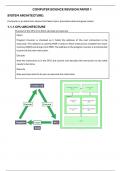
Purpose of the CPU is to fetch-decode and execute
Fetch
Program Counter is checked as it holds the address of the next instruction to be
executed. This address is used by MAR in order to fetch instructions needed from main
memory (RAM) and bring it into MDR. The address in the program counter is incremented
to point at the next instruction.
Decode
Now the instruction is in the CPU, the control unit decodes the instruction to see what
needs to be done.
Execute
Now we know what to do we can execute the instruction
, CPU components
CU- controls how data moves around the CPU
ALU- carries out arithmetic calculations and makes logical decisions
CACHE- temporary storage of data and instructions being read to or written from also provides
fast access to frequently accessed data or instruction
REGISTERS-tiny, superfast pieces of onboard memory, each having a specific purpose
MAR-Holds the address of where data is to be stored or fetched
MDR-Holds the data fetched from or written to
ACC-Holds the results of all the calculations
PC-Holds the address of the next instruction to be executed
VON NEUMANN ARCHITECTURE
• It is based on the concept of a stored program.
• Both instruction data and stored program are stored in the same memory in
binary form
• Theres no way to know if the pure binary held in memory is representing
instructions or data simply by looking at it .
1.1.2 CPU PERFORMANCE
PERFORMANCE OF CPU DEPENDS ON
• Clock Speed- no of cycles per second,(Hz),modern processors operate at billion cycles
per sec(GHz)
• Cache size-stores recent data and instructions,much quicker getting items from cache
than main memory (RAM)
• Number of cores-a complete copy of a CPU, quad-core processor would have 4 cores,
CPUs with multiple cores have more power to run multiple programs at the same time
SYSTEM ARCHITECTURE:
Computer is an electronic device that takes input ,processes data and gives output
1.1.1 CPU ARCHITECTURE
Purpose of the CPU is to fetch-decode and execute
Fetch
Program Counter is checked as it holds the address of the next instruction to be
executed. This address is used by MAR in order to fetch instructions needed from main
memory (RAM) and bring it into MDR. The address in the program counter is incremented
to point at the next instruction.
Decode
Now the instruction is in the CPU, the control unit decodes the instruction to see what
needs to be done.
Execute
Now we know what to do we can execute the instruction
, CPU components
CU- controls how data moves around the CPU
ALU- carries out arithmetic calculations and makes logical decisions
CACHE- temporary storage of data and instructions being read to or written from also provides
fast access to frequently accessed data or instruction
REGISTERS-tiny, superfast pieces of onboard memory, each having a specific purpose
MAR-Holds the address of where data is to be stored or fetched
MDR-Holds the data fetched from or written to
ACC-Holds the results of all the calculations
PC-Holds the address of the next instruction to be executed
VON NEUMANN ARCHITECTURE
• It is based on the concept of a stored program.
• Both instruction data and stored program are stored in the same memory in
binary form
• Theres no way to know if the pure binary held in memory is representing
instructions or data simply by looking at it .
1.1.2 CPU PERFORMANCE
PERFORMANCE OF CPU DEPENDS ON
• Clock Speed- no of cycles per second,(Hz),modern processors operate at billion cycles
per sec(GHz)
• Cache size-stores recent data and instructions,much quicker getting items from cache
than main memory (RAM)
• Number of cores-a complete copy of a CPU, quad-core processor would have 4 cores,
CPUs with multiple cores have more power to run multiple programs at the same time


