STUDY GUIDE FOR MOLECULAR BIOLOGY FINAL EXAM
Chapter 9 study guide questions.
1. Where does 5’ capping, 3’ cleavage/polyadenylation and RNA splicing occur in the cell?
These processes occur in the nucleus, where pre-mRNA is processed before being
exported to the cytoplasm
2. In multicellular organisms when does splicing usually begin with long genes?
Splicing begins co-transcriptionally, meaning it starts before transcription is
complete, especially for long genes
3. What role does the CTD play in RNA processing?
The carboxy-terminal domain (CTD) of RNA polymerase II acts as a platform for
recruiting RNA processing factors like capping enzymes, splicing factors, and
polyadenylation machinery during transcription
4. Be able to explain how splicing occurs at short splice sites in pre mRNAs via two
transesterification reactions (fig 9-8).
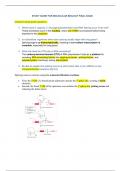
Splicing removes introns using two transesterification reactions:
• First, the 2' OH of a branch-point adenosine attacks the 5' splice site, creating a lariat
structure.
• Second, the freed 3' OH of the upstream exon attacks the 3' splice site, joining exons and
releasing the lariat intron
, 5. What are the two main snRNAs of the spliceosome? And what does the Luc7 family of
proteins provide for the spliceosome in mammals and plants?
• The two main snRNAs are U1 and U2, which help recognize splice sites.
• The Luc7 family of proteins enhances spliceosome stability and specificity, especially
important in higher eukaryotes like mammals and plants
6. Of the ten spliceosome complexes in your book, what are the three stages of splicing?
Figure 9-13.
The three stages are:
1. Recognition and Assembly of spliceosome on pre-mRNA
2. Catalytic Activation of the spliceosome
3. Release and disassembly (the two transesterification reactions
7. Following RNA splicing in vertebrates, a specific set of hnRNP proteins remained bound
to the spliced RNA. Why? What are their functions?
These proteins, including those from the exon junction complex (EJC), remain to mark
the splice site, aid in nuclear export, and help with translation efficiency and
nonsense-mediated decay
8. How is the 3’ end of an mRNA finished?
It's processed by cleavage at the poly(A) site followed by addition of a poly(A) tail by
poly(A) polymerase (PAP). This tail stabilizes the mRNA and facilitates export and
translation
9. Know the ways in which alternate expression of mRNA can occur (alternative promoters,
primary transcript alternative splicing, cutting at different Poly A sites, etc).
• Alternative promoters: Transcription starts at different sites.
• Alternative splicing: Different exons are included/excluded.
Chapter 9 study guide questions.
1. Where does 5’ capping, 3’ cleavage/polyadenylation and RNA splicing occur in the cell?
These processes occur in the nucleus, where pre-mRNA is processed before being
exported to the cytoplasm
2. In multicellular organisms when does splicing usually begin with long genes?
Splicing begins co-transcriptionally, meaning it starts before transcription is
complete, especially for long genes
3. What role does the CTD play in RNA processing?
The carboxy-terminal domain (CTD) of RNA polymerase II acts as a platform for
recruiting RNA processing factors like capping enzymes, splicing factors, and
polyadenylation machinery during transcription
4. Be able to explain how splicing occurs at short splice sites in pre mRNAs via two
transesterification reactions (fig 9-8).
Splicing removes introns using two transesterification reactions:
• First, the 2' OH of a branch-point adenosine attacks the 5' splice site, creating a lariat
structure.
• Second, the freed 3' OH of the upstream exon attacks the 3' splice site, joining exons and
releasing the lariat intron
, 5. What are the two main snRNAs of the spliceosome? And what does the Luc7 family of
proteins provide for the spliceosome in mammals and plants?
• The two main snRNAs are U1 and U2, which help recognize splice sites.
• The Luc7 family of proteins enhances spliceosome stability and specificity, especially
important in higher eukaryotes like mammals and plants
6. Of the ten spliceosome complexes in your book, what are the three stages of splicing?
Figure 9-13.
The three stages are:
1. Recognition and Assembly of spliceosome on pre-mRNA
2. Catalytic Activation of the spliceosome
3. Release and disassembly (the two transesterification reactions
7. Following RNA splicing in vertebrates, a specific set of hnRNP proteins remained bound
to the spliced RNA. Why? What are their functions?
These proteins, including those from the exon junction complex (EJC), remain to mark
the splice site, aid in nuclear export, and help with translation efficiency and
nonsense-mediated decay
8. How is the 3’ end of an mRNA finished?
It's processed by cleavage at the poly(A) site followed by addition of a poly(A) tail by
poly(A) polymerase (PAP). This tail stabilizes the mRNA and facilitates export and
translation
9. Know the ways in which alternate expression of mRNA can occur (alternative promoters,
primary transcript alternative splicing, cutting at different Poly A sites, etc).
• Alternative promoters: Transcription starts at different sites.
• Alternative splicing: Different exons are included/excluded.