
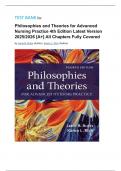
TEST BANK for
Philosophies and Theories for Advanced
Nursing Practice 4th Edition Latest Version
2025/2026 [A+] All Chapters Fully Covered
by Janie B. Butts (Author), Karen L. Rich (Author)
, TABLE OF CONTENTS
Section I Foundations of Nursing Science
Chapter 1 Philosophy of Science: An Introduction and a Grounding for Your
Practice
Chapter 2 The Evolution of Nursing Science
Chapter 3 The Essentials of the Doctor of Nursing Practice: A Philosophical
Perspective
Section II The Structure and Function of Theory
Chapter 4 Theory as Practice
Chapter 5 Components and Levels of Abstraction in Nursing Knowledge
Section III Interdisciplinary Philosophies and Theories
Chapter 6 Complexity Science and Complex Adaptive Systems
Chapter 7 Critical Theory and Emancipatory Knowing
Chapter 8 Feminist Ethics: Some Thoughts About "Care" and "Power" for
Advanced Practice Nurses
Chapter 9 Theories and Methods in Ethics
Chapter 10 Educational and Learning Theories
Chapter 11 Health Behavior Theories
Chapter 12 Theories Focused on Interpersonal Relationships
Chapter 13 Economic Theories
Chapter 14 Theories of Organizational Behavior and Leadership
Chapter 15 Theoretical Approaches to Quality Improvement
Chapter 16 Theories Focused on Health Equity
Chapter 17 Public Health Theories
Section IV Select Nursing Models and Theories
Chapter 18 Models and Theories Focused on Nursing Goals and Functions
Chapter 19 Models and Theories Focused on a Systems Approach
Chapter 20 Models and Theories Focused on Human Existence and
Universal Energy
Chapter 21 Models and Theories Focused on Competencies and Skills
Chapter 22 Theories Focused on Caring
Chapter 23 Models and Theories Focused on Culture
Chapter 24 The Praxis Theory of Suffering
Section V Tools for Integrating and Disseminating Knowledge in Advanced
Nursing Practice
Chapter 25 Theory Testing and Theory Evaluation
Chapter 26 Using Theory in Evidence-Based Advanced Nursology Practice
,Philosophies and Theories for Advanced Nursing Practice
Janie B. Butts and Karen L. Rich
MULTIPLE CHOICE
Chapter 1 – Philosophy of Science: An Introduction
1. Why are natural sciences also referred to as “pure” sciences?
A. They are considered stand-alone bodies of unique knowledge.
B. They are the only sciences to which the scientific method can be applied.
C. They are the original sciences upon which all others are based.
D. They are not affected by subjectivity in the way other sciences are.
ANS;A
2. Which is not an example of an applied science as used in health care today?
A. Social work
B. Psychotherapy
C. Examination of care disparities
D. Pathology ANS;D
3. Roberta firmly believes that individual experiences are the source of all knowledge in the world.
As a scientist, she acknowledges her role as a participant in the experiments she performs and does
consider herself merely a disconnected observer of phenomenon.
Roberta’s views are most closTeElySrTefBleActNivKeSoEf wLhLiEchRs.chCoOoMl of scientific thought?
A. Natural Science
B. Human Science
C. Applied Science
D. Soft Science ANS;B
4. What is the ultimate goal of the scientific method?
A. Application of scientific results to a related body of knowledge in order to meet some type of
human need.
, B. Examination of the decisions made by a scientist to understand the ways in which subjectivity
was introduced to the experiment.
C. Reproducible experimental results that do not take researcher individuality into account.
D. Improving the situation or process used in the experiment to yield more accurate results in
repeat experiments.
ANS;C
5. Which of the following best describes the aim of natural sciences?
A. Affirmation of the importance of cultural understanding by uncovering the common subjective
biases of different disciplines.
B. Improvement of the quality of life by understanding what helps people maximize their
functional abilities.
C. Utilization of knowledge by applying it to a specific purpose in order to better a situation or
change viewpoints.
D. Development of knowledge for the sake of developing knowledge, discovering truth, and
controlling outcomes.
ANS;D
6. Gretchen and Peter are graduate students in the same Physics lab. Their supervisor has asked
both of them to perform the same experiment using the same procedure and
equipment. After they’ve both completed their task, the compare their results and discover that they
are nearly identical. Which of the five criteria for science does Gretchen and Peter’s discovery
exemplify?
A. Intersubjective testability
B. Reliability
C. Definiteness and precision
Philosophies and Theories for Advanced
Nursing Practice 4th Edition Latest Version
2025/2026 [A+] All Chapters Fully Covered
by Janie B. Butts (Author), Karen L. Rich (Author)
, TABLE OF CONTENTS
Section I Foundations of Nursing Science
Chapter 1 Philosophy of Science: An Introduction and a Grounding for Your
Practice
Chapter 2 The Evolution of Nursing Science
Chapter 3 The Essentials of the Doctor of Nursing Practice: A Philosophical
Perspective
Section II The Structure and Function of Theory
Chapter 4 Theory as Practice
Chapter 5 Components and Levels of Abstraction in Nursing Knowledge
Section III Interdisciplinary Philosophies and Theories
Chapter 6 Complexity Science and Complex Adaptive Systems
Chapter 7 Critical Theory and Emancipatory Knowing
Chapter 8 Feminist Ethics: Some Thoughts About "Care" and "Power" for
Advanced Practice Nurses
Chapter 9 Theories and Methods in Ethics
Chapter 10 Educational and Learning Theories
Chapter 11 Health Behavior Theories
Chapter 12 Theories Focused on Interpersonal Relationships
Chapter 13 Economic Theories
Chapter 14 Theories of Organizational Behavior and Leadership
Chapter 15 Theoretical Approaches to Quality Improvement
Chapter 16 Theories Focused on Health Equity
Chapter 17 Public Health Theories
Section IV Select Nursing Models and Theories
Chapter 18 Models and Theories Focused on Nursing Goals and Functions
Chapter 19 Models and Theories Focused on a Systems Approach
Chapter 20 Models and Theories Focused on Human Existence and
Universal Energy
Chapter 21 Models and Theories Focused on Competencies and Skills
Chapter 22 Theories Focused on Caring
Chapter 23 Models and Theories Focused on Culture
Chapter 24 The Praxis Theory of Suffering
Section V Tools for Integrating and Disseminating Knowledge in Advanced
Nursing Practice
Chapter 25 Theory Testing and Theory Evaluation
Chapter 26 Using Theory in Evidence-Based Advanced Nursology Practice
,Philosophies and Theories for Advanced Nursing Practice
Janie B. Butts and Karen L. Rich
MULTIPLE CHOICE
Chapter 1 – Philosophy of Science: An Introduction
1. Why are natural sciences also referred to as “pure” sciences?
A. They are considered stand-alone bodies of unique knowledge.
B. They are the only sciences to which the scientific method can be applied.
C. They are the original sciences upon which all others are based.
D. They are not affected by subjectivity in the way other sciences are.
ANS;A
2. Which is not an example of an applied science as used in health care today?
A. Social work
B. Psychotherapy
C. Examination of care disparities
D. Pathology ANS;D
3. Roberta firmly believes that individual experiences are the source of all knowledge in the world.
As a scientist, she acknowledges her role as a participant in the experiments she performs and does
consider herself merely a disconnected observer of phenomenon.
Roberta’s views are most closTeElySrTefBleActNivKeSoEf wLhLiEchRs.chCoOoMl of scientific thought?
A. Natural Science
B. Human Science
C. Applied Science
D. Soft Science ANS;B
4. What is the ultimate goal of the scientific method?
A. Application of scientific results to a related body of knowledge in order to meet some type of
human need.
, B. Examination of the decisions made by a scientist to understand the ways in which subjectivity
was introduced to the experiment.
C. Reproducible experimental results that do not take researcher individuality into account.
D. Improving the situation or process used in the experiment to yield more accurate results in
repeat experiments.
ANS;C
5. Which of the following best describes the aim of natural sciences?
A. Affirmation of the importance of cultural understanding by uncovering the common subjective
biases of different disciplines.
B. Improvement of the quality of life by understanding what helps people maximize their
functional abilities.
C. Utilization of knowledge by applying it to a specific purpose in order to better a situation or
change viewpoints.
D. Development of knowledge for the sake of developing knowledge, discovering truth, and
controlling outcomes.
ANS;D
6. Gretchen and Peter are graduate students in the same Physics lab. Their supervisor has asked
both of them to perform the same experiment using the same procedure and
equipment. After they’ve both completed their task, the compare their results and discover that they
are nearly identical. Which of the five criteria for science does Gretchen and Peter’s discovery
exemplify?
A. Intersubjective testability
B. Reliability
C. Definiteness and precision


