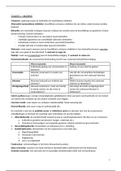
Table of Contents
Blank (2013) – Why the Lean Start-Up Changes Everything ................................................................ 2
Sledzik (2013) – Schumpeter’s View on Innovation and Entrepreneurship ........................................... 4
Kurato (2014) – Why Implementing Corporate Innovation is so difficult.............................................. 6
Wessel (2012) – Surviving Disruption .................................................................................................. 9
Crossan (2010) – A multi-dimensional framework of Organizational Innovation: A Systematic Review
of the Literature ............................................................................................................................... 10
Nylén, D (2015) – Digital Innovation Strategy: Framework for Diagnosing and Improving Digital
Product and Service Innovation ........................................................................................................ 16
Sawney, M (2006) – The 12 Different Ways for Companies to Innovate ............................................ 19
Yoo, Y (2012) – Organizig for Innovation in the Digitized World ........................................................ 21
Sarasvathy, S (2001) – Causation and Effectation: Toward a Theoretical Shift From Economic
Inevitability to Entrepreneurial Contingency ..................................................................................... 28
Brettel, M. (2012) – Corporate effectuation: Entrepreneurial Action and its impact on R&D Project
Performance .................................................................................................................................... 31
Tushman (2010) – Organizational designs and innovation streams................................................... 37
Cooper (2013) – Your NPD portfolio may be harmful to your business’s health ................................. 39
Prahalad (2002) – Serving the World’s Poor, Profitability.................................................................. 44
Mair (2006) – Social Entrepreneurship research: A source of explanation, prediction, and delight..... 45
Felicio (2013) – Social Value And Organizational Performance in non-profit social organizations ...... 46
Weiblen, T (2015) – Engaging with Startups to Enhance Corporate Innovation ................................. 51
Appleyard (2017) – The Dynamics of Open Strategy: From Adoption to Reversion ............................ 55
Ferriani (2009) – The Relational antecedents of project-entrepreneurship: Network centrality, team
composition and project performance .............................................................................................. 60
Lavie (2012) – Organizational differences, Relational Mechanisms, and Alliance performance.......... 61
Amabile (2016) – The Dynamic componential model of creativity and innovation in organizations:
Making progress, making meaning .................................................................................................. 66
Hansen (2004) – How to Build Collaborative Advantage ................................................................... 69
Shane (2002) – Network Ties, Reputation, and the Financing of New Ventures ................................. 74
Kirsch (2009) – Form or substance: The role of business plans in venture capital decision making ..... 76
Klepper, 2001 – Employee Startups in High-Tech industries (Framework paper)................................ 79
Burgelman (1983) – A process Model of Internal Corporate Venturing in the Diversified Major Firm . 81
Kacperzyk (2012) – Opportunity Structures in Established Firms: Entrepreneurship Versus
Intrapreneurship in Mutual Funds .................................................................................................... 84
Mollick (2014) – The Dynamics of Crowdfunding: An exploratory study ............................................ 88
Soubliere (2020) – The Legitimacy Treshold Revisited: How Prior Successes and Failures Spill over To
Other Endeavors on Kickstarter ........................................................................................................ 89
, Session 1: The Entrepreneurial Process
Blank (2013) – Why the Lean Start-Up Changes Everything
The Lean Start-up is a methodology that can make the process of starting a business less risky
and reduces the failure rate of new ventures à Searching for business models instead of
executing against that model (business plan). Principle is failing fast and continually learning.
Instead of executing business plans and releasing fully functional prototypes, lean start-ups
are testing hypotheses (experimentation), gathering early and frequent customer feedback
and showing ‘minimum viable products’ (MVP) to prospects (iterative design). MVP à a
product developed enough to be suitable to get customer feedback on the product (often a
prototype).
The wrong idea of the “perfect business plan” à Static document that describes the problem,
opportunity and the solution (the new venture) in a five-year forecast (profit, income and
cashflow). Before the company is even launched, tested to customers and adapted to failures
and problems it gets money from investors. After many man-hours and costs in order to
execute the idea, entrepreneurs learn that customers do not need/want most of the product’s
features. Conclusion:
1. Business plans almost never survive first contact with customers.
2. Five-years plans are waste of time as future is complete unknown.
3. Start-ups are not smaller versions of larger companies.
Lean startups are temporary organizations searching for repeatable and scalable business
models instead of executing a business plan (like existing companies do). They are going from
failure to failure, constantly adapting and improving ideas as they continually learn from
customers. Only when after quick rounds of experimentation and feedback a model works,
then founders focus on execution. Thus: The start-up produces a ‘minimum viable product’
containing only critical features, gathers feedback from customers, and then starts over with
a revised minimum viable product (short, repeated cycles).
Three key principles:
1. Business model canvas: Summarizing untested hypotheses on how a company creates
value for itself and its customers (table 1) instead of writing a business plan.
2. Customer development: Searching for a business model that works by listening to
customers. Test hypotheses (asking potential users, buyers, partners for feedback
about all elements in de BMC like features, pricing, distribution etc.), improve
(redesign or making adjustments) and repeat this until a model is proven. Only then
the start-up starts executing, building a formal organization.
3. Agile development: Eliminates wasted time and resources by developing the product
iteratively (herhalend) and incrementally (stapsgewijs).
2
, Stealth mode’s (sluipmodus) declining popularity:
While start-ups used to keep secret their market opportunity to avoid potential competitors
and only exposed prototypes during phase B, in most industries the lean start-up method
customer feedback matters more than secrecy and constant feedback generates better results
than at certain unveilings.
In the past, start-ups had 5 constraints which the lean approach reduces:
1. High cost of getting the first customer – Lean start-ups launch products that customers
actually want more quickly and cheaply than traditional methods.
2. Long technology development cycles – Lean start-ups launch products that customers
actually want more quickly and cheaply than traditional methods.
3. Risk inherent in founding or working at a start-up – Lean start-ups are less risky.
4. Need to get big investments from firms – Today early-stage investments don’t need to
come from million-dollar companies but crowdsourcing sites finance start-ups.
5. Lack of expertise in how to build start-ups – Today the only challenge is to sort out the
overwhelming amount of information / advice on the internet.
Differences Lean Traditional
Strategy Business Model Business Plan
Hypothesis driven Implementation-driven
(experimentation) (elaborated plan)
New-product Process Customer Development Product Management
(customer feedback) (intuition)
Test hypotheses in the field Step-by-Step Plan
Engineering Agile Development Waterfall Development
(iterative product (linear product
development) and short, development)
repeated cycles
Organization Customer development Departments by function
teams (hire for learning, (hire by experience and
speed and lenigheid) ability to execute)
Financial Reporting Customer acquisition cost, Accounting, income
lifetime customer value, statement, balance sheet,
viralness cash flow statement
Failure Expected, fix this by Exception, fix by firing
iterating and pivoting ones executives
that don’t work
Speed Rapid, operating on good- Measured, operating on
enough data complete data
Strategy for the 21st-century corporation:
Simply focusing on improving existing business models is not sufficient anymore. Companies
must also deal with increasing external threats by continuously innovating (inventing new
business models) to ensure survival and growth. This requires new organizational structures
and skills. Even big companies use lean method for product extensions.
The 21st century is known of its rapid change, lean start-up approach helps to innovate quickly.
3
Blank (2013) – Why the Lean Start-Up Changes Everything ................................................................ 2
Sledzik (2013) – Schumpeter’s View on Innovation and Entrepreneurship ........................................... 4
Kurato (2014) – Why Implementing Corporate Innovation is so difficult.............................................. 6
Wessel (2012) – Surviving Disruption .................................................................................................. 9
Crossan (2010) – A multi-dimensional framework of Organizational Innovation: A Systematic Review
of the Literature ............................................................................................................................... 10
Nylén, D (2015) – Digital Innovation Strategy: Framework for Diagnosing and Improving Digital
Product and Service Innovation ........................................................................................................ 16
Sawney, M (2006) – The 12 Different Ways for Companies to Innovate ............................................ 19
Yoo, Y (2012) – Organizig for Innovation in the Digitized World ........................................................ 21
Sarasvathy, S (2001) – Causation and Effectation: Toward a Theoretical Shift From Economic
Inevitability to Entrepreneurial Contingency ..................................................................................... 28
Brettel, M. (2012) – Corporate effectuation: Entrepreneurial Action and its impact on R&D Project
Performance .................................................................................................................................... 31
Tushman (2010) – Organizational designs and innovation streams................................................... 37
Cooper (2013) – Your NPD portfolio may be harmful to your business’s health ................................. 39
Prahalad (2002) – Serving the World’s Poor, Profitability.................................................................. 44
Mair (2006) – Social Entrepreneurship research: A source of explanation, prediction, and delight..... 45
Felicio (2013) – Social Value And Organizational Performance in non-profit social organizations ...... 46
Weiblen, T (2015) – Engaging with Startups to Enhance Corporate Innovation ................................. 51
Appleyard (2017) – The Dynamics of Open Strategy: From Adoption to Reversion ............................ 55
Ferriani (2009) – The Relational antecedents of project-entrepreneurship: Network centrality, team
composition and project performance .............................................................................................. 60
Lavie (2012) – Organizational differences, Relational Mechanisms, and Alliance performance.......... 61
Amabile (2016) – The Dynamic componential model of creativity and innovation in organizations:
Making progress, making meaning .................................................................................................. 66
Hansen (2004) – How to Build Collaborative Advantage ................................................................... 69
Shane (2002) – Network Ties, Reputation, and the Financing of New Ventures ................................. 74
Kirsch (2009) – Form or substance: The role of business plans in venture capital decision making ..... 76
Klepper, 2001 – Employee Startups in High-Tech industries (Framework paper)................................ 79
Burgelman (1983) – A process Model of Internal Corporate Venturing in the Diversified Major Firm . 81
Kacperzyk (2012) – Opportunity Structures in Established Firms: Entrepreneurship Versus
Intrapreneurship in Mutual Funds .................................................................................................... 84
Mollick (2014) – The Dynamics of Crowdfunding: An exploratory study ............................................ 88
Soubliere (2020) – The Legitimacy Treshold Revisited: How Prior Successes and Failures Spill over To
Other Endeavors on Kickstarter ........................................................................................................ 89
, Session 1: The Entrepreneurial Process
Blank (2013) – Why the Lean Start-Up Changes Everything
The Lean Start-up is a methodology that can make the process of starting a business less risky
and reduces the failure rate of new ventures à Searching for business models instead of
executing against that model (business plan). Principle is failing fast and continually learning.
Instead of executing business plans and releasing fully functional prototypes, lean start-ups
are testing hypotheses (experimentation), gathering early and frequent customer feedback
and showing ‘minimum viable products’ (MVP) to prospects (iterative design). MVP à a
product developed enough to be suitable to get customer feedback on the product (often a
prototype).
The wrong idea of the “perfect business plan” à Static document that describes the problem,
opportunity and the solution (the new venture) in a five-year forecast (profit, income and
cashflow). Before the company is even launched, tested to customers and adapted to failures
and problems it gets money from investors. After many man-hours and costs in order to
execute the idea, entrepreneurs learn that customers do not need/want most of the product’s
features. Conclusion:
1. Business plans almost never survive first contact with customers.
2. Five-years plans are waste of time as future is complete unknown.
3. Start-ups are not smaller versions of larger companies.
Lean startups are temporary organizations searching for repeatable and scalable business
models instead of executing a business plan (like existing companies do). They are going from
failure to failure, constantly adapting and improving ideas as they continually learn from
customers. Only when after quick rounds of experimentation and feedback a model works,
then founders focus on execution. Thus: The start-up produces a ‘minimum viable product’
containing only critical features, gathers feedback from customers, and then starts over with
a revised minimum viable product (short, repeated cycles).
Three key principles:
1. Business model canvas: Summarizing untested hypotheses on how a company creates
value for itself and its customers (table 1) instead of writing a business plan.
2. Customer development: Searching for a business model that works by listening to
customers. Test hypotheses (asking potential users, buyers, partners for feedback
about all elements in de BMC like features, pricing, distribution etc.), improve
(redesign or making adjustments) and repeat this until a model is proven. Only then
the start-up starts executing, building a formal organization.
3. Agile development: Eliminates wasted time and resources by developing the product
iteratively (herhalend) and incrementally (stapsgewijs).
2
, Stealth mode’s (sluipmodus) declining popularity:
While start-ups used to keep secret their market opportunity to avoid potential competitors
and only exposed prototypes during phase B, in most industries the lean start-up method
customer feedback matters more than secrecy and constant feedback generates better results
than at certain unveilings.
In the past, start-ups had 5 constraints which the lean approach reduces:
1. High cost of getting the first customer – Lean start-ups launch products that customers
actually want more quickly and cheaply than traditional methods.
2. Long technology development cycles – Lean start-ups launch products that customers
actually want more quickly and cheaply than traditional methods.
3. Risk inherent in founding or working at a start-up – Lean start-ups are less risky.
4. Need to get big investments from firms – Today early-stage investments don’t need to
come from million-dollar companies but crowdsourcing sites finance start-ups.
5. Lack of expertise in how to build start-ups – Today the only challenge is to sort out the
overwhelming amount of information / advice on the internet.
Differences Lean Traditional
Strategy Business Model Business Plan
Hypothesis driven Implementation-driven
(experimentation) (elaborated plan)
New-product Process Customer Development Product Management
(customer feedback) (intuition)
Test hypotheses in the field Step-by-Step Plan
Engineering Agile Development Waterfall Development
(iterative product (linear product
development) and short, development)
repeated cycles
Organization Customer development Departments by function
teams (hire for learning, (hire by experience and
speed and lenigheid) ability to execute)
Financial Reporting Customer acquisition cost, Accounting, income
lifetime customer value, statement, balance sheet,
viralness cash flow statement
Failure Expected, fix this by Exception, fix by firing
iterating and pivoting ones executives
that don’t work
Speed Rapid, operating on good- Measured, operating on
enough data complete data
Strategy for the 21st-century corporation:
Simply focusing on improving existing business models is not sufficient anymore. Companies
must also deal with increasing external threats by continuously innovating (inventing new
business models) to ensure survival and growth. This requires new organizational structures
and skills. Even big companies use lean method for product extensions.
The 21st century is known of its rapid change, lean start-up approach helps to innovate quickly.
3