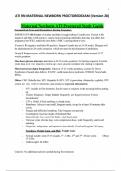
ATI RN MATERNAL NEWBORN PROCTORED EXAM (Version 28)
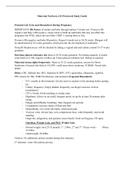
Maternal Newborn ATI Proctored Study Guide Prenatal Lab Tests and Discomforts During Pregnancy IMPORTANT: Rh Factor of mother and baby through indirect Coombs test. If mom is Rh negative and baby is Rh positive, causes mom to build up antibodies that may not affect this pregnancy but WILL attack the next baby’s RBC’s causing them to lyse. If mom is Rh negative and baby Rh positive: Repeat Coombs test at 24-28 weeks. Rhogam will be administered at 28 weeks gestation, which prevents the development of antibodies. Group B Streptococcus: will be checked by taking a vaginal and anal culture around 35-37 weeks gestation. One-hour glucose tolerance test done at 24-28 weeks gestation. No fasting required, if results come back over 140, requires a follow-up 3-hour glucose tolerance test: fasting is required. Maternal serum alpha-fetoprotein: Taken at 15-22 weeks gestation, screens for Down Syndrome of neural tube defects. If LOW: could mean down syndrome. If HIGH: Neural tube defect. Other: CBC, Rubella titer, HIV, Hepatitis B, HPV, STI’s (gonorrhea, chlamydia, syphilis), PPV (check for TB), TORCH infections, and urinalysis Expected Discomforts: - N/V: usually in first trimester. Eat dry toast or crackers in the morning before getting up - Urinary frequency: Empty bladder frequently, use Kegel exercises if stress incontinence’ - UTI’s: Notify if foul smelling or cloudy urine - Heartburn: Advice to eat small, frequent meals, sit up for at least 30 minutes after eating - Fatigue and difficulty breathing: Take frequent rest periods - Constipation: Increase intake of fluid and fiber - Hemorrhoids: Use warm Sitz baths, witch hazel pads - Varicose veins: elevate legs, were compression hose, walk frequently, and avoid standing - Gingivitis, indigestion, and epistaxis (nose bleed): Good oral hygiene, NS spray Nutrition, Weight Gain, and PKU Weight Gain: - Normal weight: total 25-35 pounds. 1st: 2-4lbs. 2nd and 3rd: 1lb per week - Obese: 15-25lbs. - Underweight: 28-40lbs. Calories: No additional calories needed during first trimester. 2 2nd trimester: extra 340 calories per day 3rd trimester: extra 460 calories per day Breastfeeding: extra 450-500 calories per day Nutrition: FOLIC ACID (IMPORTANT): Prevents neural tube defects. Recommended: 600mcg per day. Increase protein intake, possibly iron supplements (vitamin C increases absorption), calcium 1000mg per day (bone and teeth formation, vitamin D increases absorption). Fluid intake (2-3L per day). Caffeine reduced (200mg per day). NO alcohol. Phenylketonuria (PKU): A genetic disease that causes amino acid Phenylalanine to build up in body which can cause a risk for birth defects in the fetus. IMPORTANT teaching: Adhere to PKU diet 3 months prior to pregnancy and throughout pregnancy. Needs frequent blood Phenylalanine drawn. PKU diet: Very low in protein. Avoid: No meat, fish, poultry, nuts, eggs, or dairy. Ultrasound, BPP, NST, and CST Ultrasound: Noninvasive: Confirm pregnancy, site of implantation, assess baby growth and development and movement. Teaching: Have mom drink a full quart of water prior to procedure to better reflect sound waves. Biophysical Profile: Uses real time ultrasound technology to assess for fetal well-being. Score of 0-10. 8-10 = normal; less than 8 = fetal asphyxia due to insufficient oxygen. FIVE areas: reactive fetal heart rate, fetal breathing movements, gross body movements, fetal tone, and amniotic fluid volume. Non-Stress Test: Non-invasive test that measures fetal HR response to fetal movement. Done in 3rd trimester, acoustic vibration device may help awaken fetus or orange juice. Mom pushes button when she feels movement, provider assesses HR during movement to see if increasing when moving. Preformed when mom reports decreased fetal movement, diabetes, gestational HTN, or post-maturity. Results (IMPORTANT): Reactive: normal finding (HR normal rate, moderate variability, and accelerates at least 2 times in a 20-minute time period). Non-reactive: Abnormal finding, fetal HR does not accelerate sufficiently with fetal movement further assessment is needed Contraction Stress Test: Done after Non-stress test is abnormal or high risk pregnancy. More invasive, help measures fetal HR in response to contractions. Done through nipple stimulation or oxytocin to induce contractions. 3 Results (IMPORTANT): Negative result: Normal finding, no late decelerations with 3 contractions within a 10-minute period. Positive result: Abnormal finding, late decelerations are present for 50% or more of contractions. Can indicate uteroplacental insufficiency. Complications: per-term labor Amniocentesis, CVS, Abortion/Miscarriage, and Ectopic Pregnancy Amniocentesis: Invasive test to test for chromosomal abnormalities and fetal lung maturity. Amniotic fluid is aspirated under ultrasound guidance, performed after 14 weeks gestation. Results: Looking for levels of alpha-fetoprotein, LS ratio (2:1 = fetal lung maturity) Care: Empty bladder prior to procedure, after: administer Rhogam to Rh negative moms, encourage lots of fluid and rest for next 24 hours. Complications: Amniotic fluid emboli, hemorrhaging, infection, leakage of amniotic fluid, premature rupture of membranes, miscarriage. Chorionic Villus Sampling: Portion of placenta is aspirated through a catheter to assess for chromosomal abnormalities. Done between 10-13 weeks gestation. It can be done early! Complications: chorioamnionitis (infection of amniotic fluid and membrane), premature rupture of membranes, miscarriage. Spontaneous abortion: before 20 weeks gestation - Threatened: spotting, no tissue passed, cervix is closed. Fetus can survive this - Inevitable: mild to severe bleeding, no tissue is passed, cervix is dilated and tissue bulging. Abortion will occur. - Incomplete: Severe bleeding, partial fetal tissue past, cervix is dilated - Complete: minimal bleeding, complete fetal tissue passed, cervix is closed Inevitable and incomplete require surgery to clear out contents. DNC procedure, prostaglandins and oxytocin can help remove Ectopic Pregnancy: fertilized ovum is implanted in fallopian tube instead of uterus. Very dangerous for tube rupture and fatal hemorrhaging. S/S (IMPORTANT): Unilateral stabbing pain in LLQ or RLQ, vaginal spotting and bleeding, referred shoulder pain (when ruptured), hemorrhaging (low BP, tachycardia, and pallor) Procedures: Salpingectomy (removal of fallopian tube) or give methotrexate to help dissolve pregnancy and preserve fallopian tube. Trophoblastic Disease, Placenta Previa, and Abruptio Placenta Gestational Trophoblastic Disease: (Molar pregnancy). Abnormal growth of trophoblastic villi in the placenta. Look like grape-like clusters. Prevent embryo from developing and can lead to choriocarcinoma which is a type of cancer. 4 S/S (IMPORTAMT): Dark brown bleeding, N/V. abnormally high hcg levels Diagnose: ultrasound Treatment: evacuation of the mole via cartage or chemo therapy. Placenta Previa: Placenta implants on or near the cervical os vs attaching to fundus at the top. This results in BRIGHT red bleeding during the 3rd trimester. Types: - Complete: covers entirely - Incomplete: covers part of it - Marginal or low-lying: Attaches to lower uterus but does not cover at all S/S: Painless, bright red bleeding in 2nd or 3rd trimester, decreased hematocrit (37-48) and hemoglobin (12-15.5) levels Nursing care (IMPORTANT): Do not perform vaginal examinations or insert anything vaginally, administer IV and blood products as prescribed, educate on bed rest, and if delivery anticipated: give corticosteroids to promote fetal lung growth. Abruptio Placenta: Premature separation of the placenta from the uterus usually in 3rd trimester. High risk form mom and baby morbidity and mortality. Risk factors: HTN, trauma, cocaine use, smoking S/S: intense uterine pain with dark red bleeding, decreased hematocrit (37-48) and hemoglobin (12-15.5) levels, signs of hypovolemic shock (hypotension, tachycardia, pallor), fetal distress Nursing care: Administer IV fluids and blood products, oxygen, corticosteroids.
Geschreven voor
- Instelling
-
Illinois State University
- Vak
-
NUR 316
Documentinformatie
- Geüpload op
- 1 juli 2025
- Aantal pagina's
- 14
- Geschreven in
- 2024/2025
- Type
- Tentamen (uitwerkingen)
- Bevat
- Vragen en antwoorden
Onderwerpen
- maternal newborn
- maternal newborn ati
- ati rn
- ati rn maternal newborn
-
maternal newborn ati proctored study guide
-
ati rn maternal newborn proctored exam
-
prenatal lab tests and discomfort during pregnanc

Ook beschikbaar in voordeelbundel