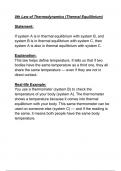
0th Law of Thermodynamics (Thermal Equilibrium)
Statement:
If system A is in thermal equilibrium with system B, and
system B is in thermal equilibrium with system C, then
system A is also in thermal equilibrium with system C.
Explanation:
This law helps define temperature. It tells us that if two
bodies have the same temperature as a third one, they all
share the same temperature — even if they are not in
direct contact.
Real-life Example:
You use a thermometer (system B) to check the
temperature of your body (system A). The thermometer
shows a temperature because it comes into thermal
equilibrium with your body. This same thermometer can be
used on someone else (system C) — and if the reading is
the same, it means both people have the same body
temperature.
, 1st Law of Thermodynamics (Conservation of Energy)
Statement:
Energy cannot be created or destroyed in an isolated
system. It can only change from one form to another.
Formula:
∆U=Q-W
Where.
● ∆U= change in internal energy of the system
● Q= heat added to the system
● W= work done by the system
Explanation:
If you add heat to a system, some of that energy goes into
increasing internal energy, and the rest does work. No
energy is lost — it's just converted.
Real-life Example:
In a car engine, fuel (chemical energy) burns and
produces heat (thermal energy). This heat increases the
pressure in the cylinders and pushes the piston
(mechanical work). The energy wasn't destroyed — it was
converted from chemical to thermal to mechanical.
Statement:
If system A is in thermal equilibrium with system B, and
system B is in thermal equilibrium with system C, then
system A is also in thermal equilibrium with system C.
Explanation:
This law helps define temperature. It tells us that if two
bodies have the same temperature as a third one, they all
share the same temperature — even if they are not in
direct contact.
Real-life Example:
You use a thermometer (system B) to check the
temperature of your body (system A). The thermometer
shows a temperature because it comes into thermal
equilibrium with your body. This same thermometer can be
used on someone else (system C) — and if the reading is
the same, it means both people have the same body
temperature.
, 1st Law of Thermodynamics (Conservation of Energy)
Statement:
Energy cannot be created or destroyed in an isolated
system. It can only change from one form to another.
Formula:
∆U=Q-W
Where.
● ∆U= change in internal energy of the system
● Q= heat added to the system
● W= work done by the system
Explanation:
If you add heat to a system, some of that energy goes into
increasing internal energy, and the rest does work. No
energy is lost — it's just converted.
Real-life Example:
In a car engine, fuel (chemical energy) burns and
produces heat (thermal energy). This heat increases the
pressure in the cylinders and pushes the piston
(mechanical work). The energy wasn't destroyed — it was
converted from chemical to thermal to mechanical.