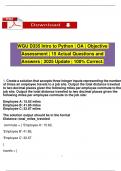
WGU D335 Intro to Python | OA | Objective
Assessment | 15 Actual Questions and
Answers | 2025 Update | 100% Correct.
1. Create a solution that accepts three integer inputs representing the number
of times an employee travels to a job site. Output the total distance traveled
to two decimal places given the following miles per employee commute to the
job site. Output the total distance traveled to two decimal places given the
following miles per employee commute to the job site:
Employee A: 15.62 miles
Employee B: 41.85 miles
Employee C: 32.67 miles
The solution output should be in the format
Distance: total_miles_traveled
commute = { 'Employee A': 15.62,
'Employee B': 41.85,
'Employee C': 32.67
}
travels = {
, 'Employee A': int(input()),
'Employee B': int(input()),
'Employee C': int(input())
}
t_d_t = sum(commute[employee]*travels[employee] for employee in travels)
print(f'Distance: {t_d_t:.2f} miles')
2. Create a Python solution to the following task. Ensure that the solution
produces output in exactly the same format shown in the sample(s) below,
including capitalization and whitespace.
Task:
Create a solution that accepts an integer input representing any number of
ounces. Output the converted total number of tons, pounds, and remaining
ounces based on the input ounces value. There are 16 ounces in a pound and
2,000 pounds in a ton.
The solution output should be in the format
Tons: value_1 Pounds: value_2 Ounces: value_3
opp = 16 top = 2000
ounces = int(input())
tons = ounces // (opp * top)
ro = ounces % (opp * top)
pounds = ro // opp
ro %= opp
Assessment | 15 Actual Questions and
Answers | 2025 Update | 100% Correct.
1. Create a solution that accepts three integer inputs representing the number
of times an employee travels to a job site. Output the total distance traveled
to two decimal places given the following miles per employee commute to the
job site. Output the total distance traveled to two decimal places given the
following miles per employee commute to the job site:
Employee A: 15.62 miles
Employee B: 41.85 miles
Employee C: 32.67 miles
The solution output should be in the format
Distance: total_miles_traveled
commute = { 'Employee A': 15.62,
'Employee B': 41.85,
'Employee C': 32.67
}
travels = {
, 'Employee A': int(input()),
'Employee B': int(input()),
'Employee C': int(input())
}
t_d_t = sum(commute[employee]*travels[employee] for employee in travels)
print(f'Distance: {t_d_t:.2f} miles')
2. Create a Python solution to the following task. Ensure that the solution
produces output in exactly the same format shown in the sample(s) below,
including capitalization and whitespace.
Task:
Create a solution that accepts an integer input representing any number of
ounces. Output the converted total number of tons, pounds, and remaining
ounces based on the input ounces value. There are 16 ounces in a pound and
2,000 pounds in a ton.
The solution output should be in the format
Tons: value_1 Pounds: value_2 Ounces: value_3
opp = 16 top = 2000
ounces = int(input())
tons = ounces // (opp * top)
ro = ounces % (opp * top)
pounds = ro // opp
ro %= opp