Notes prepared by: N Ngabaza
PROTEIN SYNTHESIS PROCESS Life sciences tutor: 068 341 2728
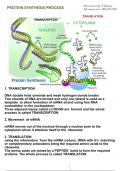
TRANSLATION
TRANSCRIPTION
TRANSCRIPTION
1. TRANSCRIPTION
DNA double helix unwinds and weak hydrogen bonds breaks
Two strands of DNA are formed and only one strand is used as a
template to allow formation of mRNA strand using free RNA
nucleotides in the nucleoplasm.
Three adjacent bases called a CODON are formed and the whole
process is called TRANSCRIPTION
2. Movement of mRNA
mRNA moves out of the nucleus through a nuclear pore to the
cytoplasm where it attaches itself to the ribosome
3. TRANSLATION
using the information from the mRNA codons, tRNA with it's matching
or complimentary anticodons bring the required amino acids to the
ribosome.
The amino acids are joined by a PEPTIDE bond to form the required
proteins. The whole process is called TRANSLATION
, Notes prepared by: N Ngabaza
Life sciences tutor: 068 341 2728
NB: DNA forms a strand of mRNA, &mRNA forms tRNA strand
DNA ATG A CAC
mRNA B AUC E GUG
tRNA C D AAG G
DNA has four nitrogenous bases that pair up as follows:
A=T
G=C
OR
C=G
T=A...
RNA has four nitrogenous bases and they pair up as follows:
A=U
G=C
OR
C=G
U=A
PROTEIN SYNTHESIS PROCESS Life sciences tutor: 068 341 2728
TRANSLATION
TRANSCRIPTION
TRANSCRIPTION
1. TRANSCRIPTION
DNA double helix unwinds and weak hydrogen bonds breaks
Two strands of DNA are formed and only one strand is used as a
template to allow formation of mRNA strand using free RNA
nucleotides in the nucleoplasm.
Three adjacent bases called a CODON are formed and the whole
process is called TRANSCRIPTION
2. Movement of mRNA
mRNA moves out of the nucleus through a nuclear pore to the
cytoplasm where it attaches itself to the ribosome
3. TRANSLATION
using the information from the mRNA codons, tRNA with it's matching
or complimentary anticodons bring the required amino acids to the
ribosome.
The amino acids are joined by a PEPTIDE bond to form the required
proteins. The whole process is called TRANSLATION
, Notes prepared by: N Ngabaza
Life sciences tutor: 068 341 2728
NB: DNA forms a strand of mRNA, &mRNA forms tRNA strand
DNA ATG A CAC
mRNA B AUC E GUG
tRNA C D AAG G
DNA has four nitrogenous bases that pair up as follows:
A=T
G=C
OR
C=G
T=A...
RNA has four nitrogenous bases and they pair up as follows:
A=U
G=C
OR
C=G
U=A