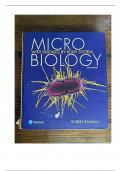
,High-Yield Microbiology Test Bank 2025:
NCLEX & Course Success with Bauman’s
Approach
Complete review of microbial structure, immunity, infection, and body
system diseases—ideal for nursing, pre-med, and health science students
Table of Contents for Chapters 1–26, showing each chapter’s main topic and its primary sub-topics:
Chapter Title Primary Sub-topics
The Early Years of Microbiology; The Golden Age of Microbiology;
A Brief History of
1 What Causes Fermentation?; What Causes Disease?; How Can We
Microbiology
Prevent Infection and Disease?; The Modern Age of Microbiology
The Chemistry of Atoms & Atomic Structure; Chemical Bonds; Chemical Reactions;
2
Microbiology Water, Acids, Bases & Salts; Organic Macromolecules
Prokaryotic vs. Eukaryotic Cells; External Structures of Bacteria &
Cell Structure and
3 Archaea; Cell Walls & Membranes; Transport Processes; Cytoplasm
Function
& Organelles
Units of Measurement; Light, Electron & Probe Microscopy;
Microscopy, Staining, and
4 Staining Techniques; Classification & Identification of
Classification
Microorganisms
Catabolism & Anabolism; Enzyme Structure & Regulation;
5 Microbial Metabolism Carbohydrate Catabolism; Fermentation & Other Pathways;
Photosynthesis; Anabolic Pathways; Metabolic Integration
Microbial Nutrition and Nutrient & Physical Requirements; Culturing Techniques & Media;
6
Growth Population Growth & Phases; Measurement of Growth
Genome Structure & Replication; Transcription & Translation;
7 Microbial Genetics Operon Regulation; Mutations & DNA Repair; Horizontal Gene
Transfer
Tools of rDNA (PCR, Restriction Enzymes, Vectors, CRISPR); Cloning
Recombinant DNA
8 & Gel/Electrophoresis; Applications (Therapeutics, Agriculture,
Technology
Genomics); Ethics & Safety
,Chapter Title Primary Sub-topics
Controlling Microbial Principles & Death Rates; Physical Methods (Heat, Filtration,
9
Growth (Environment) Radiation); Chemical Methods; Evaluating Disinfectants; Resistance
History & Mechanisms of Action; Clinical Considerations (Spectrum,
10 Antimicrobial Drugs MIC/MBC, Safety); Routes of Administration; Resistance &
Prevention
Prokaryotic Morphology & Reproduction; Archaea (Extremophiles);
Characterizing &
11 Survey of Bacterial Groups (Gram-positive & Proteobacteria;
Classifying Prokaryotes
Others)
Characterizing & Protozoa; Fungi; Algae; Parasitic Helminths & Vectors;
12
Classifying Eukaryotes Reproductive & Nuclear Division
Characterizing &
Virus Structure & Classification; Bacteriophage & Animal Virus
13 Classifying Viruses,
Cycles; Culture Methods; Viroids & Prions
Viroids & Prions
Symbiosis & Microbiome; Portals of Entry/Exit; Virulence Factors;
Infection, Infectious
14 Disease Stages; Transmission; Epidemiological Methods;
Diseases & Epidemiology
Nosocomial Infections
First-Line Defenses (Skin, Mucosa, Peptides); Second-Line Defenses
15 Innate Immunity
(Phagocytosis, NK Cells, Complement, Inflammation, Fever)
Lymphatic System & Antigens; T-Cell & B-Cell Development;
16 Adaptive Immunity Antibody Structure & Function; Cell-Mediated vs. Humoral
Responses; Immunological Memory
Immunization & Vaccine Types & Manufacture; Passive Immunotherapy; Serological
17
Diagnostic Immunoassays Tests (Precipitation, Agglutination, Neutralization, ELISA, Blots)
Hypersensitivity Types I–IV; Autoimmune Diseases; Primary &
18 Immune Disorders
Acquired Immunodeficiencies (including HIV/AIDS)
Skin Structure & Microbiome; Bacterial (Staph, Strep,
Microbial Diseases of the
19 Pseudomonas, Anthrax, etc.); Viral (Pox, Herpes, Measles, etc.);
Skin & Wounds
Mycoses & Parasitic Infestations
Nervous System Anatomy; Bacterial (Meningitis, Botulism, Tetanus,
Microbial Diseases of the
20 Leprosy); Viral (Rabies, Poliomyelitis, Arboviruses, Zika); Fungal,
Nervous System & Eyes
Protozoan & Prion Diseases; Ocular Infections
,Chapter Title Primary Sub-topics
Cardio-Lymphatic Anatomy; Bacterial (Septicemia, Endocarditis,
Microbial Cardiovascular
21 Plague, Lyme); Viral (Yellow Fever, Dengue, Mononucleosis);
& Systemic Diseases
Protozoan/Helminthic (Malaria, Chagas, Schistosomiasis)
Microbial Diseases of the Respiratory Anatomy & Microbiome; Bacterial URT & LRT Diseases;
22
Respiratory System Viral URT & LRT Diseases; Lower Respiratory Mycoses
Digestive Anatomy & Microbiome; Bacterial (Gastroenteritis, Ulcer
Microbial Diseases of the
23 Disease, Food Poisoning); Viral (Hepatitis, Gastroenteritis);
Digestive System
Protozoan & Helminthic Intestinal Diseases
Microbial Diseases of the Urinary & Reproductive Anatomy & Microbiome; UTIs &
24 Urinary & Reproductive Leptospirosis; STIs (Bacterial, Viral, Protozoan); Non-venereal
Systems Reproductive Infections
Applied & Industrial Food Fermentation & Spoilage; Industrial Fermentations &
25
Microbiology Products; Biosensors; Water Treatment & Pollution Control
Environmental Associations & Biogeochemical Cycles; Soil &
Microbial Ecology &
26 Aquatic Microbiology; Bioremediation; Biological Warfare &
Microbiomes
Bioterrorism
.
,Chapter 1: A Brief History of Microbiology (5th Ed., Bauman).
1. The Early Years of Microbiology (Questions 1–4)
1. Which scientist is credited with first observing
microorganisms using a primitive microscope?
A. Louis Pasteur
B. Robert Koch
C. Antonie van Leeuwenhoek
D. Ignaz Semmelweis
Rationale: Leeuwenhoek made the first detailed observations
of bacteria and protozoa using handcrafted lenses. Pasteur and
Koch came later; Semmelweis worked on hand hygiene.
2. The concept of spontaneous generation was widely accepted
until experiments by:
A. Robert Hooke
B. Edward Jenner
C. Francesco Redi
D. Ferdinand Cohn
Rationale: Redi’s meat-and-maggot experiments challenged
spontaneous generation. Hooke described cells; Jenner
developed vaccination; Cohn classified bacteria.
3. Early contributions to microbiology by Robert Hooke
included:
,A. Describing the cell as the fundamental unit of life
B. Observing mold structures in a cork slice
C. Establishing pasteurization
D. Defining bacterial taxonomy
Rationale: Hooke coined “cell” after viewing cork.
Pasteurization was Pasteur’s work; bacterial taxonomy
developed later.
4. Which statement best reflects the nursing importance of
early microscopy?
A. It led to immediate antibiotic therapy.
B. It allowed visualization of pathogens, reinforcing infection
control.
C. It prevented all hospital-acquired infections.
D. It made vaccines obsolete.
Rationale: Microscopy enabled nurses to appreciate unseen
pathogens and practice hand hygiene and disinfection.
Antibiotics and vaccines came later; infections remained a risk.
2. Microbial Classification: Bacteria, Archaea, Fungi, Protozoa,
Algae (Questions 5–8)
5. Which group of organisms lacks a nucleus and has
peptidoglycan in its cell wall?
A. Bacteria
B. Archaea
,C. Fungi
D. Protozoa
Rationale: Bacteria are prokaryotes with peptidoglycan.
Archaea lack peptidoglycan. Fungi and protozoa are eukaryotic.
6. Methanogens belong to which domain?
A. Bacteria
B. Archaea
C. Fungi
D. Protozoa
Rationale: Methanogens are archaea that produce methane
under anaerobic conditions. Bacteria do not produce methane.
7. Yeasts and molds are classified as:
A. Algae
B. Protozoa
C. Fungi
D. Bacteria
Rationale: Yeasts and molds are fungal organisms; algae
perform photosynthesis; protozoa are motile eukaryotes.
8. Which microbial group is most likely to perform
photosynthesis in aquatic nursing facility water sources?
A. Protozoa
B. Algae
C. Archaea
D. Fungi
,Rationale: Algae are eukaryotic photosynthesizers. Protozoa
are heterotrophic; archaea and fungi do not photosynthesize.
3. Spontaneous Generation Experiments: Redi, Needham,
Spallanzani, Pasteur (Questions 9–12)
9. In Needham’s experiment, boiled broth was left open, and
microorganisms appeared because:
A. His boiling destroyed all organisms
B. His boiling time was insufficient to kill spores
C. He sealed the flasks too tightly
D. He used sterile instruments
Rationale: Needham’s short boil left heat-resistant spores,
allowing microbial growth. Spallanzani later improved on
boiling time and sealing.
10. Spallanzani’s experiment improved on Needham’s by:
A. Showing microbes generate spontaneously
B. Using unboiled broth
C. Boiling longer and sealing flasks
D. Observing fermentation
Rationale: Spallanzani boiled longer and sealed flasks to
prevent air entry, stopping microbial growth and challenging
spontaneous generation.
11. Pasteur’s swan-neck flask experiment demonstrated:
,A. Microbes arise only in boiled broth
B. Fermentation produces disease
C. Airborne microbes can be trapped without broth
contamination
D. Broth spoils only in sealed vessels
Rationale: Pasteur showed that microbes from air settle in the
neck bend, not reaching the broth, disproving spontaneous
generation.
12. A nursing implication of Pasteur’s work on airborne
microbes is:
A. All bacteria are airborne
B. Handwashing is unnecessary
C. Sterile gowns prevent epidemics
D. Proper air filtration reduces infection spread
Rationale: Understanding airborne transmission led to using
filters and ventilation to reduce hospital-acquired infections.
Gowns and handwashing address contact transmission.
4. The Scientific Method (Questions 13–15)
13. Which step of the scientific method involves forming a
testable statement?
A. Observation
B. Experimentation
, C. Hypothesis
D. Conclusion
Rationale: A hypothesis is a predictive, testable statement.
Observations lead to hypotheses; experiments test them.
14. A nurse researcher suspects hand sanitizer reduces surgical
site infections. Testing this is an example of:
A. Theory development
B. Hypothesis testing
C. Data collection without hypothesis
D. Publication
Rationale: Testing the effect of hand sanitizer on infection rates
directly tests a hypothesis.
15. If data do not support a hypothesis, the scientific method
dictates you should:
A. Modify or reject the hypothesis
B. Hide the data
C. Declare it a theory
D. Repeat experiments or revise the hypothesis
Rationale: Negative results lead to revision and further testing.
Hiding data violates scientific ethics.
5. Fermentation: Pasteur and Buchner (Questions 16–18)
16. Pasteur showed that fermentation is caused by:
NCLEX & Course Success with Bauman’s
Approach
Complete review of microbial structure, immunity, infection, and body
system diseases—ideal for nursing, pre-med, and health science students
Table of Contents for Chapters 1–26, showing each chapter’s main topic and its primary sub-topics:
Chapter Title Primary Sub-topics
The Early Years of Microbiology; The Golden Age of Microbiology;
A Brief History of
1 What Causes Fermentation?; What Causes Disease?; How Can We
Microbiology
Prevent Infection and Disease?; The Modern Age of Microbiology
The Chemistry of Atoms & Atomic Structure; Chemical Bonds; Chemical Reactions;
2
Microbiology Water, Acids, Bases & Salts; Organic Macromolecules
Prokaryotic vs. Eukaryotic Cells; External Structures of Bacteria &
Cell Structure and
3 Archaea; Cell Walls & Membranes; Transport Processes; Cytoplasm
Function
& Organelles
Units of Measurement; Light, Electron & Probe Microscopy;
Microscopy, Staining, and
4 Staining Techniques; Classification & Identification of
Classification
Microorganisms
Catabolism & Anabolism; Enzyme Structure & Regulation;
5 Microbial Metabolism Carbohydrate Catabolism; Fermentation & Other Pathways;
Photosynthesis; Anabolic Pathways; Metabolic Integration
Microbial Nutrition and Nutrient & Physical Requirements; Culturing Techniques & Media;
6
Growth Population Growth & Phases; Measurement of Growth
Genome Structure & Replication; Transcription & Translation;
7 Microbial Genetics Operon Regulation; Mutations & DNA Repair; Horizontal Gene
Transfer
Tools of rDNA (PCR, Restriction Enzymes, Vectors, CRISPR); Cloning
Recombinant DNA
8 & Gel/Electrophoresis; Applications (Therapeutics, Agriculture,
Technology
Genomics); Ethics & Safety
,Chapter Title Primary Sub-topics
Controlling Microbial Principles & Death Rates; Physical Methods (Heat, Filtration,
9
Growth (Environment) Radiation); Chemical Methods; Evaluating Disinfectants; Resistance
History & Mechanisms of Action; Clinical Considerations (Spectrum,
10 Antimicrobial Drugs MIC/MBC, Safety); Routes of Administration; Resistance &
Prevention
Prokaryotic Morphology & Reproduction; Archaea (Extremophiles);
Characterizing &
11 Survey of Bacterial Groups (Gram-positive & Proteobacteria;
Classifying Prokaryotes
Others)
Characterizing & Protozoa; Fungi; Algae; Parasitic Helminths & Vectors;
12
Classifying Eukaryotes Reproductive & Nuclear Division
Characterizing &
Virus Structure & Classification; Bacteriophage & Animal Virus
13 Classifying Viruses,
Cycles; Culture Methods; Viroids & Prions
Viroids & Prions
Symbiosis & Microbiome; Portals of Entry/Exit; Virulence Factors;
Infection, Infectious
14 Disease Stages; Transmission; Epidemiological Methods;
Diseases & Epidemiology
Nosocomial Infections
First-Line Defenses (Skin, Mucosa, Peptides); Second-Line Defenses
15 Innate Immunity
(Phagocytosis, NK Cells, Complement, Inflammation, Fever)
Lymphatic System & Antigens; T-Cell & B-Cell Development;
16 Adaptive Immunity Antibody Structure & Function; Cell-Mediated vs. Humoral
Responses; Immunological Memory
Immunization & Vaccine Types & Manufacture; Passive Immunotherapy; Serological
17
Diagnostic Immunoassays Tests (Precipitation, Agglutination, Neutralization, ELISA, Blots)
Hypersensitivity Types I–IV; Autoimmune Diseases; Primary &
18 Immune Disorders
Acquired Immunodeficiencies (including HIV/AIDS)
Skin Structure & Microbiome; Bacterial (Staph, Strep,
Microbial Diseases of the
19 Pseudomonas, Anthrax, etc.); Viral (Pox, Herpes, Measles, etc.);
Skin & Wounds
Mycoses & Parasitic Infestations
Nervous System Anatomy; Bacterial (Meningitis, Botulism, Tetanus,
Microbial Diseases of the
20 Leprosy); Viral (Rabies, Poliomyelitis, Arboviruses, Zika); Fungal,
Nervous System & Eyes
Protozoan & Prion Diseases; Ocular Infections
,Chapter Title Primary Sub-topics
Cardio-Lymphatic Anatomy; Bacterial (Septicemia, Endocarditis,
Microbial Cardiovascular
21 Plague, Lyme); Viral (Yellow Fever, Dengue, Mononucleosis);
& Systemic Diseases
Protozoan/Helminthic (Malaria, Chagas, Schistosomiasis)
Microbial Diseases of the Respiratory Anatomy & Microbiome; Bacterial URT & LRT Diseases;
22
Respiratory System Viral URT & LRT Diseases; Lower Respiratory Mycoses
Digestive Anatomy & Microbiome; Bacterial (Gastroenteritis, Ulcer
Microbial Diseases of the
23 Disease, Food Poisoning); Viral (Hepatitis, Gastroenteritis);
Digestive System
Protozoan & Helminthic Intestinal Diseases
Microbial Diseases of the Urinary & Reproductive Anatomy & Microbiome; UTIs &
24 Urinary & Reproductive Leptospirosis; STIs (Bacterial, Viral, Protozoan); Non-venereal
Systems Reproductive Infections
Applied & Industrial Food Fermentation & Spoilage; Industrial Fermentations &
25
Microbiology Products; Biosensors; Water Treatment & Pollution Control
Environmental Associations & Biogeochemical Cycles; Soil &
Microbial Ecology &
26 Aquatic Microbiology; Bioremediation; Biological Warfare &
Microbiomes
Bioterrorism
.
,Chapter 1: A Brief History of Microbiology (5th Ed., Bauman).
1. The Early Years of Microbiology (Questions 1–4)
1. Which scientist is credited with first observing
microorganisms using a primitive microscope?
A. Louis Pasteur
B. Robert Koch
C. Antonie van Leeuwenhoek
D. Ignaz Semmelweis
Rationale: Leeuwenhoek made the first detailed observations
of bacteria and protozoa using handcrafted lenses. Pasteur and
Koch came later; Semmelweis worked on hand hygiene.
2. The concept of spontaneous generation was widely accepted
until experiments by:
A. Robert Hooke
B. Edward Jenner
C. Francesco Redi
D. Ferdinand Cohn
Rationale: Redi’s meat-and-maggot experiments challenged
spontaneous generation. Hooke described cells; Jenner
developed vaccination; Cohn classified bacteria.
3. Early contributions to microbiology by Robert Hooke
included:
,A. Describing the cell as the fundamental unit of life
B. Observing mold structures in a cork slice
C. Establishing pasteurization
D. Defining bacterial taxonomy
Rationale: Hooke coined “cell” after viewing cork.
Pasteurization was Pasteur’s work; bacterial taxonomy
developed later.
4. Which statement best reflects the nursing importance of
early microscopy?
A. It led to immediate antibiotic therapy.
B. It allowed visualization of pathogens, reinforcing infection
control.
C. It prevented all hospital-acquired infections.
D. It made vaccines obsolete.
Rationale: Microscopy enabled nurses to appreciate unseen
pathogens and practice hand hygiene and disinfection.
Antibiotics and vaccines came later; infections remained a risk.
2. Microbial Classification: Bacteria, Archaea, Fungi, Protozoa,
Algae (Questions 5–8)
5. Which group of organisms lacks a nucleus and has
peptidoglycan in its cell wall?
A. Bacteria
B. Archaea
,C. Fungi
D. Protozoa
Rationale: Bacteria are prokaryotes with peptidoglycan.
Archaea lack peptidoglycan. Fungi and protozoa are eukaryotic.
6. Methanogens belong to which domain?
A. Bacteria
B. Archaea
C. Fungi
D. Protozoa
Rationale: Methanogens are archaea that produce methane
under anaerobic conditions. Bacteria do not produce methane.
7. Yeasts and molds are classified as:
A. Algae
B. Protozoa
C. Fungi
D. Bacteria
Rationale: Yeasts and molds are fungal organisms; algae
perform photosynthesis; protozoa are motile eukaryotes.
8. Which microbial group is most likely to perform
photosynthesis in aquatic nursing facility water sources?
A. Protozoa
B. Algae
C. Archaea
D. Fungi
,Rationale: Algae are eukaryotic photosynthesizers. Protozoa
are heterotrophic; archaea and fungi do not photosynthesize.
3. Spontaneous Generation Experiments: Redi, Needham,
Spallanzani, Pasteur (Questions 9–12)
9. In Needham’s experiment, boiled broth was left open, and
microorganisms appeared because:
A. His boiling destroyed all organisms
B. His boiling time was insufficient to kill spores
C. He sealed the flasks too tightly
D. He used sterile instruments
Rationale: Needham’s short boil left heat-resistant spores,
allowing microbial growth. Spallanzani later improved on
boiling time and sealing.
10. Spallanzani’s experiment improved on Needham’s by:
A. Showing microbes generate spontaneously
B. Using unboiled broth
C. Boiling longer and sealing flasks
D. Observing fermentation
Rationale: Spallanzani boiled longer and sealed flasks to
prevent air entry, stopping microbial growth and challenging
spontaneous generation.
11. Pasteur’s swan-neck flask experiment demonstrated:
,A. Microbes arise only in boiled broth
B. Fermentation produces disease
C. Airborne microbes can be trapped without broth
contamination
D. Broth spoils only in sealed vessels
Rationale: Pasteur showed that microbes from air settle in the
neck bend, not reaching the broth, disproving spontaneous
generation.
12. A nursing implication of Pasteur’s work on airborne
microbes is:
A. All bacteria are airborne
B. Handwashing is unnecessary
C. Sterile gowns prevent epidemics
D. Proper air filtration reduces infection spread
Rationale: Understanding airborne transmission led to using
filters and ventilation to reduce hospital-acquired infections.
Gowns and handwashing address contact transmission.
4. The Scientific Method (Questions 13–15)
13. Which step of the scientific method involves forming a
testable statement?
A. Observation
B. Experimentation
, C. Hypothesis
D. Conclusion
Rationale: A hypothesis is a predictive, testable statement.
Observations lead to hypotheses; experiments test them.
14. A nurse researcher suspects hand sanitizer reduces surgical
site infections. Testing this is an example of:
A. Theory development
B. Hypothesis testing
C. Data collection without hypothesis
D. Publication
Rationale: Testing the effect of hand sanitizer on infection rates
directly tests a hypothesis.
15. If data do not support a hypothesis, the scientific method
dictates you should:
A. Modify or reject the hypothesis
B. Hide the data
C. Declare it a theory
D. Repeat experiments or revise the hypothesis
Rationale: Negative results lead to revision and further testing.
Hiding data violates scientific ethics.
5. Fermentation: Pasteur and Buchner (Questions 16–18)
16. Pasteur showed that fermentation is caused by: