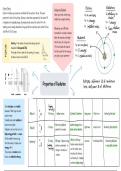
Carbon Dating: Background Radiation
Carbon-14 makes up around one ten millionth of the carbon in the air. The same radon gas, rocks, cosmic rays,
proportion is found in living things. However, when these organisms die, the carbon-14 medical use, weapons testing
is trapped and it gradually decays. By measuring the amount of carbon-14 in the
artefact, you can easily calculate how long ago the item was living since carbon-14 has Measuring: use a GM tube
a half life of 5,600 years. connected to a counter, measure
before the sources are brought
Activity => the number of nuclei which decay/second into the room, for a long time
(~1hr) and rescale the value to
Half Life
measured in Becquerels (Bq).
The length of time it takes for the activity of a source find the counts for the time you
to halve is known as the half life. are using in your experiment
Properties of Radiation
Some isotopes are unstable
because of their large size and
Alpha (α) +2 charge helium nucleus 2 protons 2 neutrons heavy mass ~5cm in air blocked by thin card
neutron count.
Unstable nuclei emit radiation to
become more stable. fast moving electron neutron changes into a
Beta (β) -1 charge light mass a few m in air blocked by 3mm think Al
Radiation can be in the form of a ejected from nucleus proton and an electron
high energy particle or a wave.
As the radiation moves away after α or β decay -
Gamma (γ) 0 charge EM wave - highest energy no mass technically infinite blocked by thick lead
from the nucleus, it takes some (helium nucleus/electron
shortest wavelength - no or very thick concrete
energy with it. can hit another atom,
change to structure of
This process is random and is knocking off electrons
nucleus
known as radioactive decay. and ionising it) - nucleus
contains surplus energy
Carbon-14 makes up around one ten millionth of the carbon in the air. The same radon gas, rocks, cosmic rays,
proportion is found in living things. However, when these organisms die, the carbon-14 medical use, weapons testing
is trapped and it gradually decays. By measuring the amount of carbon-14 in the
artefact, you can easily calculate how long ago the item was living since carbon-14 has Measuring: use a GM tube
a half life of 5,600 years. connected to a counter, measure
before the sources are brought
Activity => the number of nuclei which decay/second into the room, for a long time
(~1hr) and rescale the value to
Half Life
measured in Becquerels (Bq).
The length of time it takes for the activity of a source find the counts for the time you
to halve is known as the half life. are using in your experiment
Properties of Radiation
Some isotopes are unstable
because of their large size and
Alpha (α) +2 charge helium nucleus 2 protons 2 neutrons heavy mass ~5cm in air blocked by thin card
neutron count.
Unstable nuclei emit radiation to
become more stable. fast moving electron neutron changes into a
Beta (β) -1 charge light mass a few m in air blocked by 3mm think Al
Radiation can be in the form of a ejected from nucleus proton and an electron
high energy particle or a wave.
As the radiation moves away after α or β decay -
Gamma (γ) 0 charge EM wave - highest energy no mass technically infinite blocked by thick lead
from the nucleus, it takes some (helium nucleus/electron
shortest wavelength - no or very thick concrete
energy with it. can hit another atom,
change to structure of
This process is random and is knocking off electrons
nucleus
known as radioactive decay. and ionising it) - nucleus
contains surplus energy