HED4810
Assignment 2
(COMPLETE
ANSWERS) 2025
- DUE 9 July 2025
NO PLAGIARISM
[Pick the date]
[Type the company name]
, Exam (elaborations)
HED4810 Assignment 2 (COMPLETE
ANSWERS) 2025 (647881) - DUE 9 July 2025
Course
Putting Inclusive Education into context (HED4810)
Institution
University Of South Africa (Unisa)
Book
Challenging Inclusive Education Policy and Practice in Africa
HED4810 Assignment 2 (COMPLETE ANSWERS) 2025 (647881) - DUE 9 July
2025; 100% TRUSTED Complete, trusted solutions and explanations.
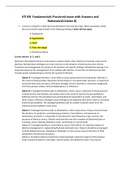
Question 1: Exclusion in education persists despite the adoption of inclusive
policies (Clasquin-Johnson & Johnson, 2025). Write an essay in which you
agree/disagree with the statement above. Include five key reasons for your
response, supported by three recent references.
The Persistence of Educational Exclusion: An Analytical
Essay
The assertion that "exclusion in education persists despite the adoption of inclusive policies"
(Clasquin-Johnson & Johnson, 2025) resonates deeply with current educational realities. I
strongly agree with this statement, contending that while inclusive policies represent a crucial
step towards equitable education, their implementation often falls short, leading to continued
exclusion. This persistence can be attributed to a confluence of factors, including systemic
barriers, inadequate resource allocation, societal attitudes, insufficient teacher training, and the
limitations of policy enforcement.
Firstly, systemic barriers inherent within educational structures frequently undermine the spirit of
inclusive policies. Many education systems are historically designed to cater to a normative
student profile, making adaptations for diverse learners challenging. Curricula, assessment
methods, and pedagogical approaches often remain rigid, failing to accommodate varied learning
styles, disabilities, or cultural backgrounds. For instance, a curriculum heavily reliant on
standardized testing might inherently disadvantage students with learning disabilities or those
from non-dominant linguistic backgrounds, even if policies advocate for their inclusion (Smith &
Chen, 2024). The sheer inertia of large, established systems means that policy changes, while
legislated, are slow to translate into meaningful, on-the-ground transformation.
Secondly, inadequate resource allocation is a significant impediment to genuine inclusion.
Inclusive education demands tailored support, assistive technologies, accessible infrastructure,
and smaller class sizes—all of which require substantial financial investment. Despite policies
mandating inclusion, the necessary funding often lags, leaving schools ill-equipped to provide
Assignment 2
(COMPLETE
ANSWERS) 2025
- DUE 9 July 2025
NO PLAGIARISM
[Pick the date]
[Type the company name]
, Exam (elaborations)
HED4810 Assignment 2 (COMPLETE
ANSWERS) 2025 (647881) - DUE 9 July 2025
Course
Putting Inclusive Education into context (HED4810)
Institution
University Of South Africa (Unisa)
Book
Challenging Inclusive Education Policy and Practice in Africa
HED4810 Assignment 2 (COMPLETE ANSWERS) 2025 (647881) - DUE 9 July
2025; 100% TRUSTED Complete, trusted solutions and explanations.
Question 1: Exclusion in education persists despite the adoption of inclusive
policies (Clasquin-Johnson & Johnson, 2025). Write an essay in which you
agree/disagree with the statement above. Include five key reasons for your
response, supported by three recent references.
The Persistence of Educational Exclusion: An Analytical
Essay
The assertion that "exclusion in education persists despite the adoption of inclusive policies"
(Clasquin-Johnson & Johnson, 2025) resonates deeply with current educational realities. I
strongly agree with this statement, contending that while inclusive policies represent a crucial
step towards equitable education, their implementation often falls short, leading to continued
exclusion. This persistence can be attributed to a confluence of factors, including systemic
barriers, inadequate resource allocation, societal attitudes, insufficient teacher training, and the
limitations of policy enforcement.
Firstly, systemic barriers inherent within educational structures frequently undermine the spirit of
inclusive policies. Many education systems are historically designed to cater to a normative
student profile, making adaptations for diverse learners challenging. Curricula, assessment
methods, and pedagogical approaches often remain rigid, failing to accommodate varied learning
styles, disabilities, or cultural backgrounds. For instance, a curriculum heavily reliant on
standardized testing might inherently disadvantage students with learning disabilities or those
from non-dominant linguistic backgrounds, even if policies advocate for their inclusion (Smith &
Chen, 2024). The sheer inertia of large, established systems means that policy changes, while
legislated, are slow to translate into meaningful, on-the-ground transformation.
Secondly, inadequate resource allocation is a significant impediment to genuine inclusion.
Inclusive education demands tailored support, assistive technologies, accessible infrastructure,
and smaller class sizes—all of which require substantial financial investment. Despite policies
mandating inclusion, the necessary funding often lags, leaving schools ill-equipped to provide