2 - Bonding and structure
Ionic bonding and structures
● ***Ionic bonding: strong electrostatic attraction between oppositely charged ions
● ***Lattice: a regular 3-D arrangement of particles in space
𝑄1 (𝑐ℎ𝑎𝑟𝑔𝑒 1 [𝑐𝑎𝑡𝑖𝑜𝑛]) × 𝑄2 (𝑐ℎ𝑎𝑟𝑔𝑒 2 [𝑎𝑛𝑖𝑜𝑛])
● ***𝐹 (𝑒𝑙𝑒𝑐𝑡𝑟𝑜𝑠𝑡𝑎𝑡𝑖𝑐 𝑓𝑜𝑟𝑐𝑒) ∝ 2
𝑑 (𝑑𝑖𝑠𝑡𝑎𝑛𝑐𝑒 𝑏𝑒𝑡𝑤𝑒𝑒𝑛 𝑐ℎ𝑎𝑟𝑔𝑒𝑠)
○ Bigger charges, stronger electrostatic force
○ Greater distance between charges, weaker electrostatic force (this has a big
effect because it is the square of the distance that affects the force)
Ionic radii (≠ atomic radii)
● +ve ions: ionic radii < atomic, -ve: ionic > atomic
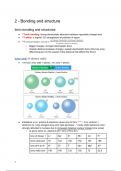
● Imbalance in no. protons & electrons cause ions to form, ***∴ if no. protons >
electrons (ie +vely charged ions) ionic radii decrease ∵ (outer shell) electrons more
strongly attracted to nucleus due to increased (relative) nuclear charge {vice versa}
○ Ie given same no. electrons (for “ions of N to Al”),
Ions of Group 1 Li+ Na+ K+ Rb+ Cs+ Fr+
Ionic radii (pm) 76 102 138 152 167 180
Ions of N to Al N3- O2- F- Na+ Mg2+ Al3+
Ionic radii (nm) 146 140 133 102 72 53.5
1
, ***(Same as atomic radii) ionic radii decrease across period, increase down
group
● ***Covalent bonding: electrostatic attraction between positive nuclei and a shared
pair of electrons
○ Proof - contours surrounding both atoms on electron density map, ie
***Ie in ionic bonding no contours surround >1 atom (electrons NOT shared)
Dative covalent bonding
● ***Definition: when one atom supplies both electrons to form the covalent bond
● Eg
○ NH4+
○ Al2Cl6
○ H3O+
2
, (← when HCl is aq)
○ NH3BF3 (ammonia borane)
○ NO3-
○ N2O (nitrous oxide)
○ CO (carbon monoxide)
3
Ionic bonding and structures
● ***Ionic bonding: strong electrostatic attraction between oppositely charged ions
● ***Lattice: a regular 3-D arrangement of particles in space
𝑄1 (𝑐ℎ𝑎𝑟𝑔𝑒 1 [𝑐𝑎𝑡𝑖𝑜𝑛]) × 𝑄2 (𝑐ℎ𝑎𝑟𝑔𝑒 2 [𝑎𝑛𝑖𝑜𝑛])
● ***𝐹 (𝑒𝑙𝑒𝑐𝑡𝑟𝑜𝑠𝑡𝑎𝑡𝑖𝑐 𝑓𝑜𝑟𝑐𝑒) ∝ 2
𝑑 (𝑑𝑖𝑠𝑡𝑎𝑛𝑐𝑒 𝑏𝑒𝑡𝑤𝑒𝑒𝑛 𝑐ℎ𝑎𝑟𝑔𝑒𝑠)
○ Bigger charges, stronger electrostatic force
○ Greater distance between charges, weaker electrostatic force (this has a big
effect because it is the square of the distance that affects the force)
Ionic radii (≠ atomic radii)
● +ve ions: ionic radii < atomic, -ve: ionic > atomic
● Imbalance in no. protons & electrons cause ions to form, ***∴ if no. protons >
electrons (ie +vely charged ions) ionic radii decrease ∵ (outer shell) electrons more
strongly attracted to nucleus due to increased (relative) nuclear charge {vice versa}
○ Ie given same no. electrons (for “ions of N to Al”),
Ions of Group 1 Li+ Na+ K+ Rb+ Cs+ Fr+
Ionic radii (pm) 76 102 138 152 167 180
Ions of N to Al N3- O2- F- Na+ Mg2+ Al3+
Ionic radii (nm) 146 140 133 102 72 53.5
1
, ***(Same as atomic radii) ionic radii decrease across period, increase down
group
● ***Covalent bonding: electrostatic attraction between positive nuclei and a shared
pair of electrons
○ Proof - contours surrounding both atoms on electron density map, ie
***Ie in ionic bonding no contours surround >1 atom (electrons NOT shared)
Dative covalent bonding
● ***Definition: when one atom supplies both electrons to form the covalent bond
● Eg
○ NH4+
○ Al2Cl6
○ H3O+
2
, (← when HCl is aq)
○ NH3BF3 (ammonia borane)
○ NO3-
○ N2O (nitrous oxide)
○ CO (carbon monoxide)
3