
CHAPTER 2
A theory is a coherent set of ideas, hypotheses and explanations to create order in the data
- Descriptive
- Explanatory
- Predictive
- Makes assumptions
- Is a reduction of reality
- Is generalizable
- Is testable
A theory will be replaced when it is falsified on the basis of observations or when a new theory
explains the observations better.
A theory is tested by following the empirical cycle: observation, induction, deduction, testing and
evaluation.
Theory of development = A scheme or system of ideas that is based on evidence and attempts to
explain, describe and predict behavior and development.
- A good developmental theory relates to ontogeny, focuses on change over time, explains the
emergence of new properties and is preferably useful in education or interventions.
Minor theories = Theories that deal only with very specific, narrow areas of development
Major theories = Theories that attempt to explain larger areas of development
Categories of development theories
- Motor development
- Cognitive development
- Social-cognitive development
- Evolution and ethology
- Psychoanalytic theories
- Humanistic theory
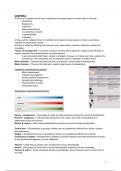
Dimensions in developmental theories
Nature / endogenous = Knowledge is innate and gets expressed during the course of development
Nurture / exogenous = Only learning mechanisms are innate, all the rest of development is
determined by the environment
Nature & nurture = Both innate predispositions and the environment shape development
Continuous = Development is gradual; children are not qualitatively different from adults; children
lack experience.
Stages = Development occurs in transitions; children are qualitatively different from adults
Continuous & stages = Development is gradual; but some behaviors dominate temporarily and that
is why development appears to occur stagewise.
Passive = Child plays a passive role; development occurs automatically
Active = Child plays an active role in its own development; constructs its own knowledge
Passive & active = Some processes develop automatically; other processes need an active role of
the child
1
,MOTOR DEVELOPMENT
Motor milestones = The basic motor skills acquired in infancy and
early childhood, such as sitting unaided, standing, crawling and
walking.
The development of motor skills has very important implications for
other aspects of development. The ability to act on the world affects
all other aspects of development, and each new accomplishment
brings with it an increasing degree of independence.
1. Maturational theories (Gesell)
Biologically directed maturation; the same developmental patterns independent of
environmental input.
- Maturation of central nervous system determines the development of the child,
behavioral development follows
- Differences in child's temperament play important role in pace of development
- Role of the parents is to provide the right environment (when the child is ready; no
pushing)
Cephalocaudal trend = Development that proceeds from head to foot along the length of the
body
Proximodistal trend = The development of motor control in infancy which is from the center
of the body outwards to more peripheral segments
Gesell believes that maturation alone shapes motor development, development is controlled
by a maturational timetable linked particularly to the central nervous system and also to
muscular development. Each animal species has its own sequence, and experience has little,
if any, effect on motor development.
Criticism
a) The fact that motor skills develop in a regular sequence does not prove a genetic
cause.
b) Does not necessarily generalize to all cultures
c) A maturational theory does not account for the considerable individual differences in
the acquisition of various motor skills
d) Environment can play guiding role (research McGraw)
McGraw
- Environment can shape motor development
- Twin study with Jimmy and Johnny Woods: Johnny received extra training in
swimming, skating and climbing, his development was accelerated
2. Dynamic systems theory
= A theoretical approach applied to many areas of development which views the individual as
interacting dynamically in a complex system in which all parts interact.
- Development is a complex interaction between properties of the system and the
environment
- An important property is self-organization
- The effects are non-linear: small changes in one variable may bring qualitative
changes in the whole pattern
Dynamic interplay between three different factors:
a) Nervous system development
b) The capabilities and biomechanics of the body
c) Environmental constraints and support
2
, The infant kicking study shows that the infants were able to change their pattern of interlimb
coordination to solve a novel, experimentally imposed task
The infant reaching study shows that infants need a stable posture before they can attain the
goal of reaching successfully, and is a clear demonstration that new motor skills are learned
through a process of modifying and developing their already existing abilities.
The infant walking study shows that infants do not have a fixed and rigid understanding of
their own abilities, and have the dynamic flexibility to adjust their abilities as they approach
each novel motor problem.
Esther Thelen
Motor development is shaped by:
- Development central nervous system (nature)
- Development motor skills (nature)
- Environment (context and task)
COGNITIVE DEVELOPMENT
Piaget's theory of development / Constructivist theory
Before Piaget children's developmental psychology was dominated by behaviorism and
psychoanalysis. In both theories the child is seen as the passive recipient of their upbringing. Neither
approach gives much credit to children in shaping their own course of development.
Cognitive adaptations = Children's developing cognitive awareness of the world. As a result of
cognitive adaptations they become better able to understand their world.
- These more advanced understandings of the world reflect themselves in the appearance,
during development, of new stages of development
Organismic world view = Portrays children as inherently active, continually interacting with the
environment in such a way as to shape their own development.
In order to adapt to the world two important processes are necessary:
a) Assimilation = The process through which children incorporate new experiences into their
preexisting schemes - that is, they assimilate the new to their already existing schemes of
thought. An important process in Piaget's theory.
- Meet a new policeman and treat them as we habitually treat policemen.
b) Accommodation = The cognitive process through which children adapt to new experiences
by modifying their preexisting schemes. An important process in Piaget's theory.
- When children meet a new teacher who is different from their previous teachers they
have to adjust their way of thinking to understand the new person.
Schemas = Mental structures in the child's thinking that provide representations and plans for
enacting behaviors.
- It is worth stressing that assimilation and accommodation always occur together during
infancy.
Functional invariants = Processes that do not change during development, such as accommodation
and assimilation in Piaget's theory.
- What do change are the cognitive structures (schemas) that allow the child to comprehend
the world at progressively higher levels of understanding.
The four stages of cognitive development
1. Sensorimotor stage = In Piaget's theory, the first stage of cognitive development, whereby
thought is based primarily on perception and action and internalized thinking is largely absent.
This stage is characteristic of infants from birth to about 2 years old.
- Development of thought in action
3
, 2. Preoperational stage = A stage of development described by Piaget in which children under
the age of approximately 7 years are unable to coordinate aspects of problems in order to
solve them.
- Egocentric = An egocentric child is one who finds it difficult to see things from
another person's point of view. Not to be confused with egotistical.
- Animism = A characteristic of children's thinking in Piaget's preoperational stage in
which they tend to attribute life and life-like qualities to inanimate objects, particularly
those that move and are active.
In this stage the children's thinking tends to be illogical and at times seems quite magical.
There is a lack of a logical framework for thought.
3. Concrete operations stage = The third Piagetian stage of development in which reasoning
is said to become more logical, systematic and rational in its application to concrete objects.
(7 to 11 years old)
- Centration = The focusing or centring of attention on one aspect of a situation to the
exclusion of others. (demonstrated in conservation tasks)
- Conservation tasks = Tasks that examine children's ability to understand that
physical attributes of objects, such as their mass and weight, do not vary when the
object changes shape.
4. Formal operations stage = The fourth Piagetian stage in which the individual acquires the
capacity for abstract scientific thought. This includes the ability to theorize about impossible
events and items. (from about 11 years old)
- The concrete operations child becomes able to solve many problems involving the
physical world, but the major limitation in their thinking is to do with the realm of
possibilities, this limitation is removed in the formal operations stage.
Why it took many years before Piaget's theory made an impact in American and British psychology:
a) American and British psychology was dominated by the theoretical school of thought known
as behaviorism, which offered the mechanistic world view that the child is inherently passive
until stimulated by the environment and so the opposing view offered by Piaget took time to
be accepted.
b) Piaget only ever wrote in French, which made his work less accessible to English-speaking
psychologists.
c) While Piaget was a brilliant thinker, his writings are often extraordinarily complex and difficult
to understand.
Information processing approaches
Information processing = The view that cognitive processes are explained in terms of inputs and
outputs and that the human mind is a system through which information flows.
Information processing theories are rooted in three 20th-century innovations.
1. The rapid and continuing advances in computer technology.
2. The view, revolutionary at the time, that an organism's behavior cannot be understood without
knowing the structure of the perceiver's environment.
3. Constructivism = Piaget's theoretical view that infants are not born with knowledge about the
world, but instead gradually construct knowledge and the ability to represent reality mentally
Information processing theories, therefore, focus on the information available in the external
environment, and the means by which the child receives and interprets this information. This way of
thinking can provide clarity with respect to understanding many aspects of cognitive development.
The task of the developing child is to use their perceptual systems - vision, hearing, touch, and so
forth - to explore the world and obtain information about its properties. The information must be
4
A theory is a coherent set of ideas, hypotheses and explanations to create order in the data
- Descriptive
- Explanatory
- Predictive
- Makes assumptions
- Is a reduction of reality
- Is generalizable
- Is testable
A theory will be replaced when it is falsified on the basis of observations or when a new theory
explains the observations better.
A theory is tested by following the empirical cycle: observation, induction, deduction, testing and
evaluation.
Theory of development = A scheme or system of ideas that is based on evidence and attempts to
explain, describe and predict behavior and development.
- A good developmental theory relates to ontogeny, focuses on change over time, explains the
emergence of new properties and is preferably useful in education or interventions.
Minor theories = Theories that deal only with very specific, narrow areas of development
Major theories = Theories that attempt to explain larger areas of development
Categories of development theories
- Motor development
- Cognitive development
- Social-cognitive development
- Evolution and ethology
- Psychoanalytic theories
- Humanistic theory
Dimensions in developmental theories
Nature / endogenous = Knowledge is innate and gets expressed during the course of development
Nurture / exogenous = Only learning mechanisms are innate, all the rest of development is
determined by the environment
Nature & nurture = Both innate predispositions and the environment shape development
Continuous = Development is gradual; children are not qualitatively different from adults; children
lack experience.
Stages = Development occurs in transitions; children are qualitatively different from adults
Continuous & stages = Development is gradual; but some behaviors dominate temporarily and that
is why development appears to occur stagewise.
Passive = Child plays a passive role; development occurs automatically
Active = Child plays an active role in its own development; constructs its own knowledge
Passive & active = Some processes develop automatically; other processes need an active role of
the child
1
,MOTOR DEVELOPMENT
Motor milestones = The basic motor skills acquired in infancy and
early childhood, such as sitting unaided, standing, crawling and
walking.
The development of motor skills has very important implications for
other aspects of development. The ability to act on the world affects
all other aspects of development, and each new accomplishment
brings with it an increasing degree of independence.
1. Maturational theories (Gesell)
Biologically directed maturation; the same developmental patterns independent of
environmental input.
- Maturation of central nervous system determines the development of the child,
behavioral development follows
- Differences in child's temperament play important role in pace of development
- Role of the parents is to provide the right environment (when the child is ready; no
pushing)
Cephalocaudal trend = Development that proceeds from head to foot along the length of the
body
Proximodistal trend = The development of motor control in infancy which is from the center
of the body outwards to more peripheral segments
Gesell believes that maturation alone shapes motor development, development is controlled
by a maturational timetable linked particularly to the central nervous system and also to
muscular development. Each animal species has its own sequence, and experience has little,
if any, effect on motor development.
Criticism
a) The fact that motor skills develop in a regular sequence does not prove a genetic
cause.
b) Does not necessarily generalize to all cultures
c) A maturational theory does not account for the considerable individual differences in
the acquisition of various motor skills
d) Environment can play guiding role (research McGraw)
McGraw
- Environment can shape motor development
- Twin study with Jimmy and Johnny Woods: Johnny received extra training in
swimming, skating and climbing, his development was accelerated
2. Dynamic systems theory
= A theoretical approach applied to many areas of development which views the individual as
interacting dynamically in a complex system in which all parts interact.
- Development is a complex interaction between properties of the system and the
environment
- An important property is self-organization
- The effects are non-linear: small changes in one variable may bring qualitative
changes in the whole pattern
Dynamic interplay between three different factors:
a) Nervous system development
b) The capabilities and biomechanics of the body
c) Environmental constraints and support
2
, The infant kicking study shows that the infants were able to change their pattern of interlimb
coordination to solve a novel, experimentally imposed task
The infant reaching study shows that infants need a stable posture before they can attain the
goal of reaching successfully, and is a clear demonstration that new motor skills are learned
through a process of modifying and developing their already existing abilities.
The infant walking study shows that infants do not have a fixed and rigid understanding of
their own abilities, and have the dynamic flexibility to adjust their abilities as they approach
each novel motor problem.
Esther Thelen
Motor development is shaped by:
- Development central nervous system (nature)
- Development motor skills (nature)
- Environment (context and task)
COGNITIVE DEVELOPMENT
Piaget's theory of development / Constructivist theory
Before Piaget children's developmental psychology was dominated by behaviorism and
psychoanalysis. In both theories the child is seen as the passive recipient of their upbringing. Neither
approach gives much credit to children in shaping their own course of development.
Cognitive adaptations = Children's developing cognitive awareness of the world. As a result of
cognitive adaptations they become better able to understand their world.
- These more advanced understandings of the world reflect themselves in the appearance,
during development, of new stages of development
Organismic world view = Portrays children as inherently active, continually interacting with the
environment in such a way as to shape their own development.
In order to adapt to the world two important processes are necessary:
a) Assimilation = The process through which children incorporate new experiences into their
preexisting schemes - that is, they assimilate the new to their already existing schemes of
thought. An important process in Piaget's theory.
- Meet a new policeman and treat them as we habitually treat policemen.
b) Accommodation = The cognitive process through which children adapt to new experiences
by modifying their preexisting schemes. An important process in Piaget's theory.
- When children meet a new teacher who is different from their previous teachers they
have to adjust their way of thinking to understand the new person.
Schemas = Mental structures in the child's thinking that provide representations and plans for
enacting behaviors.
- It is worth stressing that assimilation and accommodation always occur together during
infancy.
Functional invariants = Processes that do not change during development, such as accommodation
and assimilation in Piaget's theory.
- What do change are the cognitive structures (schemas) that allow the child to comprehend
the world at progressively higher levels of understanding.
The four stages of cognitive development
1. Sensorimotor stage = In Piaget's theory, the first stage of cognitive development, whereby
thought is based primarily on perception and action and internalized thinking is largely absent.
This stage is characteristic of infants from birth to about 2 years old.
- Development of thought in action
3
, 2. Preoperational stage = A stage of development described by Piaget in which children under
the age of approximately 7 years are unable to coordinate aspects of problems in order to
solve them.
- Egocentric = An egocentric child is one who finds it difficult to see things from
another person's point of view. Not to be confused with egotistical.
- Animism = A characteristic of children's thinking in Piaget's preoperational stage in
which they tend to attribute life and life-like qualities to inanimate objects, particularly
those that move and are active.
In this stage the children's thinking tends to be illogical and at times seems quite magical.
There is a lack of a logical framework for thought.
3. Concrete operations stage = The third Piagetian stage of development in which reasoning
is said to become more logical, systematic and rational in its application to concrete objects.
(7 to 11 years old)
- Centration = The focusing or centring of attention on one aspect of a situation to the
exclusion of others. (demonstrated in conservation tasks)
- Conservation tasks = Tasks that examine children's ability to understand that
physical attributes of objects, such as their mass and weight, do not vary when the
object changes shape.
4. Formal operations stage = The fourth Piagetian stage in which the individual acquires the
capacity for abstract scientific thought. This includes the ability to theorize about impossible
events and items. (from about 11 years old)
- The concrete operations child becomes able to solve many problems involving the
physical world, but the major limitation in their thinking is to do with the realm of
possibilities, this limitation is removed in the formal operations stage.
Why it took many years before Piaget's theory made an impact in American and British psychology:
a) American and British psychology was dominated by the theoretical school of thought known
as behaviorism, which offered the mechanistic world view that the child is inherently passive
until stimulated by the environment and so the opposing view offered by Piaget took time to
be accepted.
b) Piaget only ever wrote in French, which made his work less accessible to English-speaking
psychologists.
c) While Piaget was a brilliant thinker, his writings are often extraordinarily complex and difficult
to understand.
Information processing approaches
Information processing = The view that cognitive processes are explained in terms of inputs and
outputs and that the human mind is a system through which information flows.
Information processing theories are rooted in three 20th-century innovations.
1. The rapid and continuing advances in computer technology.
2. The view, revolutionary at the time, that an organism's behavior cannot be understood without
knowing the structure of the perceiver's environment.
3. Constructivism = Piaget's theoretical view that infants are not born with knowledge about the
world, but instead gradually construct knowledge and the ability to represent reality mentally
Information processing theories, therefore, focus on the information available in the external
environment, and the means by which the child receives and interprets this information. This way of
thinking can provide clarity with respect to understanding many aspects of cognitive development.
The task of the developing child is to use their perceptual systems - vision, hearing, touch, and so
forth - to explore the world and obtain information about its properties. The information must be
4


