CBEST Reading UPDATED Exam
Questions and CORRECT Answers
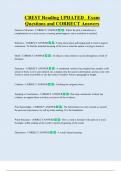
Narrative Structure - CORRECT ANSWER - Where the plot is introduced, a
complications or a crisis occurs, a turning point happens, and a resolution is reached.
Inference - CORRECT ANSWER - Using observation and background to reach a logical
conclusion. To find the intended meaning of the text or what the author is trying to teach us.
Motif - CORRECT ANSWER - An object or idea which re-occurs throughout a work of
literature.
Summary - CORRECT ANSWER - A condensed version of an original text, usually a full
article or book. Leave your opinion out, contains only the sources information, and use your own
words as much as possible or cite the source if needed. About a paragraph in length.
Citations - CORRECT ANSWER - Crediting the original source.
Jumping to Conclusions - CORRECT ANSWER - Drawing conclusions without any
evidence to support them or before you know all the evidence.
Prior Knowledge - CORRECT ANSWER - The information we carry around us, and all
the previous experiences we call up when reading. It is the foundation.
Word Structure - CORRECT ANSWER - How a word is formed or the parts of a word.
Example: suffix (ending of the word) or prefix (beginning of the word)
Denotation - CORRECT ANSWER - A word's literal meaning.
, Connotation - CORRECT ANSWER - A words underlying meanings, it's all the stuff we
associate with a word. Go beyond the literal to what we think and feel when we hear or see a
word.
Euphemism - CORRECT ANSWER - Alternate, inoffensive ways of saying something
that might be considered improper or even taboo.
Metaphor - CORRECT ANSWER - A kind of analogy that uses figurative language
connecting one thing to another to connect how they're alike.
Extended Metaphor - CORRECT ANSWER - A metaphor written large and lengthy to
make an even deeper, more involved comparison between the subject and the thing it's being
compared to. Found in poetry and fiction. It makes the subject equivalent to the thing it's being
compared to.
Simile - CORRECT ANSWER - A comparison using the terms 'like' or 'as'. It qualifies the
comparison.
Synecdoche - CORRECT ANSWER - A part of something is used to refer to the whole
entity, or a whole entity is used to refer to part of something. Examples: Americans = USA,
threads = clothes, and steel = sword.
Metonymy - CORRECT ANSWER - When a thing refers to something else that's closely
associated with it. The part does not have to refer to the whole or vice-versa. Contextual
associations linking one word to its meaning in conversations or writing. Examples: ride = car,
plates = guests, and kicks = shoes.
Cliche - CORRECT ANSWER - Elements of a literary work, from descriptions to plot
points, which have lost their impact through overuse.
Paradox - CORRECT ANSWER - A contradiction that at first glance appears to make
sense, but which, upon further reflection is seen as illogical. Example" "All animals are equal,
but some animals are more equal than others."
Questions and CORRECT Answers
Narrative Structure - CORRECT ANSWER - Where the plot is introduced, a
complications or a crisis occurs, a turning point happens, and a resolution is reached.
Inference - CORRECT ANSWER - Using observation and background to reach a logical
conclusion. To find the intended meaning of the text or what the author is trying to teach us.
Motif - CORRECT ANSWER - An object or idea which re-occurs throughout a work of
literature.
Summary - CORRECT ANSWER - A condensed version of an original text, usually a full
article or book. Leave your opinion out, contains only the sources information, and use your own
words as much as possible or cite the source if needed. About a paragraph in length.
Citations - CORRECT ANSWER - Crediting the original source.
Jumping to Conclusions - CORRECT ANSWER - Drawing conclusions without any
evidence to support them or before you know all the evidence.
Prior Knowledge - CORRECT ANSWER - The information we carry around us, and all
the previous experiences we call up when reading. It is the foundation.
Word Structure - CORRECT ANSWER - How a word is formed or the parts of a word.
Example: suffix (ending of the word) or prefix (beginning of the word)
Denotation - CORRECT ANSWER - A word's literal meaning.
, Connotation - CORRECT ANSWER - A words underlying meanings, it's all the stuff we
associate with a word. Go beyond the literal to what we think and feel when we hear or see a
word.
Euphemism - CORRECT ANSWER - Alternate, inoffensive ways of saying something
that might be considered improper or even taboo.
Metaphor - CORRECT ANSWER - A kind of analogy that uses figurative language
connecting one thing to another to connect how they're alike.
Extended Metaphor - CORRECT ANSWER - A metaphor written large and lengthy to
make an even deeper, more involved comparison between the subject and the thing it's being
compared to. Found in poetry and fiction. It makes the subject equivalent to the thing it's being
compared to.
Simile - CORRECT ANSWER - A comparison using the terms 'like' or 'as'. It qualifies the
comparison.
Synecdoche - CORRECT ANSWER - A part of something is used to refer to the whole
entity, or a whole entity is used to refer to part of something. Examples: Americans = USA,
threads = clothes, and steel = sword.
Metonymy - CORRECT ANSWER - When a thing refers to something else that's closely
associated with it. The part does not have to refer to the whole or vice-versa. Contextual
associations linking one word to its meaning in conversations or writing. Examples: ride = car,
plates = guests, and kicks = shoes.
Cliche - CORRECT ANSWER - Elements of a literary work, from descriptions to plot
points, which have lost their impact through overuse.
Paradox - CORRECT ANSWER - A contradiction that at first glance appears to make
sense, but which, upon further reflection is seen as illogical. Example" "All animals are equal,
but some animals are more equal than others."