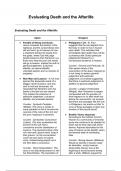
Evaluating Death and the Afterlife
Evaluating Death and the Afterlife:
Agree Disagree
● Parable of Sheep and Goats - ● Philippians 1:24 - St. Paul
Jesus compares the division of the suggests that the soul departs from
righteous and the cursed (those who the body in order to live in heaven
will and won’t go to heaven) to how upon death. This indicates that
a shepherd divides the sheep from immediately after death there will be
the goats, where God will judge a presence with Christ (particular
people based on their behaviour e.g judgement) followed by a
those who help the poor and needy non-physical existence in heaven.
will go to heaven. Implies the truth of
general judgement, a physical Counter : General and Particular, St.
afterlife, an eternal afterlife, Paul spoke clearly of the
unlimited election and no mention of resurrection of the dead, implying he
purgatory. is not trying to replace general
judgement with particular
● Rich Man and Lazarus - A rich man judgement, but instead suggesting
ignored the desperate needs of a that there is particular judgement in
beggar named Lazarus, and was addition to general judgement
sent to hell and tormented. He
requested that Abraham warn his Counter : Largely Uninterested
family of his fate but was denied. (Wright), New Testament is largely
This implies the existence of uninterested with the question of
particular judgement, a physical what happens to us after death but
afterlife, and unlimited election. before the resurrection. He accepts
that there are passages like this one
Counter : Symbolic Parables in Philippians, but points out that “in
(Wright), This story is similar to none of these passages is there any
many parables in that it involves the mention of the psyche [soul]”
reversal of the roles of the rich and
the poor, implying it is symbolic ● Beatific Vision (Aquinas) -
According to the Catholic Church,
Counter : Symbolises Conscience Heaven is a community of immortal
(Luther), The story symbolises the souls who continue to be obedient to
torment of the rich man’s God's will as they reign with Christ
conscience and the satisfaction of forever. Aquinas advocated for this
Lazarus. The physical bodies of the view of heaven as the beatific vision,
rich man and Lazarus were ‘lying in the blessed state of everlasting
their graves’, so the conversation bliss.
could not have been of natural
voice, instead being played out in Counter : Boring Heaven (Williams),
the Rich Man’s conscience Would an eternity in heaven really
be desirable - surely however
Counter : Sheol Interpretation, This pleasurable heaven was at the
story is not describing heaven or hell beginning it would become boring
but Sheol/Hades. The translation of after a while. Williams argued the
, Sheol/Hades to Hell is also likely a pleasure of living is making choices
mistranslation as, when describing about what we will do with our
Hell, Jesus uses the word Gehenna limited lifespans
● Physical Resurrection Counter Counter : God’s
(Augustine) - Paul calls the Omnipotence, such restrictions
resurrection of Jesus “the first fruits”, would not apply in the afterlife and
indicating that it was the first God would have the power to
resurrection after which ours will bypass them
follow. When Jesus returns God will
resurrect the dead and give them ● Jeremiah 31 - Describes heaven as
immortal ‘spiritual’ bodies. Augustine a place of happiness and free of
argues that it is more sensible to say suffering where, ‘they will be like a
that our earthly bodies could be well watered garden, and they will
raised into a heavenly and exalted sorrow no more’, a description
form than to say our souls can be similar to Aquinas’ Beatific Vision
bound to sinful bodies, and Jesus’
Resurrection being physical is an ● Annihilationism (Stott) - Hell is
indicator of our own resurrection. eternal and the destination of the
unrighteous dead, they do not spend
Counter : Cannibalism, If a person's an eternity in hell but are instead
body was cremated, or rots away, or annihilated into non-existence. In
is consumed after one’s death what Matthew 10:28 Jesus said “fear him
happens when they come to be who is able to destroy both soul and
resurrected? It makes no logical body in Gehenna”, seeming to
sense to say both the body of the suggest that in Gehenna the body
cannibal and the cannibalised can and soul are destroyed,
be raised contradicting the traditional view of
Hell.
Counter Counter : Replica Theory
(Hick), Since God is omnipotent, he Counter : Non-existence as
could create an exact replica of a Punishment, The Parable of the
person’s body in heaven or on earth Sheep and the Goats uses the
phrase ‘eternal punishment’ and
● Revelations 21 - Revelations 21, many do not consider eternal
God shows John the future where non-existence to classify as eternal
there is a “new heavens and the punishment; if eternal non-existence
new Earth” where there is “no more did classify as eternal punishment
death, or mourning, or crying, or then Annihilationism would no
pain”. It also describes hell as a longer resolve issues raised by Hick
‘fiery pit of burning sulfur’ where the and Hume of the immorality of Hell
unrighteous are tortured for eternity.
Counter Counter : Temporary
● New Earth (Wright) - Argues for Punishment, in the parable of the
Heaven as a New Earth by pointing sheep and the goats, Jesus says the
to the Sermon on the Mount and the sinful depart into eternal fire, but not
Lord’s Prayer, that says “Your that they actually spend eternity in it.
Kingdom come, your will be done, It could be the case that sinners
on Earth as it is in heaven”. Implies depart into the eternal flames of
the Kingdom of Heaven is not a Hell, withstand a temporary
separate place that we go after punishment proportional to their
death, but instead represents God’s sins, and are then destroyed with
sovereignty coming to Earth to the non-existence itself not being
create heaven. considered a ‘punishment’.
Evaluating Death and the Afterlife:
Agree Disagree
● Parable of Sheep and Goats - ● Philippians 1:24 - St. Paul
Jesus compares the division of the suggests that the soul departs from
righteous and the cursed (those who the body in order to live in heaven
will and won’t go to heaven) to how upon death. This indicates that
a shepherd divides the sheep from immediately after death there will be
the goats, where God will judge a presence with Christ (particular
people based on their behaviour e.g judgement) followed by a
those who help the poor and needy non-physical existence in heaven.
will go to heaven. Implies the truth of
general judgement, a physical Counter : General and Particular, St.
afterlife, an eternal afterlife, Paul spoke clearly of the
unlimited election and no mention of resurrection of the dead, implying he
purgatory. is not trying to replace general
judgement with particular
● Rich Man and Lazarus - A rich man judgement, but instead suggesting
ignored the desperate needs of a that there is particular judgement in
beggar named Lazarus, and was addition to general judgement
sent to hell and tormented. He
requested that Abraham warn his Counter : Largely Uninterested
family of his fate but was denied. (Wright), New Testament is largely
This implies the existence of uninterested with the question of
particular judgement, a physical what happens to us after death but
afterlife, and unlimited election. before the resurrection. He accepts
that there are passages like this one
Counter : Symbolic Parables in Philippians, but points out that “in
(Wright), This story is similar to none of these passages is there any
many parables in that it involves the mention of the psyche [soul]”
reversal of the roles of the rich and
the poor, implying it is symbolic ● Beatific Vision (Aquinas) -
According to the Catholic Church,
Counter : Symbolises Conscience Heaven is a community of immortal
(Luther), The story symbolises the souls who continue to be obedient to
torment of the rich man’s God's will as they reign with Christ
conscience and the satisfaction of forever. Aquinas advocated for this
Lazarus. The physical bodies of the view of heaven as the beatific vision,
rich man and Lazarus were ‘lying in the blessed state of everlasting
their graves’, so the conversation bliss.
could not have been of natural
voice, instead being played out in Counter : Boring Heaven (Williams),
the Rich Man’s conscience Would an eternity in heaven really
be desirable - surely however
Counter : Sheol Interpretation, This pleasurable heaven was at the
story is not describing heaven or hell beginning it would become boring
but Sheol/Hades. The translation of after a while. Williams argued the
, Sheol/Hades to Hell is also likely a pleasure of living is making choices
mistranslation as, when describing about what we will do with our
Hell, Jesus uses the word Gehenna limited lifespans
● Physical Resurrection Counter Counter : God’s
(Augustine) - Paul calls the Omnipotence, such restrictions
resurrection of Jesus “the first fruits”, would not apply in the afterlife and
indicating that it was the first God would have the power to
resurrection after which ours will bypass them
follow. When Jesus returns God will
resurrect the dead and give them ● Jeremiah 31 - Describes heaven as
immortal ‘spiritual’ bodies. Augustine a place of happiness and free of
argues that it is more sensible to say suffering where, ‘they will be like a
that our earthly bodies could be well watered garden, and they will
raised into a heavenly and exalted sorrow no more’, a description
form than to say our souls can be similar to Aquinas’ Beatific Vision
bound to sinful bodies, and Jesus’
Resurrection being physical is an ● Annihilationism (Stott) - Hell is
indicator of our own resurrection. eternal and the destination of the
unrighteous dead, they do not spend
Counter : Cannibalism, If a person's an eternity in hell but are instead
body was cremated, or rots away, or annihilated into non-existence. In
is consumed after one’s death what Matthew 10:28 Jesus said “fear him
happens when they come to be who is able to destroy both soul and
resurrected? It makes no logical body in Gehenna”, seeming to
sense to say both the body of the suggest that in Gehenna the body
cannibal and the cannibalised can and soul are destroyed,
be raised contradicting the traditional view of
Hell.
Counter Counter : Replica Theory
(Hick), Since God is omnipotent, he Counter : Non-existence as
could create an exact replica of a Punishment, The Parable of the
person’s body in heaven or on earth Sheep and the Goats uses the
phrase ‘eternal punishment’ and
● Revelations 21 - Revelations 21, many do not consider eternal
God shows John the future where non-existence to classify as eternal
there is a “new heavens and the punishment; if eternal non-existence
new Earth” where there is “no more did classify as eternal punishment
death, or mourning, or crying, or then Annihilationism would no
pain”. It also describes hell as a longer resolve issues raised by Hick
‘fiery pit of burning sulfur’ where the and Hume of the immorality of Hell
unrighteous are tortured for eternity.
Counter Counter : Temporary
● New Earth (Wright) - Argues for Punishment, in the parable of the
Heaven as a New Earth by pointing sheep and the goats, Jesus says the
to the Sermon on the Mount and the sinful depart into eternal fire, but not
Lord’s Prayer, that says “Your that they actually spend eternity in it.
Kingdom come, your will be done, It could be the case that sinners
on Earth as it is in heaven”. Implies depart into the eternal flames of
the Kingdom of Heaven is not a Hell, withstand a temporary
separate place that we go after punishment proportional to their
death, but instead represents God’s sins, and are then destroyed with
sovereignty coming to Earth to the non-existence itself not being
create heaven. considered a ‘punishment’.