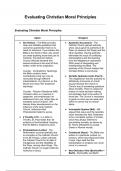
Evaluating Christian Moral Principles
Evaluating Christian Moral Principles:
Agree Disagree
● Dei Verbum - The Bible provides ● Apostolic Succession - The
clear and infallible guidelines that Catholic Church gained authority
cannot be questioned, there is no when Jesus gave his authority to St.
need for inference. If you believe the Peter (in essence first Pope) and the
Bible is the Word of God, why would other Apostles. Having authority
you need anything more than just its eliminates the issue of conflicting
contents. The Second Vatican interpretations and the teaching
Council officially declared that from the Magisterium represents
sacred scripture is the word of God, 2000 years of interpreting and
written under divine inspiration. reinterpreting the Bible. The
authority of the Church implies that
Counter : Contradictory Teachings, Christian Ethics is communal
the Bible contains many
contradictions that can only be ● Veritatis Splendor (John Paul II) -
reconciled through different The magisterium has the authority to
interpretations. E.g Sermon on the definitively pronounce on moral
Mount and many Old Testament issues because the Church is
teachings Christ’s way of answering questions
about morality. There is a place for
Counter : Passive Obedience (Mill), reason in moral decision making,
Christian ethics is a reaction to but ultimately God is the author of
paganism, and emphasised ‘an moral law. The Church is necessary
abstinence from evil, rather than an to guide us since we are weak and
energetic pursuit of good’. Mill sinful so cannot rely on reason
blames these developments on the alone.
influence of the early Catholic
Church, influences that ● Incomplete System (Mill) - Mill
Protestantism failed to excise argued that Jesus and the Apostles
never intended the New Testament
● 2 Timothy 3:16 - In a letter to to be a complete system of morals,
Timothy, St. Paul states that ‘all since they always referred to
scripture is God-breathed’ implying pre-existing morality, as shown by
that the Bible is inspired by God. St. Paul's willingness to accept
Greek or Roman morals.
● Protestantism (Luther) - The
Reformation occurred partially due ● Contextual (Hays) - The Bible was
to corruption in the Catholic Church. written in a particular context, by
In his 95 Theses, Luther criticised humans, which has influenced what
the Catholic Church for its Sale of it says. Hays said that the
Indulgences and the infallibility of interpretation of scripture can never
the Pope, among other things. The occur in a vacuum.
Catholic Church no longer holds the
Authority of Jesus. ● Neo-Orthodox View (Bonhoeffer +
Barth) - Bonhoeffer and Barth
Evaluating Christian Moral Principles:
Agree Disagree
● Dei Verbum - The Bible provides ● Apostolic Succession - The
clear and infallible guidelines that Catholic Church gained authority
cannot be questioned, there is no when Jesus gave his authority to St.
need for inference. If you believe the Peter (in essence first Pope) and the
Bible is the Word of God, why would other Apostles. Having authority
you need anything more than just its eliminates the issue of conflicting
contents. The Second Vatican interpretations and the teaching
Council officially declared that from the Magisterium represents
sacred scripture is the word of God, 2000 years of interpreting and
written under divine inspiration. reinterpreting the Bible. The
authority of the Church implies that
Counter : Contradictory Teachings, Christian Ethics is communal
the Bible contains many
contradictions that can only be ● Veritatis Splendor (John Paul II) -
reconciled through different The magisterium has the authority to
interpretations. E.g Sermon on the definitively pronounce on moral
Mount and many Old Testament issues because the Church is
teachings Christ’s way of answering questions
about morality. There is a place for
Counter : Passive Obedience (Mill), reason in moral decision making,
Christian ethics is a reaction to but ultimately God is the author of
paganism, and emphasised ‘an moral law. The Church is necessary
abstinence from evil, rather than an to guide us since we are weak and
energetic pursuit of good’. Mill sinful so cannot rely on reason
blames these developments on the alone.
influence of the early Catholic
Church, influences that ● Incomplete System (Mill) - Mill
Protestantism failed to excise argued that Jesus and the Apostles
never intended the New Testament
● 2 Timothy 3:16 - In a letter to to be a complete system of morals,
Timothy, St. Paul states that ‘all since they always referred to
scripture is God-breathed’ implying pre-existing morality, as shown by
that the Bible is inspired by God. St. Paul's willingness to accept
Greek or Roman morals.
● Protestantism (Luther) - The
Reformation occurred partially due ● Contextual (Hays) - The Bible was
to corruption in the Catholic Church. written in a particular context, by
In his 95 Theses, Luther criticised humans, which has influenced what
the Catholic Church for its Sale of it says. Hays said that the
Indulgences and the infallibility of interpretation of scripture can never
the Pope, among other things. The occur in a vacuum.
Catholic Church no longer holds the
Authority of Jesus. ● Neo-Orthodox View (Bonhoeffer +
Barth) - Bonhoeffer and Barth