Evaluating Religious Language
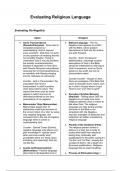
Evaluating Via Negativa:
Agree Disagree
● God’s Transcendence ● Biblical Language - The Via
(Pseudo-Dionysius) - Since God is Negativa view appears to conflict
completely beyond our with the Bible, where positive
understanding, God is ‘beyond descriptions of God and his actions
every assertion’. God does not exist are quite frequent.
on any spectrum of meaning that we
can possibly imagine. Trying to Counter : God’s Immanence
understand God is not just pointless (Maimonides), seemingly positive
but actually counterproductive descriptions of God in the Bible
because it separates us from God, should be interpreted as referring to
with Pseudo-Dionysius using Moses God’s immanence, such as God’s
receiving the 10 Commandments as actions in the world, but not his
an example, with Moses plunging transcendent nature
into the ‘darkness of unknowing’
Counter Counter : Gospel of John,
Counter : God is Transcendent, the there are passages of the Bible that
proposition that ‘God is seem to describe God’s nature such
transcendent’ is itself a positive as in John’s Gospel where it says
claim about God’s nature. This “God is love” and “God is spirit”
means that there must be some
degree to which God can be ● Everyday Christian Meaning
described positively by the very (Aquinas) - Talking about God Via
assumptions of via negativa Negativa is not really how most
religious believers want or intend to
● Maimonides’ Ship (Maimonides) - talk about God. The religious
Maimonides argues that 10 language you hear during worship
statements could lead someone to and even in the Bible is not
the correct notion of a ‘ship’ by using consistent with Via Negativa.
only negative language, and Aquinas’ analogies of attribution and
compares this to the use of negative proportion are better at explaining
language when it comes to religious language
understanding God.
● Parable of the Gardener (Flew) -
Counter : Special Cases (Davies), The religious person claims to
negative language only allows us to believe in a God, but in order to
gain knowledge in “special cases” protect that belief from empirical
when we know exactly what testing they continually add
possibilities there are. Most cases qualifications to the belief, saying it’s
including (and especially) God are ‘not this’ and ‘not that’, causing the
not like this. concept of God to ‘die a death of a
thousand qualifications’. Religious
● Avoids Anthropomorphism language fails to assert anything.
(Maimonides) - Positive language
about God is disrespectful since it ● Process of Elimination (Inge +
, anthropomorphises him and brings Davies) - God cannot be reached
him down to the level of mere via process of elimination. Since we
humans. have not experienced God, and his
being could be one of infinite
● Misconceptions of God (Lewis) - possibilities, saying what he is not
In popular imagination God is often gives no idea as to what he is. To
imagined in human terms, say black is ‘the opposite of white’ is
sometimes due to religious art. Via of no use to someone who is blind.
Negativa is a way to clear our minds Davies said that ‘declaring that God
of misconceptions about God. We is not a wombat does not get you
must then refill our minds with the closer to saying what God is’.
truth about God, untainted by
mythology, bad analogies, or false
mind-pictures.
● Hinders True Knowledge
(Eckhart) - Language about God is
not only insufficient for
understanding God but that it also
hinders true knowledge. When
Eckhart spoke of God he used
self-contradictory or paradoxical
phrases such as “I pray to God that
he might rid me of God”.
Evaluating Via Positiva (Analogy):
Agree Disagree
● Biblical Language - The Via ● God’s Transcendence
Positiva view is supported by the (Pseudo-Dionysius) - Since God is
Bible, where positive descriptions of completely beyond our
God and his actions are quite understanding, God is ‘beyond
frequent. every assertion’. God does not exist
on any spectrum of meaning that we
Counter : God’s Immanence can possibly imagine. Trying to
(Maimonides), seemingly positive understand God is not just pointless
descriptions of God in the Bible but actually counterproductive
should be interpreted as referring to because it separates us from God,
God’s immanence, such as God’s with Pseudo-Dionysius using Moses
actions in the world, but not his receiving the 10 Commandments as
transcendent nature an example, with Moses plunging
into the ‘darkness of unknowing’
Counter Counter : Gospel of John,
there are passages of the Bible that Counter : God is Transcendent, the
seem to describe God’s nature such proposition that ‘god is
as in John’s Gospel where it says transcendent’ is itself a positive
“God is love” and “God is spirit” claim about God’s nature. This
means that there must be some
● Analogy of Attribution (Aquinas) - degree to which God can be
Since certain effects flow from described positively by the very
certain causes, we can learn assumptions of via negativa
Evaluating Via Negativa:
Agree Disagree
● God’s Transcendence ● Biblical Language - The Via
(Pseudo-Dionysius) - Since God is Negativa view appears to conflict
completely beyond our with the Bible, where positive
understanding, God is ‘beyond descriptions of God and his actions
every assertion’. God does not exist are quite frequent.
on any spectrum of meaning that we
can possibly imagine. Trying to Counter : God’s Immanence
understand God is not just pointless (Maimonides), seemingly positive
but actually counterproductive descriptions of God in the Bible
because it separates us from God, should be interpreted as referring to
with Pseudo-Dionysius using Moses God’s immanence, such as God’s
receiving the 10 Commandments as actions in the world, but not his
an example, with Moses plunging transcendent nature
into the ‘darkness of unknowing’
Counter Counter : Gospel of John,
Counter : God is Transcendent, the there are passages of the Bible that
proposition that ‘God is seem to describe God’s nature such
transcendent’ is itself a positive as in John’s Gospel where it says
claim about God’s nature. This “God is love” and “God is spirit”
means that there must be some
degree to which God can be ● Everyday Christian Meaning
described positively by the very (Aquinas) - Talking about God Via
assumptions of via negativa Negativa is not really how most
religious believers want or intend to
● Maimonides’ Ship (Maimonides) - talk about God. The religious
Maimonides argues that 10 language you hear during worship
statements could lead someone to and even in the Bible is not
the correct notion of a ‘ship’ by using consistent with Via Negativa.
only negative language, and Aquinas’ analogies of attribution and
compares this to the use of negative proportion are better at explaining
language when it comes to religious language
understanding God.
● Parable of the Gardener (Flew) -
Counter : Special Cases (Davies), The religious person claims to
negative language only allows us to believe in a God, but in order to
gain knowledge in “special cases” protect that belief from empirical
when we know exactly what testing they continually add
possibilities there are. Most cases qualifications to the belief, saying it’s
including (and especially) God are ‘not this’ and ‘not that’, causing the
not like this. concept of God to ‘die a death of a
thousand qualifications’. Religious
● Avoids Anthropomorphism language fails to assert anything.
(Maimonides) - Positive language
about God is disrespectful since it ● Process of Elimination (Inge +
, anthropomorphises him and brings Davies) - God cannot be reached
him down to the level of mere via process of elimination. Since we
humans. have not experienced God, and his
being could be one of infinite
● Misconceptions of God (Lewis) - possibilities, saying what he is not
In popular imagination God is often gives no idea as to what he is. To
imagined in human terms, say black is ‘the opposite of white’ is
sometimes due to religious art. Via of no use to someone who is blind.
Negativa is a way to clear our minds Davies said that ‘declaring that God
of misconceptions about God. We is not a wombat does not get you
must then refill our minds with the closer to saying what God is’.
truth about God, untainted by
mythology, bad analogies, or false
mind-pictures.
● Hinders True Knowledge
(Eckhart) - Language about God is
not only insufficient for
understanding God but that it also
hinders true knowledge. When
Eckhart spoke of God he used
self-contradictory or paradoxical
phrases such as “I pray to God that
he might rid me of God”.
Evaluating Via Positiva (Analogy):
Agree Disagree
● Biblical Language - The Via ● God’s Transcendence
Positiva view is supported by the (Pseudo-Dionysius) - Since God is
Bible, where positive descriptions of completely beyond our
God and his actions are quite understanding, God is ‘beyond
frequent. every assertion’. God does not exist
on any spectrum of meaning that we
Counter : God’s Immanence can possibly imagine. Trying to
(Maimonides), seemingly positive understand God is not just pointless
descriptions of God in the Bible but actually counterproductive
should be interpreted as referring to because it separates us from God,
God’s immanence, such as God’s with Pseudo-Dionysius using Moses
actions in the world, but not his receiving the 10 Commandments as
transcendent nature an example, with Moses plunging
into the ‘darkness of unknowing’
Counter Counter : Gospel of John,
there are passages of the Bible that Counter : God is Transcendent, the
seem to describe God’s nature such proposition that ‘god is
as in John’s Gospel where it says transcendent’ is itself a positive
“God is love” and “God is spirit” claim about God’s nature. This
means that there must be some
● Analogy of Attribution (Aquinas) - degree to which God can be
Since certain effects flow from described positively by the very
certain causes, we can learn assumptions of via negativa