3 - 11 The electromagnetic spectrum
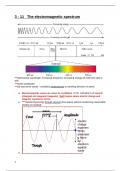
***(decreasing wavelength, increasing frequency; increasing energy) {if read from right to
left}
***(same amplitude)
***(all transverse waves - oscillation perpendicular to travelling direction of wave)
● Electromagnetic waves are waves by oscillation (振盪) (vibration) of electric
(charges) and magnetic (magnets) field (region where electric charge and
magnets experience force)
● ***Transferring energy through vacuum (free space) without transferring mass/matter
{media not needed}
wave
speed
electric
charge
experien
ce an
alternatin
g force
by
electrom
agnetic
wave
●
1
, ● ALL electromagnetic waves travel at same constant speed - speed of light (c) in
vacuum (3 * 108 m/s)
● ***3 * 108 m/s = c (speed of light) = f (frequency) * λ (wavelength)
● Can all be reflected, refracted & diffracted
Applications of electromagnetic radiations***
Electromagnetic Typical Typical Sources Detectors Uses
radiation frequency wavelength
(Hz) (m)
Radio waves 105 - 1010 103 - 10-2 - Radio - Radio - Long/medium/short
transmitters - TV aerials wave radio
- TV - TV (UHF)
transmitters - Broadcasting &
communications
(voice radio, walkie-
talkie)
Microwaves 1010 - 1011 10-2 - 10-3 - Microwave - Microwave - Mobile phone
transmitters receivers - Satellite
- Ovens communication
transmissions
- Cooking
Infrared (IR) 1011-1014 10-3 - 10-6 - Hot objects - Skin - Infrared cookers
- Blackened - Heaters
thermometer - TV
- Special - Stereo remote
photographic controls \
film communication
- Night vision
equipment (infrared
image, temperature
measurement)
Visible light 1014-1015 10-6 - 10-7 - Luminous - Eye - Vision
objects - Photographic - Optical fibres
film communication
- Light-dependent - Photography
resistors (LDRs)
Ultraviolet (UV) 1015-1016 10-7 - 10-8 - UV lamps - Skin - Fluorescent tube
- Sun - Photographic lamps
film - UV tanning lamps
- Fluorescent - Lighting
chemicals
X-ray 1016-1018 10-8 - 10-10 - X-ray tubes - Photographic - X-radiography,
film medical
applications
observing internal
2
***(decreasing wavelength, increasing frequency; increasing energy) {if read from right to
left}
***(same amplitude)
***(all transverse waves - oscillation perpendicular to travelling direction of wave)
● Electromagnetic waves are waves by oscillation (振盪) (vibration) of electric
(charges) and magnetic (magnets) field (region where electric charge and
magnets experience force)
● ***Transferring energy through vacuum (free space) without transferring mass/matter
{media not needed}
wave
speed
electric
charge
experien
ce an
alternatin
g force
by
electrom
agnetic
wave
●
1
, ● ALL electromagnetic waves travel at same constant speed - speed of light (c) in
vacuum (3 * 108 m/s)
● ***3 * 108 m/s = c (speed of light) = f (frequency) * λ (wavelength)
● Can all be reflected, refracted & diffracted
Applications of electromagnetic radiations***
Electromagnetic Typical Typical Sources Detectors Uses
radiation frequency wavelength
(Hz) (m)
Radio waves 105 - 1010 103 - 10-2 - Radio - Radio - Long/medium/short
transmitters - TV aerials wave radio
- TV - TV (UHF)
transmitters - Broadcasting &
communications
(voice radio, walkie-
talkie)
Microwaves 1010 - 1011 10-2 - 10-3 - Microwave - Microwave - Mobile phone
transmitters receivers - Satellite
- Ovens communication
transmissions
- Cooking
Infrared (IR) 1011-1014 10-3 - 10-6 - Hot objects - Skin - Infrared cookers
- Blackened - Heaters
thermometer - TV
- Special - Stereo remote
photographic controls \
film communication
- Night vision
equipment (infrared
image, temperature
measurement)
Visible light 1014-1015 10-6 - 10-7 - Luminous - Eye - Vision
objects - Photographic - Optical fibres
film communication
- Light-dependent - Photography
resistors (LDRs)
Ultraviolet (UV) 1015-1016 10-7 - 10-8 - UV lamps - Skin - Fluorescent tube
- Sun - Photographic lamps
film - UV tanning lamps
- Fluorescent - Lighting
chemicals
X-ray 1016-1018 10-8 - 10-10 - X-ray tubes - Photographic - X-radiography,
film medical
applications
observing internal
2