International relations theory
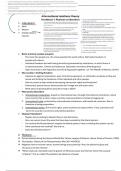
Hoofdstuk 1: Realism vs liberalism
1. Liberalism
➢ Kant:
➢ Wilson:
➢ United nations
charter:
➢ Basic premise: people are good
- The more free people are, the more peaceful the world will be. Self-determination of
people and nations.
- Individual freedom and well-being should be guaranteed by institutions, in which there is
no absolute power. Checks and balances. Separation of powers (Montesquieu)
- Open economy is self-regulatory and will bring people together. (cf. The Wealth of Nations, Smith)
➢ War society = limiting freedom
- Liberals are against imperialism, wars of territory expansion, or militaristic societies as they are
unjust and limiting the freedoms of the individual and other people.
- How to protect a state without decreasing democratic rights and freedoms?
- Democratic peace theory: democracies don’t wage war with each other.
- What about imposing democracy like in Iraq in 2003?
➢ Main points liberalism
1. International cooperation, based on international law, through international institutions, where
every country has a voice, make countries resolve problems instead of waging war.
2. International trade, protected by internationals institutions, will benefit all countries. War is
therefore a losing proposition.
3. International norms, like human rights, push countries to respect them. If not, sanctions will
harm the country’s economic and political position.
➢ Utopian? Idealistic?
- Maybe, but according to liberals there is not alternative.
- Also, we cannot count the wars that have been avoided by the liberal system.
- If a country like Russia doesn’t respect the liberal system, there is nothing the system can do.
- Have sanctions ever worked? Yes and no.
- Does the UN need reform?
2. Realism
❖ School started during the Second World War: failure League of Nations, failure Treaty of Munich (1938)
❖ Thucidydes: History of the Peloponnesian War (431-404 BCE)
❖ Negative view on human nature: human beings are pushed by “fear, the desire for glory and
the pursuit of self-interest”
❖ “What made war inevitable was the growth of Athenian power and the fear which this caused
in Sparta.” The so-called Thucydides trap. Balance of power
, ➢ Hobbes’ leviathan
- State of Nature is a state of anarchy, “a war as is of every man against every man.”
- “every man ought to endeavour peace, as far as he has hope of obtaining it; and when and
when he cannot obtain it, that he may seek, and use, all helps, and advantages of war.”
- On state level a Leviathan, or absolute, centralized power is needed to stop the anarchy.
As this does not exist on the international level, anarchy and self-interest is what we have
to deal with.
➢ Realistis see
- International relations mainly as a struggle of self-interested, sovereign states that are
involved in a game of power-politics within a permanent state of anarchy.
- There is no effective international governance. Therefore only balance of power, with
deterrence, is the way to peace. Human nature remains the same.
- International relations is not about morals or values, but a rational zero-sum game between states.
Difference between - What individuals do, doesn’t really matter. The state is what matters in international relations.
spring and ➢ Most States are rational most of the time
revolutions(/revolt) =>
- They argue against the psychological arguments (following Kahneman and Sversky) that political
spring fails in the end,
leaders, just like everyone, have biases and think with short-cuts.
revolutions succeed;
- According to Mearsheimer and Rosato war decisions are made with many stakeholders, which
revolution has a goal to
change the system, revolt excludes the biases of one person.
want to change things in- We have to focus on the process, not the result. It’s not because a decision resulted
in defeat that the process was non-rational. onrust te sussen door beloften te
the society without the
doen en concessies aan te bieden,
intention to change the maar deze werden als ontoereikend
system beschouwd door de demonstranten
Hoofdstuk 2: Revolutions
Tunisia, 17 December 2010
➔ Mohamed Bouazizi sets himself on fire after his vegetable cart had been confiscated by
the police
➔ People start protesting (tegen werkloosheid, corruptie en repressie in Tunesië)
➔ As-shab yurid eskat an-nizam : the people want the regime to go
➔ 14 January 2011: President Ben Ali flees the country .
April 6 Movement
➔ Started in 2008 by Ahmed Maher, Mohammed Adel, Ahmed Douma
➔ Adel followed some classes organized by Otpor!, the organisation that ousted Milosevic in 2000.
➔ They wanted to start protests during the planned presidential campaign in 2012, when
Hosni Mubarak’s son would run in his father’s place
➔ After the Tunisian success, they moved the protests to 25 January, Egypt’s day of the police.
11 February 2011: Hosni Mubarak treedt af/resigns
➔ Thousands of protesters gathered in Tahrir Square, with demands including::
• End of corruption + Resignation of Mubarak + Free elections and democratic reforms
•
➔ The regime tried to suppress the protests with violence, but the pressure became too great
when parts of the army and the international community also turned against Mubarak
28 februari 2011: Transition period and chaos
• After Mubarak's resignation, Egypt was ruled by the Supreme Council of the Armed Forces (SCAF).
Dit zou de voortzetting van een autoritair bewind inspireerden soortgelijke opstanden in andere Arabische
betekenen. landen, een beweging die bekend werd als de "Arabische
De beweging was sterk anti-corruptie en pro- Lente". Landen zoals Egypte, Libië en Syrië zagen massale
democratie. protesten tegen autoritaire regimes
, Many Egyptians hoped for a smooth transition to democracy, but instead::
•
o The military continued to retain much power.
leger belooft
macht over te o Protests continued to be violently suppressed.
dragen aan o Political instability arose, with rival groups fighting for influence.
democratisch And now?
gekozen ➔ The military takes over Marshal Tantawi becomes interim-president
president. eerste vrije verkiezingen voor parlement sinds
➔ Elections for Parliament in December 2011
Mohamed decennia w gehouden.
Morsi ➔ Elections for President scheduled in April 2012
Moslimbroederschap, via de partij Vrijheid en
(Moslimbroeders ➔ 30 June 2012 should be end of interim period, maar Gerechtigheid, wint een meerderheid vd zetels.
chap) en Ahmed o Het leger blijft een sterke invloed behouden. Ook Salafistische partij Al-Nour behaalt veel
Shafik (ex- o economie en veiligheidssituatie = instabiel.
stemmen, wat laat zien dat islamistische partijen
premier onder populair zijn.
Mubarak) zijn de o spanningen tssn islamisten en seculiere groeperingen
belangrijkste Bloody incidents between army and protesters
kandidaten. ➔ Maspero Massacre: October 2011
– Coptic Christians protested at the Maspero building (state media center in Cairo) against
the destruction of a church in Aswan
– Egyptian army opened fire on the protesters and used armored vehicles to literally run
people over.
– State media spread false reports that the Christians attacked the police, which further
escalated the situation.
➔ Mohammed Mahmoud Street: November 2011
– Heavy clashes between protesters and security forces on Mohammed Mahmoud Street, near
Tahrir Square in Cairo
– Protests were against SCAF, which took power after Mubarak’s resignation.
➔ Port Said Football Massacre: February 2012
– Disastrous football riots after a match between Al-Masry and Al-Ahly in Port Said.
– After the match, Al-Masry supporters stormed the pitch and attacked Al-Ahly fans with
knives, sticks and fireworks.
Elections Tunisia: 23 October 2011
➔ eerste vrije verkiezingen na de val van president Ben Ali
➔ Tunesië koos een Constituent Assembly ,
Egyptian elections: 28/11/2011 – 11/01/2012
➔ Na de val van Hosni Mubarak in februari 2011 werden tussen 28 november 2011 en 11
januari 2012 de eerste vrije parlementsverkiezingen in Egypte gehouden
Libya – Bahrain – Morocco – Jordan – Syria
➔ Morocco – Jordan: two Kingdoms, with a King that is a descendant from the Prophet.
Reforms. Moderate revolutions.
➔ Bahrain: invasion of Saudi Arabia to stop it
– – protests in Bahrain, led by the Shiite majority against the Sunni monarchy of King
Hamad bin Isa Al Khalifa
– Bahraini government asked for help from GCC
➔ Libya – Syria: 2 most brutal regimes of the Arab world turn into violence (more in other week)
– Protests started in Benghazi against Muammar Gaddafi's regime,
Libië – The regime responded with extreme violence, and the conflict escalated into a civil war
– Gaddafi was captured and killed by rebels in Sirte.
– After his death, Libya fell into chaos and rival militias
– Protests began in Daraa, where youths were arrested and tortured for anti-regime graffiti.
Syrië
Hoofdstuk 1: Realism vs liberalism
1. Liberalism
➢ Kant:
➢ Wilson:
➢ United nations
charter:
➢ Basic premise: people are good
- The more free people are, the more peaceful the world will be. Self-determination of
people and nations.
- Individual freedom and well-being should be guaranteed by institutions, in which there is
no absolute power. Checks and balances. Separation of powers (Montesquieu)
- Open economy is self-regulatory and will bring people together. (cf. The Wealth of Nations, Smith)
➢ War society = limiting freedom
- Liberals are against imperialism, wars of territory expansion, or militaristic societies as they are
unjust and limiting the freedoms of the individual and other people.
- How to protect a state without decreasing democratic rights and freedoms?
- Democratic peace theory: democracies don’t wage war with each other.
- What about imposing democracy like in Iraq in 2003?
➢ Main points liberalism
1. International cooperation, based on international law, through international institutions, where
every country has a voice, make countries resolve problems instead of waging war.
2. International trade, protected by internationals institutions, will benefit all countries. War is
therefore a losing proposition.
3. International norms, like human rights, push countries to respect them. If not, sanctions will
harm the country’s economic and political position.
➢ Utopian? Idealistic?
- Maybe, but according to liberals there is not alternative.
- Also, we cannot count the wars that have been avoided by the liberal system.
- If a country like Russia doesn’t respect the liberal system, there is nothing the system can do.
- Have sanctions ever worked? Yes and no.
- Does the UN need reform?
2. Realism
❖ School started during the Second World War: failure League of Nations, failure Treaty of Munich (1938)
❖ Thucidydes: History of the Peloponnesian War (431-404 BCE)
❖ Negative view on human nature: human beings are pushed by “fear, the desire for glory and
the pursuit of self-interest”
❖ “What made war inevitable was the growth of Athenian power and the fear which this caused
in Sparta.” The so-called Thucydides trap. Balance of power
, ➢ Hobbes’ leviathan
- State of Nature is a state of anarchy, “a war as is of every man against every man.”
- “every man ought to endeavour peace, as far as he has hope of obtaining it; and when and
when he cannot obtain it, that he may seek, and use, all helps, and advantages of war.”
- On state level a Leviathan, or absolute, centralized power is needed to stop the anarchy.
As this does not exist on the international level, anarchy and self-interest is what we have
to deal with.
➢ Realistis see
- International relations mainly as a struggle of self-interested, sovereign states that are
involved in a game of power-politics within a permanent state of anarchy.
- There is no effective international governance. Therefore only balance of power, with
deterrence, is the way to peace. Human nature remains the same.
- International relations is not about morals or values, but a rational zero-sum game between states.
Difference between - What individuals do, doesn’t really matter. The state is what matters in international relations.
spring and ➢ Most States are rational most of the time
revolutions(/revolt) =>
- They argue against the psychological arguments (following Kahneman and Sversky) that political
spring fails in the end,
leaders, just like everyone, have biases and think with short-cuts.
revolutions succeed;
- According to Mearsheimer and Rosato war decisions are made with many stakeholders, which
revolution has a goal to
change the system, revolt excludes the biases of one person.
want to change things in- We have to focus on the process, not the result. It’s not because a decision resulted
in defeat that the process was non-rational. onrust te sussen door beloften te
the society without the
doen en concessies aan te bieden,
intention to change the maar deze werden als ontoereikend
system beschouwd door de demonstranten
Hoofdstuk 2: Revolutions
Tunisia, 17 December 2010
➔ Mohamed Bouazizi sets himself on fire after his vegetable cart had been confiscated by
the police
➔ People start protesting (tegen werkloosheid, corruptie en repressie in Tunesië)
➔ As-shab yurid eskat an-nizam : the people want the regime to go
➔ 14 January 2011: President Ben Ali flees the country .
April 6 Movement
➔ Started in 2008 by Ahmed Maher, Mohammed Adel, Ahmed Douma
➔ Adel followed some classes organized by Otpor!, the organisation that ousted Milosevic in 2000.
➔ They wanted to start protests during the planned presidential campaign in 2012, when
Hosni Mubarak’s son would run in his father’s place
➔ After the Tunisian success, they moved the protests to 25 January, Egypt’s day of the police.
11 February 2011: Hosni Mubarak treedt af/resigns
➔ Thousands of protesters gathered in Tahrir Square, with demands including::
• End of corruption + Resignation of Mubarak + Free elections and democratic reforms
•
➔ The regime tried to suppress the protests with violence, but the pressure became too great
when parts of the army and the international community also turned against Mubarak
28 februari 2011: Transition period and chaos
• After Mubarak's resignation, Egypt was ruled by the Supreme Council of the Armed Forces (SCAF).
Dit zou de voortzetting van een autoritair bewind inspireerden soortgelijke opstanden in andere Arabische
betekenen. landen, een beweging die bekend werd als de "Arabische
De beweging was sterk anti-corruptie en pro- Lente". Landen zoals Egypte, Libië en Syrië zagen massale
democratie. protesten tegen autoritaire regimes
, Many Egyptians hoped for a smooth transition to democracy, but instead::
•
o The military continued to retain much power.
leger belooft
macht over te o Protests continued to be violently suppressed.
dragen aan o Political instability arose, with rival groups fighting for influence.
democratisch And now?
gekozen ➔ The military takes over Marshal Tantawi becomes interim-president
president. eerste vrije verkiezingen voor parlement sinds
➔ Elections for Parliament in December 2011
Mohamed decennia w gehouden.
Morsi ➔ Elections for President scheduled in April 2012
Moslimbroederschap, via de partij Vrijheid en
(Moslimbroeders ➔ 30 June 2012 should be end of interim period, maar Gerechtigheid, wint een meerderheid vd zetels.
chap) en Ahmed o Het leger blijft een sterke invloed behouden. Ook Salafistische partij Al-Nour behaalt veel
Shafik (ex- o economie en veiligheidssituatie = instabiel.
stemmen, wat laat zien dat islamistische partijen
premier onder populair zijn.
Mubarak) zijn de o spanningen tssn islamisten en seculiere groeperingen
belangrijkste Bloody incidents between army and protesters
kandidaten. ➔ Maspero Massacre: October 2011
– Coptic Christians protested at the Maspero building (state media center in Cairo) against
the destruction of a church in Aswan
– Egyptian army opened fire on the protesters and used armored vehicles to literally run
people over.
– State media spread false reports that the Christians attacked the police, which further
escalated the situation.
➔ Mohammed Mahmoud Street: November 2011
– Heavy clashes between protesters and security forces on Mohammed Mahmoud Street, near
Tahrir Square in Cairo
– Protests were against SCAF, which took power after Mubarak’s resignation.
➔ Port Said Football Massacre: February 2012
– Disastrous football riots after a match between Al-Masry and Al-Ahly in Port Said.
– After the match, Al-Masry supporters stormed the pitch and attacked Al-Ahly fans with
knives, sticks and fireworks.
Elections Tunisia: 23 October 2011
➔ eerste vrije verkiezingen na de val van president Ben Ali
➔ Tunesië koos een Constituent Assembly ,
Egyptian elections: 28/11/2011 – 11/01/2012
➔ Na de val van Hosni Mubarak in februari 2011 werden tussen 28 november 2011 en 11
januari 2012 de eerste vrije parlementsverkiezingen in Egypte gehouden
Libya – Bahrain – Morocco – Jordan – Syria
➔ Morocco – Jordan: two Kingdoms, with a King that is a descendant from the Prophet.
Reforms. Moderate revolutions.
➔ Bahrain: invasion of Saudi Arabia to stop it
– – protests in Bahrain, led by the Shiite majority against the Sunni monarchy of King
Hamad bin Isa Al Khalifa
– Bahraini government asked for help from GCC
➔ Libya – Syria: 2 most brutal regimes of the Arab world turn into violence (more in other week)
– Protests started in Benghazi against Muammar Gaddafi's regime,
Libië – The regime responded with extreme violence, and the conflict escalated into a civil war
– Gaddafi was captured and killed by rebels in Sirte.
– After his death, Libya fell into chaos and rival militias
– Protests began in Daraa, where youths were arrested and tortured for anti-regime graffiti.
Syrië