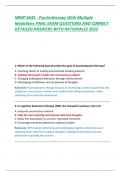
NRNP 6645 Psychotherapy With
Multiple Modalities Midterm Exam 2
Questions And Correct Answers
(Verified Answers) Plus Rationales 2025
1. Which of the following best describes the core focus of psychodynamic
psychotherapy?
A. Challenging distorted thoughts
B. Identifying problematic behaviors
C. Exploring unconscious conflicts
D. Practicing mindfulness skills
Exploring unconscious conflicts is central to psychodynamic psychotherapy,
which emphasizes internal psychological processes, especially those
stemming from childhood.
2. In cognitive behavioral therapy (CBT), automatic thoughts are:
A. Long-term unconscious patterns
B. Immediate, reflexive thoughts in response to a situation
,C. Developed during early attachment stages
D. Only applicable in mood disorders
Automatic thoughts are the quick, habitual responses individuals have in
reaction to events, often influenced by core beliefs and schemas.
3. Which of the following therapies is most focused on the client’s
experience in the present moment?
A. Psychodynamic therapy
B. Rational emotive behavior therapy
C. Gestalt therapy
D. Behavioral activation
Gestalt therapy emphasizes awareness, experience, and feelings in the
here-and-now, rather than past events.
4. Which therapy primarily utilizes exposure techniques to treat phobias?
A. Humanistic therapy
B. Behavioral therapy
C. Interpersonal therapy
D. Supportive therapy
Behavioral therapy uses systematic desensitization and exposure
techniques to help clients reduce avoidance and anxiety responses.
5. The goal of motivational interviewing is to:
A. Solve the client’s ambivalence for them
B. Persuade the client to change
C. Explore resistance
,D. Strengthen personal motivation for change
Motivational interviewing is a client-centered approach to increase
motivation and commitment by resolving ambivalence.
6. Dialectical behavior therapy (DBT) was initially developed for which
condition?
A. Major depressive disorder
B. Borderline personality disorder
C. Panic disorder
D. PTSD
DBT was created by Marsha Linehan to address emotion dysregulation and
impulsive behaviors seen in borderline personality disorder.
7. Which of the following is NOT one of the core components of CBT?
A. Identifying cognitive distortions
B. Behavioral activation
C. Developing insight into unconscious conflict
D. Cognitive restructuring
Insight into unconscious conflict is a focus of psychodynamic, not cognitive
behavioral, therapy.
8. In psychodynamic therapy, transference refers to:
A. A therapist projecting onto the client
B. A client projecting feelings from past relationships onto the therapist
C. Avoidance of therapy
D. Disruption in the therapeutic alliance
, Transference occurs when clients unconsciously transfer emotions from
important figures in their life onto the therapist.
9. Which therapeutic approach focuses on modifying core beliefs or
schemas?
A. Person-centered therapy
B. Cognitive behavioral therapy
C. Narrative therapy
D. Psychoanalysis
CBT helps clients identify, challenge, and change maladaptive core beliefs
that influence thoughts and behaviors.
10. What is the primary mechanism of change in humanistic therapy?
A. Behavioral modification
B. Unconditional positive regard
C. Insight into unconscious processes
D. Thought tracking
Humanistic therapy emphasizes empathy, authenticity, and unconditional
positive regard as vehicles for client growth.
11. Which modality emphasizes the use of validation and mindfulness
strategies?
A. EMDR
B. DBT
C. REBT
Multiple Modalities Midterm Exam 2
Questions And Correct Answers
(Verified Answers) Plus Rationales 2025
1. Which of the following best describes the core focus of psychodynamic
psychotherapy?
A. Challenging distorted thoughts
B. Identifying problematic behaviors
C. Exploring unconscious conflicts
D. Practicing mindfulness skills
Exploring unconscious conflicts is central to psychodynamic psychotherapy,
which emphasizes internal psychological processes, especially those
stemming from childhood.
2. In cognitive behavioral therapy (CBT), automatic thoughts are:
A. Long-term unconscious patterns
B. Immediate, reflexive thoughts in response to a situation
,C. Developed during early attachment stages
D. Only applicable in mood disorders
Automatic thoughts are the quick, habitual responses individuals have in
reaction to events, often influenced by core beliefs and schemas.
3. Which of the following therapies is most focused on the client’s
experience in the present moment?
A. Psychodynamic therapy
B. Rational emotive behavior therapy
C. Gestalt therapy
D. Behavioral activation
Gestalt therapy emphasizes awareness, experience, and feelings in the
here-and-now, rather than past events.
4. Which therapy primarily utilizes exposure techniques to treat phobias?
A. Humanistic therapy
B. Behavioral therapy
C. Interpersonal therapy
D. Supportive therapy
Behavioral therapy uses systematic desensitization and exposure
techniques to help clients reduce avoidance and anxiety responses.
5. The goal of motivational interviewing is to:
A. Solve the client’s ambivalence for them
B. Persuade the client to change
C. Explore resistance
,D. Strengthen personal motivation for change
Motivational interviewing is a client-centered approach to increase
motivation and commitment by resolving ambivalence.
6. Dialectical behavior therapy (DBT) was initially developed for which
condition?
A. Major depressive disorder
B. Borderline personality disorder
C. Panic disorder
D. PTSD
DBT was created by Marsha Linehan to address emotion dysregulation and
impulsive behaviors seen in borderline personality disorder.
7. Which of the following is NOT one of the core components of CBT?
A. Identifying cognitive distortions
B. Behavioral activation
C. Developing insight into unconscious conflict
D. Cognitive restructuring
Insight into unconscious conflict is a focus of psychodynamic, not cognitive
behavioral, therapy.
8. In psychodynamic therapy, transference refers to:
A. A therapist projecting onto the client
B. A client projecting feelings from past relationships onto the therapist
C. Avoidance of therapy
D. Disruption in the therapeutic alliance
, Transference occurs when clients unconsciously transfer emotions from
important figures in their life onto the therapist.
9. Which therapeutic approach focuses on modifying core beliefs or
schemas?
A. Person-centered therapy
B. Cognitive behavioral therapy
C. Narrative therapy
D. Psychoanalysis
CBT helps clients identify, challenge, and change maladaptive core beliefs
that influence thoughts and behaviors.
10. What is the primary mechanism of change in humanistic therapy?
A. Behavioral modification
B. Unconditional positive regard
C. Insight into unconscious processes
D. Thought tracking
Humanistic therapy emphasizes empathy, authenticity, and unconditional
positive regard as vehicles for client growth.
11. Which modality emphasizes the use of validation and mindfulness
strategies?
A. EMDR
B. DBT
C. REBT