Elizabeth I Foreign Affairs
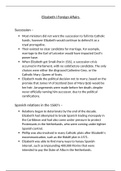
Succession –
Most ministers did not want the succession to fall into Catholic
hands, however Elizabeth would continue to defend it as a
royal prerogative.
Their existed no clear candidate for marriage. For example,
marriage to the Earl of Leicester would have impacted Cecil’s
power base.
When Elizabeth got Small-Pox in 1562, a succession crisis
occurred in Parliament, with no satisfactory candidate. The only
choices were either the disgraced Catherine Grey, or the
Catholic Mary, Queen of Scots.
Elizabeth made the political decision not to marry, based on the
premise that James VI of Scotland (Son of Mary QoS) would be
her heir. Arrangements were made before her death, despite
never officially naming him successor, due to the political
ramifications.
Spanish relations in the 1560’s –
Relations began to deteriorate by the end of the decade.
Elizabeth had attempted to break Spanish trading monopoly in
the Caribbean and had also come under pressure to protect
Protestants in the Netherlands, who were coming under tighter
Spanish control.
Phillip was also involved in many Catholic plots after Elizabeth’s
excommunication, such as the Ridolfi plot in 1571.
Elizabeth was able to find many ways to harass Spanish
interest, such as impounding 400,000 Florins that were
intended to pay the Duke of Alba in the Netherlands.
Succession –
Most ministers did not want the succession to fall into Catholic
hands, however Elizabeth would continue to defend it as a
royal prerogative.
Their existed no clear candidate for marriage. For example,
marriage to the Earl of Leicester would have impacted Cecil’s
power base.
When Elizabeth got Small-Pox in 1562, a succession crisis
occurred in Parliament, with no satisfactory candidate. The only
choices were either the disgraced Catherine Grey, or the
Catholic Mary, Queen of Scots.
Elizabeth made the political decision not to marry, based on the
premise that James VI of Scotland (Son of Mary QoS) would be
her heir. Arrangements were made before her death, despite
never officially naming him successor, due to the political
ramifications.
Spanish relations in the 1560’s –
Relations began to deteriorate by the end of the decade.
Elizabeth had attempted to break Spanish trading monopoly in
the Caribbean and had also come under pressure to protect
Protestants in the Netherlands, who were coming under tighter
Spanish control.
Phillip was also involved in many Catholic plots after Elizabeth’s
excommunication, such as the Ridolfi plot in 1571.
Elizabeth was able to find many ways to harass Spanish
interest, such as impounding 400,000 Florins that were
intended to pay the Duke of Alba in the Netherlands.