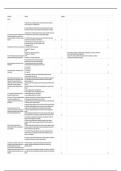
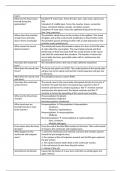
QUESTION OPTIONS ANSWER
Lecture 1:
A. Adolescents have fully developed cognitive control systems but are less emotionally
sensitive, leading them to underestimate risks.
B. The rapid development of the limbic system increases emotional sensitivity, while the
prefrontal cortex, matures more slowly that leads to increased impulsivity and risk-taking.
C. Adolescents have a slower development of the limbic system, making them less aware of
In the context of the Dual Process Models, which of emotional stimuli, which reduces their ability to recognize potential dangers.
the following best explains why adolescents are
more likely to engage in risky behaviors compared D. The cognitive control systems in adolescents are more advanced than those in adults,
to adults? allowing them to take calculated risks more effectively. B B B
A: Grey matter tends to thin, white matter increases in volume.
B: White matter tends to thin, grey matter increases in volume.
C: synapses grow by 40%
What happens to the brain structure in adolecents? D: grey matter and white matter increases A A
A: increase in TPJ, decrease in
dmPFC
B: increase in TPJ, decrease in parietal cortex - both increases and decreases in prefrontal activation during adolescence; increases in parietal cortex
C: decrease in TPJ, increase in - Peak in subcortical processing in mid-adolescence.
Which of the following functional brain changes are dmPFC - increase in TPJ, decrease in dmPFC (anterior-posterior shift) from adolescence to adulthood.
associated with adolencent brain development? D: decrease in TPJ, decrease in parietal cortex A - increased response to acceptance and rejection. --
A: Female are better at face memory and face perception
B: Males are better at face memory and face perception
what is true about gender, face memory and face C: Females are better at face memory but not perception
identification? D: Females are better at face perceptrion but not face memory C D
A: 8 -12 year olds
B: 22-32 year olds
In the general population, what age group is the C: 12-16 year olds
most trusting? D: 68+ year olds B B
A: Increased activity in the visual cortex was observed when participants received
incongruent feedback about body size.
What was found by Van der Meulen et al, 2017 B: Increased activity in the dorsal medial prefrontal cortex (dmPFC)/anterior cingulate cortex
examining the effects of media imagery and peer (ACC) and bilateral insula was observed when participants encountered incongruent
feedback on body image perceptions in late feedback about body size.
adolescent girls, what was a significant finding C:Decreased activity in the amygdala was noted when participants rated models' body sizes
related to brain activity when participants as normal.
encountered incongruent feedback about body D:No significant changes in brain activity were noted regardless of the congruence of peer
size? feedback. B B
A: exclusuon triggers anxiety in young addolecents
B: exclusion triggers anziety in young addolecents and adults
In a social exclusion experiment, what were the C: exlusion trggers anxiety most in mid adolecents
age related findings abour anxiety? D: exclusion triggers anxiety least in young adults A --
In Rodman’s (2017) study on self-protective biases A: Adolescents boost their self-views, while adults experience a drop in self-views.
in response to social feedback, how do B: Both adolescents and adults experience a drop in self-views.
adolescents and adults differ in their reactions to C: Adolescents' self-views drop, while adults boost their self-views and criticize the rejecters.
peer rejection? D: Neither group shows a change in self-views. C C
A: Adolescents showed increased activity in the visual cortex when witnessing peer rejection.
B: Adolescents displayed heightened activity in the anterior insula and subgenual anterior
In the study by Masten et al. (2013) on cingulate cortex when witnessing peer rejection after experiencing social exclusion.
adolescents’ neural responses to witnessing peer C: Adolescents showed decreased activity in the prefrontal cortex when witnessing peer
rejection after being socially excluded, what were rejection.
the key findings regarding brain activity? D: Adolescents displayed decreased activity in the anterior insula and increases subgenual
anterior cingulate cortex when witnessing peer rejection after experiencing social exclusion. B
A: All age groups, including children, early adolescents, and young adults, maintain their
impressions of peers regardless of peer feedback.
B: Children and early adolescents tend to update their impressions of peers based on
acceptance or rejection, whereas young adults maintain their impressions regardless of
feedback.
which of the following best describes the C: Children and early adolescents maintain their impressions of peers regardless of whether
differences between children, early adolescents, they receive acceptance or rejection feedback, while young adults adjust their impressions
and young adults? based on whether peers accept or reject them. C C
A: Only friendships formed in late adolescence (ages 16-18) were significantly linked to
resilient functioning in young adulthood, while early adolescent friendships (ages 12-15)
showed no such relationship.
B: Adolescents with higher quality friendships showed no significant difference in resilience in
young adulthood compared to those with lower quality friendships.
In the study by van Harmelen et al. (2017), which C: Resilient functioning in young adulthood was predominantly influenced by family
examined the impact of adolescent friendships on relationships, and adolescent friendships had minimal impact on resilience across
later resilient functioning across various psychosocial domains.
psychosocial domains, what specific findings were
reported about the relationship between the quality D: The study found that high-quality adolescent friendships were significantly associated with
of adolescent friendships and resilience in young better resilient functioning in young adulthood, particularly in emotional, social, and academic
adulthood? domains. D D
, Lecture 2:
A) To focus on changing negative thought patterns through cognitive restructuring.
B) To identify and reduce maladaptive behaviors that maintain depression.
What is the primary goal of Behavioral Activation C) To encourage patients to increase engagement in activities that are positively reinforcing.
(BA) in the treatment of depression according to
Veale (2008)? D) To provide medication to balance neurotransmitter levels. C C
A: the goal is to attend but not act on emotions
B: it works though suppression of negative memories
C: as effective as CBT
what is NOT true about mindfullness? D: most effective for anxiety and depression B B
A) The role of irrational thoughts and beliefs in maintaining depressive symptoms.
B) The significance of early childhood experiences and unconscious conflicts.
According to Veale (2008), what does the C) The influence of environmental factors and the consequences of one’s actions.
Behavioral Activation model emphasize in the
treatment of depression? D) The necessity of exploring and resolving past traumatic experiences. C C
A: it is used alone or in combination with CBT
B: it can be delivered by non-mental health specialists
What is NOT true about behavioural activation C: It is most effective for children
therapy? D: it is most effective for severe depression C C
A) It involves focusing on specific negative events in great detail, leading to heightened
feelings of sadness and despair.
B) It is characterized by the tendency to recall personal memories in a vague, non-specific
manner, especially negative experiences.
C) It refers to the habitual generation of overly optimistic memories to compensate for present
depressive feelings.
Which of the following best describes the concept
of “over-general memory” as a symptom of D) It is the process of frequently revisiting traumatic childhood memories with clear and
depression? detailed recollection. B B
A) CT involves medication to balance neurotransmitters, which indirectly changes
dysfunctional cognitions.
B) CT focuses on exploring past experiences to understand the origins of dysfunctional
cognitions.
C) CT helps patients identify and challenge dysfunctional cognitions, replacing them with
In the context of Cognitive Therapy (CT), which of more functional ones to alter emotions and behaviors.
the following best describes the process used to
address dysfunctional cognitions and their role in D) CT emphasizes avoiding negative thoughts through distraction techniques to prevent them
depression? from affecting emotions and behaviors. C C
1: BA + cognitive restructuring is as effective as BA
alone
2: CBT with only cognitive restructuring is slightly less
effective than CBT with more components
A: Both 1 and 2 are true
B: Both 1 and 2 are false
C: 1 is true, 2 is false
True or false D: 1 is false, 2 is true A A??
Lecture 3:
A: Mindfullness
Which of the following interventions for criminal B: Emotional
behaviour are NOT mentioned in the article by Ling C: Transcranial magnetic stimulation
et al., 2019 ? D: EMDR D D
A: Accidental
Which form of agression is it if you are really angry, B: Expressive
so you punch a wall and that feels good to let the C: Instrumental
anger out? D: Hostile B B
A: Primary (low anxious & impulsive); Secondary (high anxious & predatory)
B: Primary (low anxious & predatory); Secondary (high anxious & impulsive)
which of the following combines the correct C: Primary (high anxious & predatory); Secondary (low anxious & impulsive)
termanology for psychopaths? D: Primary (high anxious & impulsive); Secondary (low anxious & predatory) B B
A: 5%
B: 12%
what is the percentage criminally offending C: 26%
population has ADHD? D: 34% C C
A: 15%
B: 20%
what is the percentage criminally offending C: 30%
population has an aquired brain injury? D: 50% D D
Lecture 1:
A. Adolescents have fully developed cognitive control systems but are less emotionally
sensitive, leading them to underestimate risks.
B. The rapid development of the limbic system increases emotional sensitivity, while the
prefrontal cortex, matures more slowly that leads to increased impulsivity and risk-taking.
C. Adolescents have a slower development of the limbic system, making them less aware of
In the context of the Dual Process Models, which of emotional stimuli, which reduces their ability to recognize potential dangers.
the following best explains why adolescents are
more likely to engage in risky behaviors compared D. The cognitive control systems in adolescents are more advanced than those in adults,
to adults? allowing them to take calculated risks more effectively. B B B
A: Grey matter tends to thin, white matter increases in volume.
B: White matter tends to thin, grey matter increases in volume.
C: synapses grow by 40%
What happens to the brain structure in adolecents? D: grey matter and white matter increases A A
A: increase in TPJ, decrease in
dmPFC
B: increase in TPJ, decrease in parietal cortex - both increases and decreases in prefrontal activation during adolescence; increases in parietal cortex
C: decrease in TPJ, increase in - Peak in subcortical processing in mid-adolescence.
Which of the following functional brain changes are dmPFC - increase in TPJ, decrease in dmPFC (anterior-posterior shift) from adolescence to adulthood.
associated with adolencent brain development? D: decrease in TPJ, decrease in parietal cortex A - increased response to acceptance and rejection. --
A: Female are better at face memory and face perception
B: Males are better at face memory and face perception
what is true about gender, face memory and face C: Females are better at face memory but not perception
identification? D: Females are better at face perceptrion but not face memory C D
A: 8 -12 year olds
B: 22-32 year olds
In the general population, what age group is the C: 12-16 year olds
most trusting? D: 68+ year olds B B
A: Increased activity in the visual cortex was observed when participants received
incongruent feedback about body size.
What was found by Van der Meulen et al, 2017 B: Increased activity in the dorsal medial prefrontal cortex (dmPFC)/anterior cingulate cortex
examining the effects of media imagery and peer (ACC) and bilateral insula was observed when participants encountered incongruent
feedback on body image perceptions in late feedback about body size.
adolescent girls, what was a significant finding C:Decreased activity in the amygdala was noted when participants rated models' body sizes
related to brain activity when participants as normal.
encountered incongruent feedback about body D:No significant changes in brain activity were noted regardless of the congruence of peer
size? feedback. B B
A: exclusuon triggers anxiety in young addolecents
B: exclusion triggers anziety in young addolecents and adults
In a social exclusion experiment, what were the C: exlusion trggers anxiety most in mid adolecents
age related findings abour anxiety? D: exclusion triggers anxiety least in young adults A --
In Rodman’s (2017) study on self-protective biases A: Adolescents boost their self-views, while adults experience a drop in self-views.
in response to social feedback, how do B: Both adolescents and adults experience a drop in self-views.
adolescents and adults differ in their reactions to C: Adolescents' self-views drop, while adults boost their self-views and criticize the rejecters.
peer rejection? D: Neither group shows a change in self-views. C C
A: Adolescents showed increased activity in the visual cortex when witnessing peer rejection.
B: Adolescents displayed heightened activity in the anterior insula and subgenual anterior
In the study by Masten et al. (2013) on cingulate cortex when witnessing peer rejection after experiencing social exclusion.
adolescents’ neural responses to witnessing peer C: Adolescents showed decreased activity in the prefrontal cortex when witnessing peer
rejection after being socially excluded, what were rejection.
the key findings regarding brain activity? D: Adolescents displayed decreased activity in the anterior insula and increases subgenual
anterior cingulate cortex when witnessing peer rejection after experiencing social exclusion. B
A: All age groups, including children, early adolescents, and young adults, maintain their
impressions of peers regardless of peer feedback.
B: Children and early adolescents tend to update their impressions of peers based on
acceptance or rejection, whereas young adults maintain their impressions regardless of
feedback.
which of the following best describes the C: Children and early adolescents maintain their impressions of peers regardless of whether
differences between children, early adolescents, they receive acceptance or rejection feedback, while young adults adjust their impressions
and young adults? based on whether peers accept or reject them. C C
A: Only friendships formed in late adolescence (ages 16-18) were significantly linked to
resilient functioning in young adulthood, while early adolescent friendships (ages 12-15)
showed no such relationship.
B: Adolescents with higher quality friendships showed no significant difference in resilience in
young adulthood compared to those with lower quality friendships.
In the study by van Harmelen et al. (2017), which C: Resilient functioning in young adulthood was predominantly influenced by family
examined the impact of adolescent friendships on relationships, and adolescent friendships had minimal impact on resilience across
later resilient functioning across various psychosocial domains.
psychosocial domains, what specific findings were
reported about the relationship between the quality D: The study found that high-quality adolescent friendships were significantly associated with
of adolescent friendships and resilience in young better resilient functioning in young adulthood, particularly in emotional, social, and academic
adulthood? domains. D D
, Lecture 2:
A) To focus on changing negative thought patterns through cognitive restructuring.
B) To identify and reduce maladaptive behaviors that maintain depression.
What is the primary goal of Behavioral Activation C) To encourage patients to increase engagement in activities that are positively reinforcing.
(BA) in the treatment of depression according to
Veale (2008)? D) To provide medication to balance neurotransmitter levels. C C
A: the goal is to attend but not act on emotions
B: it works though suppression of negative memories
C: as effective as CBT
what is NOT true about mindfullness? D: most effective for anxiety and depression B B
A) The role of irrational thoughts and beliefs in maintaining depressive symptoms.
B) The significance of early childhood experiences and unconscious conflicts.
According to Veale (2008), what does the C) The influence of environmental factors and the consequences of one’s actions.
Behavioral Activation model emphasize in the
treatment of depression? D) The necessity of exploring and resolving past traumatic experiences. C C
A: it is used alone or in combination with CBT
B: it can be delivered by non-mental health specialists
What is NOT true about behavioural activation C: It is most effective for children
therapy? D: it is most effective for severe depression C C
A) It involves focusing on specific negative events in great detail, leading to heightened
feelings of sadness and despair.
B) It is characterized by the tendency to recall personal memories in a vague, non-specific
manner, especially negative experiences.
C) It refers to the habitual generation of overly optimistic memories to compensate for present
depressive feelings.
Which of the following best describes the concept
of “over-general memory” as a symptom of D) It is the process of frequently revisiting traumatic childhood memories with clear and
depression? detailed recollection. B B
A) CT involves medication to balance neurotransmitters, which indirectly changes
dysfunctional cognitions.
B) CT focuses on exploring past experiences to understand the origins of dysfunctional
cognitions.
C) CT helps patients identify and challenge dysfunctional cognitions, replacing them with
In the context of Cognitive Therapy (CT), which of more functional ones to alter emotions and behaviors.
the following best describes the process used to
address dysfunctional cognitions and their role in D) CT emphasizes avoiding negative thoughts through distraction techniques to prevent them
depression? from affecting emotions and behaviors. C C
1: BA + cognitive restructuring is as effective as BA
alone
2: CBT with only cognitive restructuring is slightly less
effective than CBT with more components
A: Both 1 and 2 are true
B: Both 1 and 2 are false
C: 1 is true, 2 is false
True or false D: 1 is false, 2 is true A A??
Lecture 3:
A: Mindfullness
Which of the following interventions for criminal B: Emotional
behaviour are NOT mentioned in the article by Ling C: Transcranial magnetic stimulation
et al., 2019 ? D: EMDR D D
A: Accidental
Which form of agression is it if you are really angry, B: Expressive
so you punch a wall and that feels good to let the C: Instrumental
anger out? D: Hostile B B
A: Primary (low anxious & impulsive); Secondary (high anxious & predatory)
B: Primary (low anxious & predatory); Secondary (high anxious & impulsive)
which of the following combines the correct C: Primary (high anxious & predatory); Secondary (low anxious & impulsive)
termanology for psychopaths? D: Primary (high anxious & impulsive); Secondary (low anxious & predatory) B B
A: 5%
B: 12%
what is the percentage criminally offending C: 26%
population has ADHD? D: 34% C C
A: 15%
B: 20%
what is the percentage criminally offending C: 30%
population has an aquired brain injury? D: 50% D D