Critical Analysis of “Othello” by William Shakespeare
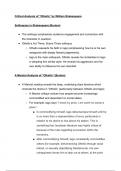
Soliloquies in Shakespeare (Bunten)
● The soliloquy emphasises audience engagement and connection with
the character in question.
● Othello’s Act Three, Scene Three soliloquy
○ Othello reasserts his faith in Iago (emphasising how he is his own
antagonist with deeply flawed judgements).
○ Iago is the main soliloquist- Othello reveals his similarities to Iago
in adopting this similar style. He reveals his aggression and his
own ability to influence his own downfall.
A Marxist Analysis of “Othello” (Bunten)
● A Marxist reading reveals the deep, underlying class tensions which
motivate the drama in “Othello” (particularly between Othello and Iago).
○ A Marxist critique notices how people become increasingly
commodified and dependent on social status.
○ For example, Iago says “I know my price, I am worth no worse a
place.”.
■ In commodifying himself, Iago dehumanises himself until he
is no more than a representation of envy, particularly in
relation to his desire to rise above his station. This is
something that Jacobean literature was highly critical of
because of the rules regarding succession within the
monarchy.
■ After commodifying himself, Iago consistently commodifies
others (for example, dehumanising Othello through racial
hatred, or sexually objectifying Desdemona). His own
unhappiness forces him to lash out at others, to the point
, that it may be interpreted that he is not a character in his
own right at all, but a personified version of the jealousy
and malice which rests within mankind. He is the
audience’s dark mirror.
● The value of “place” as social status is important- it is why Iago desires
the position of lieutenant (which he believes he deserves).
○ Iago is incredibly defensive regarding his status, bragging that he
has the support of “three great ones of the city”. This implies that
this is his weakness and sensitivity.
○ The men in the play (eg. Othello, Cassio, Iago) are all motivated
by a desire to improve, maintain, or reinstate their “place”,
something which is emphasised by the highly hierarchical setting
of an army base.
● Iago wishes to subvert the ranks of the army (which can be seen as a
representation for social classes) by replacing Cassio as lieutenant.
● Within the army context, the general/ensign relationship resembles that
of master/servant.
○ Iago is resentful of his position.
○ “We cannot all be masters, nor all masters / Cannot be truly
followed”- Iago, alluding to Othello
● The world of Venice and the army base in Cyprus is controlled by
money and power. Iago does not possess these tools himself, but finds
a way to manipulate others to do his work. This might have made him
somewhat sympathetic to a contemporary working class audience,
particularly in his treatment of the foolish Roderigo..
○ Iago has Roderigo’s purse “as if the strings were thine” (Roderigo,
to Iago).
■ Repetition of “Put money in thine purse” shows the
preoccupation with financial power. Money is synonymous
with influence.
Soliloquies in Shakespeare (Bunten)
● The soliloquy emphasises audience engagement and connection with
the character in question.
● Othello’s Act Three, Scene Three soliloquy
○ Othello reasserts his faith in Iago (emphasising how he is his own
antagonist with deeply flawed judgements).
○ Iago is the main soliloquist- Othello reveals his similarities to Iago
in adopting this similar style. He reveals his aggression and his
own ability to influence his own downfall.
A Marxist Analysis of “Othello” (Bunten)
● A Marxist reading reveals the deep, underlying class tensions which
motivate the drama in “Othello” (particularly between Othello and Iago).
○ A Marxist critique notices how people become increasingly
commodified and dependent on social status.
○ For example, Iago says “I know my price, I am worth no worse a
place.”.
■ In commodifying himself, Iago dehumanises himself until he
is no more than a representation of envy, particularly in
relation to his desire to rise above his station. This is
something that Jacobean literature was highly critical of
because of the rules regarding succession within the
monarchy.
■ After commodifying himself, Iago consistently commodifies
others (for example, dehumanising Othello through racial
hatred, or sexually objectifying Desdemona). His own
unhappiness forces him to lash out at others, to the point
, that it may be interpreted that he is not a character in his
own right at all, but a personified version of the jealousy
and malice which rests within mankind. He is the
audience’s dark mirror.
● The value of “place” as social status is important- it is why Iago desires
the position of lieutenant (which he believes he deserves).
○ Iago is incredibly defensive regarding his status, bragging that he
has the support of “three great ones of the city”. This implies that
this is his weakness and sensitivity.
○ The men in the play (eg. Othello, Cassio, Iago) are all motivated
by a desire to improve, maintain, or reinstate their “place”,
something which is emphasised by the highly hierarchical setting
of an army base.
● Iago wishes to subvert the ranks of the army (which can be seen as a
representation for social classes) by replacing Cassio as lieutenant.
● Within the army context, the general/ensign relationship resembles that
of master/servant.
○ Iago is resentful of his position.
○ “We cannot all be masters, nor all masters / Cannot be truly
followed”- Iago, alluding to Othello
● The world of Venice and the army base in Cyprus is controlled by
money and power. Iago does not possess these tools himself, but finds
a way to manipulate others to do his work. This might have made him
somewhat sympathetic to a contemporary working class audience,
particularly in his treatment of the foolish Roderigo..
○ Iago has Roderigo’s purse “as if the strings were thine” (Roderigo,
to Iago).
■ Repetition of “Put money in thine purse” shows the
preoccupation with financial power. Money is synonymous
with influence.