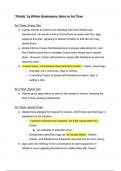
“Othello” by William Shakespeare- Notes on Act Three
Act Three, Scene One
● Cassio intends to improve his standing with both Othello and
Desdemona. He sends a fool to fetch Emilia to speak with him. Iago
supports this plan, agreeing to distract Othello so that the two may
speak freely.
● Emilia informs Cassio that Desdemona is already defending him, and
that Othello would like to reinstate Cassio when things have calmed
down. However, Cassio still wishes to speak with Desdemona alone to
plead his case.
● “I never knew / A Florentine more kind and honest.”- Cassio, about Iago
○ Dramatic irony (ominous). Iago is chilling.
○ In sending Cassio to speak with Desdemona alone, Iago is
setting a trap.
Act Three, Scene Two
● Othello gives Iago letters to send to the senate in Venice, showing the
trust in their working relationship.
Act Three, Scene Three
● Desdemona pledges her support to Cassio, and Emilia says that Iago is
saddened by his situation.
○ “I warrant it grieves my husband / As if the cause were his.”-
Emilia
■ (an example of dramatic irony).
○ Desdemona describes Iago as “an honest fellow”. Othello,
Cassio, and Desdemona frequently describe him as such (irony).
● Iago uses the intimacy of the conversation to plant suspicions in
Othello’s mind regarding Desdemona’s relationship with Cassio.
, ○ “Assure thee, / If I do vow a friendship, I’ll perform it / To the last
article. My lord shall never rest. / I’ll watch him tame and talk him
out of patience; / His bed shall seem a school, his board a shrift; /
I’ll intermingle everything he does / With Cassio’s suit. Therefore
be merry, Cassio, / For thy solicitor shall rather die / Than give thy
cause away.”- Desdemona, to Cassio
■ Desdemona will, in fact, die for Cassio’s friendship (albeit
unintentionally). This is perhaps ironic.
○ This highlights her dedication and purity of heart.
○ After this speech, Cassio exits swiftly (shown by the monosyllabic
language in “Madam, I’ll take my leave.”- Cassio). This seems
suspicious to Othello when combined with Iago’s manipulation.
■ “That he would sneak away so guilty-like, / Seeing you
coming.”- Iago, to Othello, about Cassio.
● Shakespeare employs wordplay to heighten suspicion regarding
Desdemona’s relationship with Cassio, allowing the audience to
understand Othello’s doubts even as they believe her fidelity.
○ “I have been talking with a suitor here, / A man that languishes in
your displeasure.”- Desdemona, about Cassio
○ The sympathetic tone (“languishes”) implies an intimate
friendship. Moreover, “suitor” can mean both a man who makes a
request, or a man who pursues a woman romantically/sexually.
● Othello refuses Desdemona’s request to call Cassio back immediately,
although he appears sympathetic.
● “Excellent wretch! Perdition catch my soul / But I do love thee; and
when I love thee not, / Chaos is come again.”- Othello, about
Desdemona
○ Othello reasserts his love for his wife, and says that chaos will
reign if he loses this love. This creates a sense of foreboding.
From this point, Othello tumbles deeper into madness and
aggression.
Act Three, Scene One
● Cassio intends to improve his standing with both Othello and
Desdemona. He sends a fool to fetch Emilia to speak with him. Iago
supports this plan, agreeing to distract Othello so that the two may
speak freely.
● Emilia informs Cassio that Desdemona is already defending him, and
that Othello would like to reinstate Cassio when things have calmed
down. However, Cassio still wishes to speak with Desdemona alone to
plead his case.
● “I never knew / A Florentine more kind and honest.”- Cassio, about Iago
○ Dramatic irony (ominous). Iago is chilling.
○ In sending Cassio to speak with Desdemona alone, Iago is
setting a trap.
Act Three, Scene Two
● Othello gives Iago letters to send to the senate in Venice, showing the
trust in their working relationship.
Act Three, Scene Three
● Desdemona pledges her support to Cassio, and Emilia says that Iago is
saddened by his situation.
○ “I warrant it grieves my husband / As if the cause were his.”-
Emilia
■ (an example of dramatic irony).
○ Desdemona describes Iago as “an honest fellow”. Othello,
Cassio, and Desdemona frequently describe him as such (irony).
● Iago uses the intimacy of the conversation to plant suspicions in
Othello’s mind regarding Desdemona’s relationship with Cassio.
, ○ “Assure thee, / If I do vow a friendship, I’ll perform it / To the last
article. My lord shall never rest. / I’ll watch him tame and talk him
out of patience; / His bed shall seem a school, his board a shrift; /
I’ll intermingle everything he does / With Cassio’s suit. Therefore
be merry, Cassio, / For thy solicitor shall rather die / Than give thy
cause away.”- Desdemona, to Cassio
■ Desdemona will, in fact, die for Cassio’s friendship (albeit
unintentionally). This is perhaps ironic.
○ This highlights her dedication and purity of heart.
○ After this speech, Cassio exits swiftly (shown by the monosyllabic
language in “Madam, I’ll take my leave.”- Cassio). This seems
suspicious to Othello when combined with Iago’s manipulation.
■ “That he would sneak away so guilty-like, / Seeing you
coming.”- Iago, to Othello, about Cassio.
● Shakespeare employs wordplay to heighten suspicion regarding
Desdemona’s relationship with Cassio, allowing the audience to
understand Othello’s doubts even as they believe her fidelity.
○ “I have been talking with a suitor here, / A man that languishes in
your displeasure.”- Desdemona, about Cassio
○ The sympathetic tone (“languishes”) implies an intimate
friendship. Moreover, “suitor” can mean both a man who makes a
request, or a man who pursues a woman romantically/sexually.
● Othello refuses Desdemona’s request to call Cassio back immediately,
although he appears sympathetic.
● “Excellent wretch! Perdition catch my soul / But I do love thee; and
when I love thee not, / Chaos is come again.”- Othello, about
Desdemona
○ Othello reasserts his love for his wife, and says that chaos will
reign if he loses this love. This creates a sense of foreboding.
From this point, Othello tumbles deeper into madness and
aggression.