100% satisfaction guarantee Immediately available after payment Both online and in PDF No strings attached 4.2 TrustPilot
logo-home
Exam (elaborations)

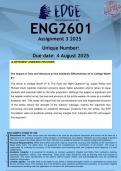
ENG2601 Assignment 2 (COMPLETE ANSWERS) 2025 - DUE 24 June 2025

Rating
5.0
(1)
Sold
1
Pages
16
Grade
A+
Uploaded on
18-06-2025
Written in
2024/2025

ENG2601 Assignment 2 (COMPLETE ANSWERS) 2025 - DUE 24 June 2025; 100% TRUSTED Complete, trusted solutions and explanations. For assistance, Whats-App 0.6.7-1.7.1-1.7.3.9. Ensure your success with us.. Read the article below and answer the questions that follow. The big lie about speed limits in South Africa Lower speed limits do not translate into reduced road fatalities despite what authorities would have you believe. This is the view of Rob Handfield-Jones, road safety expert and managing director of advanced driver training company D. In 2022, the Road Traffic Management Corporation (RTMC) proposed slashing speed limits in an effort to address the scourge of road deaths in the country. At the time, it noted that a process was underway to reduce urban speed limits from 60km/h to 50km/h, and freeway speed limits from 120km/h to 110km/h. It said these suggested changes were based on recommendations by the United Nations’ road council, of which South Africa is a member, which said countries with high road fatalities should consider slashing speed limits by 10km/h. Handfield-Jones told MyBroadband that the fixation on speed limits is rooted in the fact that it is a significant income generator for the authorities, and that it has nothing to do with improving the safety of the roads. Speed cameras are easy money “In 1998, South Africa had its safest year in history on our roads despite speed limits which were, on many roads, considerably higher than now,” said Handfield-Jones. “Speed only gets airtime because it is Assignment 02 Due date: 09 June 2025 Compulsory: Yes ENG2601/ASSIGNMENT 02/2025 associated with motor racing and danger, but the irony is that back in 2006 — the last year in which South Africa had credible traffic statistics — a South African racing driver was statistically twice as likely to die in their road car than in their racing car.” He said that the RTMC, the biggest proponent of speed cap adjustments, has disregarded government’s own research on the efficacy of lower limits. Referencing a 2003 study of contributory factors to fatal crashes, the expert said that only 7.9% of fatal car accidents listed speed as a contributing factor. “In other words, 92.1% didn’t — and that’s fatal crashes,” said Handfield-Jones. “Extend the study to include all crashes and speed would fade into insignificance compared to driver errors like incorrect following distance or insufficient awareness before manoeuvering.” Several years ago government revised speed limits for public transport vehicles from 120km/h to 100km/h to enhance safety, however, this had nowhere near the intended outcome. “In fact, four years after the change, the bus occupant fatality rate — as reported by the RTMC — rose by nearly 30% in a single year from 2005 to 2006!” said Handfield-Jones. In 2021 the RTMC commissioned a more comprehensive study into the effect speed limits have on road fatalities, which Handfield-Jones labeled “almost comedic.” “For example, on page 16, the document includes a graph that accidentally demonstrates an inverse correlation between speeding infringements and fatal crashes for almost all vehicle types, undermining the entire thrust of their argument that more speed prosecution was needed,” he said. Low speeds are far more dangerous than people realise, said Handfield-Jones. In a 2004 book titled Traffic Safety by Leonard Evans, the author wrote that the median change in velocity (delta-v) at which most vehicle occupants are killed is just 39km/h. “This research was a primary driver of the global move towards lower urban speed limits, although improved crashworthiness of modern vehicles has played a large part in reducing urban fatality rates,” said Handfield-Jones. “But a crash with a delta-V over 115km/h is uniformly fatal, so it’s a moot point whether one hits a bridge at 120km/h, nice and legally, or at 140km/h (shock-horror, a reckless speedster!). You’re stone dead in both cases.” Throwing gasoline on the fire, he said a study by BMW discovered that while the average speed on German Autobahns rose from 115km/h to 124km/h between 1977 and 1994, the fatality rate dropped by 56%. As such, driver behaviour is the main cause of road deaths, not speed control, said Handfield- Jones. ENG2601/ASSIGNMENT 02/2025 “The only reason speed continues to suck oxygen from the road safety debate is because it’s misunderstood by most people, but easy to measure and amazingly profitable,” he said. “Some municipalities derive over 50% of their revenue from traffic fines, almost all of which are for speeding.” Roughly 15 years ago, data presented at an Institute of Licensing Officers conference revealed that in the three months between 12 February 2009 and 8 May 2009, the Johannesburg metro issued 1,011,084 infringement notices. These were classified as follows: 98.94% for speeding 0.57% for disobeying road traffic signs 0.24% for disobeying the rules of the road 0.08% in connection with fitness of vehicles 0.07% for learners and drivers licenses 0.05% for registration and licensing of vehicles 0.03% for professional driving permits 0.01% for passenger carrying vehicles “Alcohol and driving did not even merit a mention, despite repeated National Injury Mortality Surveillance System studies showing that nearly 58% of all drivers killed in crashes were under the influence,” said Handfield-Jones. Other experts believe that this 58% statistic doesn’t reflect reality and that the true figure is much higher. Be that as it may, Handfield-Jones said that prosecuting drunk drivers is hard and expensive, which is why it’s not as frequently discussed by the powers that be as speed limit changes. “Speed cameras are easy money,” he concluded. Source: africa/#:~:text=Lower%20speed%20limits%20do%20not,company%20D The question/instructions and grading criteria In an essay of 1000 to 1200 words, discuss how the writer of the article above manipulates the relationships between genre, register, context and meaning to construct a persuasive or argumentative article. In your response, consider the application by the author of the article of any or all of the following argumentation/persuasive techniques as anchors of the overall argument and of individual supporting arguments: emotive language, repetition, rhetorical questions, generalisation, quoting experts, specialist vocabulary, case study, anecdote, hyperbole and euphemism. ENG2601/ASSIGNMENT 02/2025 Your essay will be graded in the following manner: Maximum marks (on the left) may be awarded if … 2 There is an appropriate title of the essay - derived from the essay instruction. 5 There is clear introductory paragraph that provides a suitable background and then introduces the essay by stating what the gist of the essay will be as derived from the instruction. 10 The discussion demonstrates a clearly understanding of genre, register, context and meaning as exemplified in the selected article. 10 There is well-developed, compelling, argument on what constitutes genre, register, context and meaning in the article and how these aspects manifest in the selected article. 15 Each point of argument is supported by clear and relevant excerpts as evidence from the text. The evidence is analysed/interpreted insightfully to effectively and clearly show how the genre, register, context and meaning are manipulated to achieve the writing purpose, and appropriate references are provided where necessary. 5 The essay is exceptionally well-written, and well-organized, with well-developed body paragraphs that progress logically from one point of argument to another. Transitions are seamless and enhance coherence. 3 There is strong conclusion that effectively summarizes the key points discussed in the essay.

Show more Read less
Institution
Course


Whoops! We can’t load your doc right now. Try again or contact support.

Connected book

Written for

Institution
Course

Document information

Uploaded on
June 18, 2025
Number of pages
16
Written in
2024/2025
Type
Exam (elaborations)
Contains
Questions & answers

Subjects

Content preview

ENG2601
Assignment 2 2025
Detailed Solutions, References & Explanations

Unique number:

Due Date: 24 June 2025
3 ESSAYS PROVIDED

An Analysis of How Genre, Register, Context and Meaning Are Manipulated in
“The Big Lie About Speed Limits in South Africa” to Construct a Persuasive
Argument

In the article titled “The Big Lie About Speed Limits in South Africa,” the author
strategically employs genre, register, context, and meaning to construct a powerful
persuasive argument against the commonly held belief that lowering speed limits
reduces road fatalities. Written in the form of an opinion piece, the article uses both
factual evidence and emotive appeals to criticise government policy, specifically
targeting the Road Traffic Management Corporation (RTMC). By quoting experts, using
specialised vocabulary, and deploying techniques such as hyperbole, anecdote, and
generalisation, the author manipulates linguistic and structural elements to challenge
dominant narratives about road safety in South Africa. This essay will examine how the
relationships between genre, register, context, and meaning are manipulated Terms
in theof use
By making use of this document you agree to:
article, focusing on the writer’s argumentative techniques and their contribution to
 Use this document as a guide for learning, comparison and reference purpose,
Terms of use
 Not to duplicate, reproduce and/or misrepresent the contents of this document as your own work,
By making use of this document you agree to:
 Use this document
Fully accept the consequences
solely as a guide forshould you plagiarise
learning, reference,or and
misuse this document.
comparison purposes,
 Ensure originality of your own work, and fully accept the consequences should you plagiarise or misuse this document.
 Comply with all relevant standards, guidelines, regulations, and legislation governing academic and written work.

Disclaimer
Great care has been taken in the preparation of this document; however, the contents are provided "as is" without any express or
implied representations or warranties. The author accepts no responsibility or liability for any actions taken based on the
information contained within this document. This document is intended solely for comparison, research, and reference purposes.
Reproduction, resale, or transmission of any part of this document, in any form or by any means, is strictly prohibited.


Reviews from verified buyers

Showing all reviews
5 months ago

5.0

1 reviews

5
1
4
0
3
0
2
0
1
0
Trustworthy reviews on Stuvia

All reviews are made by real Stuvia users after verified purchases.

Get to know the seller

Seller avatar
Reputation scores are based on the amount of documents a seller has sold for a fee and the reviews they have received for those documents. There are three levels: Bronze, Silver and Gold. The better the reputation, the more your can rely on the quality of the sellers work.
EduPal University of South Africa (Unisa)
Follow You need to be logged in order to follow users or courses
Sold
149166
Member since
7 year
Number of followers
35995
Documents
4321
Last sold
1 day ago

4.2

13557 reviews

5
7805
4
2688
3
1790
2
455
1
819

Recently viewed by you

Why students choose Stuvia

Created by fellow students, verified by reviews

Quality you can trust: written by students who passed their tests and reviewed by others who've used these notes.

Didn't get what you expected? Choose another document

No worries! You can instantly pick a different document that better fits what you're looking for.

Pay as you like, start learning right away

No subscription, no commitments. Pay the way you're used to via credit card and download your PDF document instantly.

Student with book image

“Bought, downloaded, and aced it. It really can be that simple.”

Alisha Student

Frequently asked questions