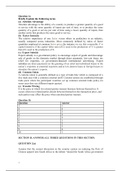
Question 1a
Briefly Explain the Following terms
(a) Absolute Advantage
Absolute advantage is the ability of a country to produce a greater quantity of a good
or service with the same quantity of inputs per unit of time, or to produce the same
quantity of a good or service per unit of time using a lesser quantity of inputs, than
another entity that produces the same good or service.
(b) Factor Intensity
The relative importance of one factor versus others in production in an industry,
usually compared across industries. Most commonly defined by ratios of factor
quantities employed at common factor prices,for instance we say that commodity Y is
capital intensive if the capital–labor ratio (K/L) used in the production of Y is greater
than K/L used in the production of X.
(c) Export Subsidy
Export subsidy is a government policy to encourage export of goods and discourage
sale of goods on the domestic market through direct payments, low-cost loans, tax
relief for exporters, or government-financed international advertising. Export
subsidies are direct payments (or the granting of tax relief and subsidized loans) to the
nation’s exporters or potential exporters and/or low-interest loans to foreign buyers to
stimulate the nation’s exports.
(d) Customs Union
A customs union is generally defined as a type of trade bloc which is composed of a
free trade area with a common external tariff. Customs unions are established through
trade pacts where the participant countries set up common external trade policy (in
some cases they use different import quotas).
(e) Transfer Pricing
It is the price at which two related parties transact business between themselves. It
occurs when two related parties decide between themselves the transaction price, and
such parties may affect the price when unrelated parties transact.
Question 1b
Question Answer
1 1
2 2
3 3
4 2
5 4
6 1
7 2
8 3
9 4
10 1
SECTION B: ANSWER ALL THREE QUESTIONS IN THIS SECTION.
QUESTION 2(a)
Assume that the current discussion in the country centers on reducing the flow of
Chinese apparel into South Africa to the debate “should the South Africa government
1
, decide to implement a limit on the importation of apparels from China, South Africa
apparel production would increase and the country will be better off”
(i) Define the effective rate of protection and explain why nominal tariff is
sometime considered to be deceptive in terms of protection accorded to domestic
producers. (5)
The effective tariff rate of protection is the percentage increase in domestic value
added per unit of output made possible by the tariff structure. It is a measure of the
total effect of the entire tariff structure on the value added per unit of output in each
industry, when both intermediate and final goods are imported.
Sometimes it is considered to be deceptive in terms of protection accorded to
domestic producers, because of the implication that to impose tariffs on both imported
inputs and the final products of the industry is self defeating as the tariff on the
imported inputs reduces the effective tariff protection on the final goods.
(ii) Using the formula below, show that it is possible for the the effective rate of
protection to be (a) negative and (b) equal to the nominal tariff rate on the
consumers of the final commodity Formula for the effective rate of protection.
(5)
g=(t-aiti)/1-ai
where g = the rate of effective protection to producers of the final commodity
t = the nominal tariff rate on consumers of the final commodity
ai = the ratio of the cost of the imported input to the price of the final commodity in
the absence of tariffs
ti = the nominal tariff rate on the imported input
(a) Negative
If ti is 20%, therefore:
(b) Equal to the nominal tariff rate on the consumers of the final commodity
If ti is 10% instead
2
Briefly Explain the Following terms
(a) Absolute Advantage
Absolute advantage is the ability of a country to produce a greater quantity of a good
or service with the same quantity of inputs per unit of time, or to produce the same
quantity of a good or service per unit of time using a lesser quantity of inputs, than
another entity that produces the same good or service.
(b) Factor Intensity
The relative importance of one factor versus others in production in an industry,
usually compared across industries. Most commonly defined by ratios of factor
quantities employed at common factor prices,for instance we say that commodity Y is
capital intensive if the capital–labor ratio (K/L) used in the production of Y is greater
than K/L used in the production of X.
(c) Export Subsidy
Export subsidy is a government policy to encourage export of goods and discourage
sale of goods on the domestic market through direct payments, low-cost loans, tax
relief for exporters, or government-financed international advertising. Export
subsidies are direct payments (or the granting of tax relief and subsidized loans) to the
nation’s exporters or potential exporters and/or low-interest loans to foreign buyers to
stimulate the nation’s exports.
(d) Customs Union
A customs union is generally defined as a type of trade bloc which is composed of a
free trade area with a common external tariff. Customs unions are established through
trade pacts where the participant countries set up common external trade policy (in
some cases they use different import quotas).
(e) Transfer Pricing
It is the price at which two related parties transact business between themselves. It
occurs when two related parties decide between themselves the transaction price, and
such parties may affect the price when unrelated parties transact.
Question 1b
Question Answer
1 1
2 2
3 3
4 2
5 4
6 1
7 2
8 3
9 4
10 1
SECTION B: ANSWER ALL THREE QUESTIONS IN THIS SECTION.
QUESTION 2(a)
Assume that the current discussion in the country centers on reducing the flow of
Chinese apparel into South Africa to the debate “should the South Africa government
1
, decide to implement a limit on the importation of apparels from China, South Africa
apparel production would increase and the country will be better off”
(i) Define the effective rate of protection and explain why nominal tariff is
sometime considered to be deceptive in terms of protection accorded to domestic
producers. (5)
The effective tariff rate of protection is the percentage increase in domestic value
added per unit of output made possible by the tariff structure. It is a measure of the
total effect of the entire tariff structure on the value added per unit of output in each
industry, when both intermediate and final goods are imported.
Sometimes it is considered to be deceptive in terms of protection accorded to
domestic producers, because of the implication that to impose tariffs on both imported
inputs and the final products of the industry is self defeating as the tariff on the
imported inputs reduces the effective tariff protection on the final goods.
(ii) Using the formula below, show that it is possible for the the effective rate of
protection to be (a) negative and (b) equal to the nominal tariff rate on the
consumers of the final commodity Formula for the effective rate of protection.
(5)
g=(t-aiti)/1-ai
where g = the rate of effective protection to producers of the final commodity
t = the nominal tariff rate on consumers of the final commodity
ai = the ratio of the cost of the imported input to the price of the final commodity in
the absence of tariffs
ti = the nominal tariff rate on the imported input
(a) Negative
If ti is 20%, therefore:
(b) Equal to the nominal tariff rate on the consumers of the final commodity
If ti is 10% instead
2