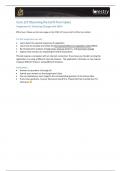
Cons 127 Observing the Earth from Space
Assignment 6: Detecting Change with NDVI
Office hours: Please see the zoom page on the CONS 127 canvas site for office hour details.
For this assignment you will…
• Learn about the spectral responses of vegetation
• Learn how to calculate and utilize the Normalized Difference Vegetation Index (NDVI)
• Be introduced to analyses of land cover, land use patterns, and land cover change
• Explore how humans are impacting terrestrial ecosystems
This lab requires a computer with an internet connection. If you have any trouble running the
application, try using a different internet browser. The application is finnicky, so may require
trying at different times or using different browsers.
Deliverables:
• Answers to questions 1 through 18
• Submit your answers to the Assignment 6 Quiz
• You can upload your own image to the corresponding question in the Canvas Quiz.
• If you have questions, try your discussion board first. Please feel free to email your TA
otherwise 😊
, Part 1: Interpreting Change using ESRI Change Matters
Understanding how Earth systems change through time, either due to natural or anthropogenic
processes (or both!), is an integral part of understanding how the world around us operates,
how it affects us, and how humanity impacts the natural world. With increasing data availability
and quality, newer and better sensors and satellite constellations, and an increasingly long
timeline of observations, remote sensing scientists are well positioned to detect change on the
Earth at many resolutions – in time, space, and the EM spectrum. Satellite sensors provide
consistent and repeatable measurements of everything from whole-earth phenomena, like
global primary productivity maps derived from MODIS data, to sub-meter imagery of the trees
lining city streets.
The most well-known vegetation index is probably the Normalized Difference Vegetation Index
(NDVI), which takes advantage of vegetation’s spectral qualities. Using spectral vegetation
indices, we can directly and quantitatively compare remotely sensed images.
https://www.usgs.gov/faqs/what-are-band-designations-landsat-satellites (information about band
designations for the Landsat satellites) https://gisgeography.com/ndvi-normalized-difference-
vegetation-index/ (NDVI information) Getting Started
1. Visit https://livingatlas2.arcgis.com/landsatexplorer/.
2. On the left-hand side of the screen, there are several icons. Hover over them to see
what they do.
3. Find and click the “Tutorial” icon.
4. Complete the “Renderer” and “Time, Swipe and Change” tutorials. (When the
“Renderer” tutorial switches to talking about the “Identify” tool, simply select the
tutorial icon again, and choose the and “Time, Swipe and Change” option. If the
imagery doesn’t load, try changing your browser window size or choose a different
browser.
Q1. The formula for NDVI is:_____. (Select from presented options)
Q2. The Landsat 7 bands used to calculate NDVI are ___ and ___.
The Landsat 8 bands used to calculate NDVI are ___ and ___.
(Select from presented options)
Assignment 6: Detecting Change with NDVI
Office hours: Please see the zoom page on the CONS 127 canvas site for office hour details.
For this assignment you will…
• Learn about the spectral responses of vegetation
• Learn how to calculate and utilize the Normalized Difference Vegetation Index (NDVI)
• Be introduced to analyses of land cover, land use patterns, and land cover change
• Explore how humans are impacting terrestrial ecosystems
This lab requires a computer with an internet connection. If you have any trouble running the
application, try using a different internet browser. The application is finnicky, so may require
trying at different times or using different browsers.
Deliverables:
• Answers to questions 1 through 18
• Submit your answers to the Assignment 6 Quiz
• You can upload your own image to the corresponding question in the Canvas Quiz.
• If you have questions, try your discussion board first. Please feel free to email your TA
otherwise 😊
, Part 1: Interpreting Change using ESRI Change Matters
Understanding how Earth systems change through time, either due to natural or anthropogenic
processes (or both!), is an integral part of understanding how the world around us operates,
how it affects us, and how humanity impacts the natural world. With increasing data availability
and quality, newer and better sensors and satellite constellations, and an increasingly long
timeline of observations, remote sensing scientists are well positioned to detect change on the
Earth at many resolutions – in time, space, and the EM spectrum. Satellite sensors provide
consistent and repeatable measurements of everything from whole-earth phenomena, like
global primary productivity maps derived from MODIS data, to sub-meter imagery of the trees
lining city streets.
The most well-known vegetation index is probably the Normalized Difference Vegetation Index
(NDVI), which takes advantage of vegetation’s spectral qualities. Using spectral vegetation
indices, we can directly and quantitatively compare remotely sensed images.
https://www.usgs.gov/faqs/what-are-band-designations-landsat-satellites (information about band
designations for the Landsat satellites) https://gisgeography.com/ndvi-normalized-difference-
vegetation-index/ (NDVI information) Getting Started
1. Visit https://livingatlas2.arcgis.com/landsatexplorer/.
2. On the left-hand side of the screen, there are several icons. Hover over them to see
what they do.
3. Find and click the “Tutorial” icon.
4. Complete the “Renderer” and “Time, Swipe and Change” tutorials. (When the
“Renderer” tutorial switches to talking about the “Identify” tool, simply select the
tutorial icon again, and choose the and “Time, Swipe and Change” option. If the
imagery doesn’t load, try changing your browser window size or choose a different
browser.
Q1. The formula for NDVI is:_____. (Select from presented options)
Q2. The Landsat 7 bands used to calculate NDVI are ___ and ___.
The Landsat 8 bands used to calculate NDVI are ___ and ___.
(Select from presented options)