Europees Recht/European Union Law
Topic: EU State Aid Law
Why is EU State Aid Law important?
EU State Aid law is important because of Article 108(3) TFEU
(the so-called standstill clause)
- (3) The Commission shall be informed, in sufficient time to
enable it to submit its comments, of any plans to grant or
alter aid. If it considers that any such plan is not
compatible with the internal market having regard to Article
107, it shall without delay initiate the procedure provided
for in paragraph 2. The Member State concerned shall not
put its proposed measures into effect until this procedure
has resulted in a final decision.
Without a decision of the Commission on any plans to grand
aid, such aid may not be paid out.
Article 108(2) TFEU has direct effect and can be applied by
national Courts
Procedure:
- Procedure: Regulation (EU) No /2015/1589
- Standstill obligation: Member States cannot implement aid
measures until the Commission authorises them (see
Article 3 of Regulation (EU) No 2015/1589)
o Provision has direct effect
o Provision can be enforced in national courts
o Provision includes an obligation to recover unlawful
aid: ‘’recovery of unlawful aid is the logical
consequence of the finding that it is unlawful’’ (Case
142/87, Belgium v COM, para 66).
- After notification (Article 108(2) TFEU): Commission
investigates whether (1) the notified measure meets the
state aid criteria in Article 107(1) TFEU and (2), if so,
whether the measure could be exempted under Articles
107(2) or (3) TFEU and approved (or not, then: abolishing
or altering the notified measure)
- Before and during the investigation: unlawful aid
,What is a prohibited state aid under EU law?
In order for a measure to constitute State aid falling under
Article 107(1) TFEU it must:
1. Involve any aid granted by a Member State or through
State resources in any form whatsoever
2. That distorts or threatens to distort competition
3. By favouring certain undertakings or the production of
certain goods
4. In so far as it affect trade between Member States
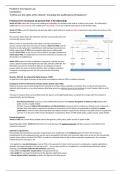
What is the standard case of state aid?
- The difference between the amount paid by Company C to
B and the amount paid by the State to A is state aid.
- Criteria:
1. Aid (economic Advantage) financed by the state or
through state resources
2. Distortion of competition
3. Selectivity
4. Affecting trade between Member States
Aid: Granting an economic advantage
- Positive dimension: The measure must constitute a
financial advantage to some undertakings
- In the alternative, negative dimension: The measure must
relieve some undertakings of charges normally born by
them
o Tax measures (reduction in the tax base, total or
partial reduction in the amount of tax (such as
exemption or a tax credit, cancellation or even
special rescheduling of tax debt)
- Assessment: ‘’Market Economy Operator Test’’ (MEOT)
o Does the state act outside of its public capacity?
o If so: Would a prudent independent operator acting
under normal market conditions have acted at the
moment when the aid was granted in the same
manner as the state did?
o Private investor/vendor/purchaser/creditor
By the Member State
, - Measures adopted by local, regional and central
government
- Measures by public or private bodies designated or
established by the state
Through State resources
- Direct or indirect implication of State resources (Case C-
379/98, PreussenElektra)
- Not the same as a purchase obligation for undertakings,
which is imposed by statue
Through private resources?
- Case C-482/99 Stardust
- Only IF formally private resources are actually under State
control
- And IF the decision to grand is imputable to the State
- The ‘or’ in Article 107(1) TFEU must be read as an ‘and’
Distortion of competition
- Main requirement: The existence of a competitive link
between the undertaking receiving the advantage and the
disadvantaged undertakings
o Definition of the relevant market (as known under
Article 102 TFEU)
Selectivity
- Measure in question must favour certain undertakings or
the production of certain goods
- Easy to establish in case of subsidies
- Difficult to establish in case of tax measures (‘relief of
charges normally born by undertakings’)
o Three-step test
1. Identifying the common or normal tax system
applicable in the Member State concerned
2. Prima-facie selectivity: Favouring certain
undertakings or the production of certain goods in
comparison with other undertakings which are in
a legal and factual situation that is comparable in
the light of the objective pursued by the measure
in question
3. Justification: ‘in the light of the nature or overall
structure of the tax system’
Topic: EU State Aid Law
Why is EU State Aid Law important?
EU State Aid law is important because of Article 108(3) TFEU
(the so-called standstill clause)
- (3) The Commission shall be informed, in sufficient time to
enable it to submit its comments, of any plans to grant or
alter aid. If it considers that any such plan is not
compatible with the internal market having regard to Article
107, it shall without delay initiate the procedure provided
for in paragraph 2. The Member State concerned shall not
put its proposed measures into effect until this procedure
has resulted in a final decision.
Without a decision of the Commission on any plans to grand
aid, such aid may not be paid out.
Article 108(2) TFEU has direct effect and can be applied by
national Courts
Procedure:
- Procedure: Regulation (EU) No /2015/1589
- Standstill obligation: Member States cannot implement aid
measures until the Commission authorises them (see
Article 3 of Regulation (EU) No 2015/1589)
o Provision has direct effect
o Provision can be enforced in national courts
o Provision includes an obligation to recover unlawful
aid: ‘’recovery of unlawful aid is the logical
consequence of the finding that it is unlawful’’ (Case
142/87, Belgium v COM, para 66).
- After notification (Article 108(2) TFEU): Commission
investigates whether (1) the notified measure meets the
state aid criteria in Article 107(1) TFEU and (2), if so,
whether the measure could be exempted under Articles
107(2) or (3) TFEU and approved (or not, then: abolishing
or altering the notified measure)
- Before and during the investigation: unlawful aid
,What is a prohibited state aid under EU law?
In order for a measure to constitute State aid falling under
Article 107(1) TFEU it must:
1. Involve any aid granted by a Member State or through
State resources in any form whatsoever
2. That distorts or threatens to distort competition
3. By favouring certain undertakings or the production of
certain goods
4. In so far as it affect trade between Member States
What is the standard case of state aid?
- The difference between the amount paid by Company C to
B and the amount paid by the State to A is state aid.
- Criteria:
1. Aid (economic Advantage) financed by the state or
through state resources
2. Distortion of competition
3. Selectivity
4. Affecting trade between Member States
Aid: Granting an economic advantage
- Positive dimension: The measure must constitute a
financial advantage to some undertakings
- In the alternative, negative dimension: The measure must
relieve some undertakings of charges normally born by
them
o Tax measures (reduction in the tax base, total or
partial reduction in the amount of tax (such as
exemption or a tax credit, cancellation or even
special rescheduling of tax debt)
- Assessment: ‘’Market Economy Operator Test’’ (MEOT)
o Does the state act outside of its public capacity?
o If so: Would a prudent independent operator acting
under normal market conditions have acted at the
moment when the aid was granted in the same
manner as the state did?
o Private investor/vendor/purchaser/creditor
By the Member State
, - Measures adopted by local, regional and central
government
- Measures by public or private bodies designated or
established by the state
Through State resources
- Direct or indirect implication of State resources (Case C-
379/98, PreussenElektra)
- Not the same as a purchase obligation for undertakings,
which is imposed by statue
Through private resources?
- Case C-482/99 Stardust
- Only IF formally private resources are actually under State
control
- And IF the decision to grand is imputable to the State
- The ‘or’ in Article 107(1) TFEU must be read as an ‘and’
Distortion of competition
- Main requirement: The existence of a competitive link
between the undertaking receiving the advantage and the
disadvantaged undertakings
o Definition of the relevant market (as known under
Article 102 TFEU)
Selectivity
- Measure in question must favour certain undertakings or
the production of certain goods
- Easy to establish in case of subsidies
- Difficult to establish in case of tax measures (‘relief of
charges normally born by undertakings’)
o Three-step test
1. Identifying the common or normal tax system
applicable in the Member State concerned
2. Prima-facie selectivity: Favouring certain
undertakings or the production of certain goods in
comparison with other undertakings which are in
a legal and factual situation that is comparable in
the light of the objective pursued by the measure
in question
3. Justification: ‘in the light of the nature or overall
structure of the tax system’