Complete notes for A-Levels BiologyCIE according to syllabus objectives - updated 2025
Biology (9700) notes A-Level - Classification, Biodiversity and Conservation (CIE)
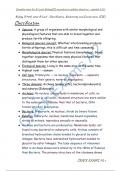
Classification
● Species: A group of organisms with similar morphological and
physiological features that are able to breed together and
produce fertile offspring.
● Biological species concept: Whether interbreeding produces
fertile offsprings, this is difficult and time consuming.
● Morphological species: Physical features (morphology). Group
A2
together organisms that share many physical features that
distinguish them for other species.
● Ecological species: Living in the same area at the same time.
s
● Highest rank → domain
am
● Cell type: Prokaryote → no nucleus. Eukaryote → separate
structures, their genetic material segregated.
● Three domains: Archaea (prokaryote), bacteria(prokaryote)
Ex
and eukarya (Eukaryote)
● Archaea: No nucleus, unique lipids in membrane of cells, no
peptidoglycan in cell walls, ribosomal structure are more similar
to the eukaryotic ribosome than that of bacteria, DNA
ck
transcription to eukaryotes.
● Bacteria: Prokaryote, no nucleus, divide by binary fission.
ra
● Eukarya: Eukaryote, nucleus, membrane bound organelles,
divide by mitosis, reproduce sexually or asexually.
C
● Archaea and bacteria are prokaryotes. Membrane lipids; not
found in any bacterial or eukaryotic cells, Archae consists of
branched hydrocarbon chains bonded to glycerol by ester
linkages. Bacteria have unbranched hydrocarbon bonded to
glycerol by ester linkages. The base sequence of ribosomal
RNA in Archaea shows more similarity to the rRNA of Eukarya
than Bacteria. The primary structure of the ribosome shows
CRACK EXAMS A2 1
Biology (9700) notes A-Level - Classification, Biodiversity and Conservation (CIE)
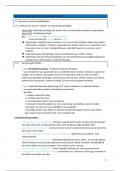
Classification
● Species: A group of organisms with similar morphological and
physiological features that are able to breed together and
produce fertile offspring.
● Biological species concept: Whether interbreeding produces
fertile offsprings, this is difficult and time consuming.
● Morphological species: Physical features (morphology). Group
A2
together organisms that share many physical features that
distinguish them for other species.
● Ecological species: Living in the same area at the same time.
s
● Highest rank → domain
am
● Cell type: Prokaryote → no nucleus. Eukaryote → separate
structures, their genetic material segregated.
● Three domains: Archaea (prokaryote), bacteria(prokaryote)
Ex
and eukarya (Eukaryote)
● Archaea: No nucleus, unique lipids in membrane of cells, no
peptidoglycan in cell walls, ribosomal structure are more similar
to the eukaryotic ribosome than that of bacteria, DNA
ck
transcription to eukaryotes.
● Bacteria: Prokaryote, no nucleus, divide by binary fission.
ra
● Eukarya: Eukaryote, nucleus, membrane bound organelles,
divide by mitosis, reproduce sexually or asexually.
C
● Archaea and bacteria are prokaryotes. Membrane lipids; not
found in any bacterial or eukaryotic cells, Archae consists of
branched hydrocarbon chains bonded to glycerol by ester
linkages. Bacteria have unbranched hydrocarbon bonded to
glycerol by ester linkages. The base sequence of ribosomal
RNA in Archaea shows more similarity to the rRNA of Eukarya
than Bacteria. The primary structure of the ribosome shows
CRACK EXAMS A2 1