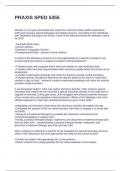
PRAXIS SPED 5355
Michael is a 14-year-old student who meets the criteria for other health impairments
(OHI) and receives special education and related services. According to the Individuals
with Disabilities Education Act (IDEA), which of the following meets the definition criteria
for OHI?
-Traumatic Brain Injury
-Chronic Asthma
-Expressive Language Disorder
-Developmental Delay - answer Chronic Asthma
In which of the following scenarios is it most appropriate for a teacher to begin to use
prompt-fading techniques to support a student's skill development?
-A student reads only assigned fiction texts and refuses to read nonfiction texts.
-A student often becomes argumentative after receiving a grade below 50 percent on an
assignment.
-A student reciprocates greetings only when the teacher provides verbal reminders.
-A student ignores the gesture whenever the teacher points to the clock to remind the
student to stay on task. - answerA student reciprocates greetings only when the teacher
provides verbal reminders.
A second-grade student, John, has autism spectrum disorder. John receives special
education and related services and has a special education teacher in the classroom to
support his learning. During gym class, John struggles with physical activities because
of low muscle tone and repetitive rocking behaviors. Which of the following is the most
effective approach to help John develop and improve gross motor skills?
-Integrating more physical movements into classroom activities throughout the day
-Contacting the parents to find out what exercises John likes to engage in at home with
his family.
-Asking an occupational therapist to evaluate the classroom environment and
recommend updates to support John.
-Having a physical therapist design, implement, and document a treatment therapy plan
that can help John. - answerHaving a physical therapist design, implement, and
document a treatment therapy plan that can help John.
After a student is referred by a teacher for an evaluation for special education services,
which of the following is the most appropriate next step for the school to take?
-Provide the student with appropriate tier 3 interventions
-Obtain consent from a legal guardian for the initial evaluation of the student
, -Schedule professional testing for the student
-Draft an agenda with a list of participants for the initial IEP meeting - answerObtain
consent from a legal guardian for the initial evaluation of the student
Which of the following is the most appropriate way for a kindergarten teacher to ensure
that a student with fine motor deficits will be able to work on activities at the literacy
center in an inclusion classroom?
-Assigning a paraprofessional to monitor the literacy center
-Modifying the checklist used for assessing activities at the center
-Providing various-sized pencils, grips, and slant boards
-Eliminating all activities that consist of individual writing rather than participating in
writing. - answerProviding various-sized pencils, grips, and slant boards
The Response to Intervention (RTI) approach primarily affects special education
procedures by requiring that students
-obtain a learning disability before receiving special education services
-be provided with instruction in an inclusion classroom with the support of a special
education teacher
-received daily personalized instruction in a resource classroom
-be provided with research-based interventions before evaluations are are conducted. -
answerbe provided with research-based interventions before evaluations are are
conducted.
Kelly is a first-grade student with multiple disabilities who is receiving special education
and related services in a general education classroom. Kelly has a one-on-one aide to
assist her throughout the day. During an IEP review meeting, Kelly's parents expressed
concern that Kelly's functional skills are not progressing at home as well as her parents
would like, compared with the progress she is making in the classroom. Which of the
following is the best way to address the parents' concerns?
-Arranging videoconferences at regular intervals with a trained professional to discuss
goals, share resources, and recommend other community programs
-Asking the parents to document specific skills that they would like their child to learn so
the skills can be added to the annual goal at the next IEP meeting
-Sharing links to pages on the IDEA website that contain information about how children
with multiple disabilities are - answerArranging videoconferences at regular intervals
with a trained professional to discuss goals, share resources, and recommend other
community programs
Ms. Jenkins is teaching a 5-year-old student named Kyle who has Autism Spectrum
Disorder (ASD) and little language to use a communication board. Ms. Jenkins has 3
toys. She shows Kyle one toy at a time and asks him if it is in the picture from a big
book. He responds "yes" by touching a yellow happy face and "no" by touching a red
Michael is a 14-year-old student who meets the criteria for other health impairments
(OHI) and receives special education and related services. According to the Individuals
with Disabilities Education Act (IDEA), which of the following meets the definition criteria
for OHI?
-Traumatic Brain Injury
-Chronic Asthma
-Expressive Language Disorder
-Developmental Delay - answer Chronic Asthma
In which of the following scenarios is it most appropriate for a teacher to begin to use
prompt-fading techniques to support a student's skill development?
-A student reads only assigned fiction texts and refuses to read nonfiction texts.
-A student often becomes argumentative after receiving a grade below 50 percent on an
assignment.
-A student reciprocates greetings only when the teacher provides verbal reminders.
-A student ignores the gesture whenever the teacher points to the clock to remind the
student to stay on task. - answerA student reciprocates greetings only when the teacher
provides verbal reminders.
A second-grade student, John, has autism spectrum disorder. John receives special
education and related services and has a special education teacher in the classroom to
support his learning. During gym class, John struggles with physical activities because
of low muscle tone and repetitive rocking behaviors. Which of the following is the most
effective approach to help John develop and improve gross motor skills?
-Integrating more physical movements into classroom activities throughout the day
-Contacting the parents to find out what exercises John likes to engage in at home with
his family.
-Asking an occupational therapist to evaluate the classroom environment and
recommend updates to support John.
-Having a physical therapist design, implement, and document a treatment therapy plan
that can help John. - answerHaving a physical therapist design, implement, and
document a treatment therapy plan that can help John.
After a student is referred by a teacher for an evaluation for special education services,
which of the following is the most appropriate next step for the school to take?
-Provide the student with appropriate tier 3 interventions
-Obtain consent from a legal guardian for the initial evaluation of the student
, -Schedule professional testing for the student
-Draft an agenda with a list of participants for the initial IEP meeting - answerObtain
consent from a legal guardian for the initial evaluation of the student
Which of the following is the most appropriate way for a kindergarten teacher to ensure
that a student with fine motor deficits will be able to work on activities at the literacy
center in an inclusion classroom?
-Assigning a paraprofessional to monitor the literacy center
-Modifying the checklist used for assessing activities at the center
-Providing various-sized pencils, grips, and slant boards
-Eliminating all activities that consist of individual writing rather than participating in
writing. - answerProviding various-sized pencils, grips, and slant boards
The Response to Intervention (RTI) approach primarily affects special education
procedures by requiring that students
-obtain a learning disability before receiving special education services
-be provided with instruction in an inclusion classroom with the support of a special
education teacher
-received daily personalized instruction in a resource classroom
-be provided with research-based interventions before evaluations are are conducted. -
answerbe provided with research-based interventions before evaluations are are
conducted.
Kelly is a first-grade student with multiple disabilities who is receiving special education
and related services in a general education classroom. Kelly has a one-on-one aide to
assist her throughout the day. During an IEP review meeting, Kelly's parents expressed
concern that Kelly's functional skills are not progressing at home as well as her parents
would like, compared with the progress she is making in the classroom. Which of the
following is the best way to address the parents' concerns?
-Arranging videoconferences at regular intervals with a trained professional to discuss
goals, share resources, and recommend other community programs
-Asking the parents to document specific skills that they would like their child to learn so
the skills can be added to the annual goal at the next IEP meeting
-Sharing links to pages on the IDEA website that contain information about how children
with multiple disabilities are - answerArranging videoconferences at regular intervals
with a trained professional to discuss goals, share resources, and recommend other
community programs
Ms. Jenkins is teaching a 5-year-old student named Kyle who has Autism Spectrum
Disorder (ASD) and little language to use a communication board. Ms. Jenkins has 3
toys. She shows Kyle one toy at a time and asks him if it is in the picture from a big
book. He responds "yes" by touching a yellow happy face and "no" by touching a red