Written by students who passed Immediately available after payment Read online or as PDF Wrong document? Swap it for free 4.6 TrustPilot
logo-home
Exam (elaborations)

Pathophysiology Exam 1 Rasmussen: Questions and Answer Key

Rating
-
Sold
-
Pages
13
Grade
A+
Uploaded on
15-06-2025
Written in
2024/2025

3 stages of adaptation (GAS) - ANSWER alarm reaction, stage of resistance, stage of exhaustion 4 topics of pathophysiology - ANSWER etiology, pathogenesis, clinical manifestations, treatment 5 cardinal signs of inflammation - ANSWER heat, redness, swelling, pain, loss of function 7 warning signs of cancer - ANSWER (CAUTION) Change in bowel or bladder habits A sore that does not heal Unusual bleeding or discharge Thickening or lump in breast or elsewhere Indigestion or difficulty swallowing Obvious change in wart or mole Nagging cough or hoarseness active immunity - ANSWER A form of acquired immunity in which the body produces its own antibodies against disease-causing antigens. active transport - ANSWER requires energy, against the gradient from low concentration to high (ex: endocytosis (entering cell), exocytosis(exiting cell), and protein pumps) acute - ANSWER sudden onset and short duration adaptation/resistance stage - ANSWER trying to return to homeotasis alarm stage - ANSWER fight or flight response reduced resistance to stressors release catecholamines (epinephrine and norepinephrine) and adrenocortical steroids (cortisol and aldostrone) antimicrobial resistance - ANSWER occurs when pathogens undergo changes that allow them to resist antimicrobials (Ex: MRSA) atopic dermatitis - ANSWER Excess inflammation; dry skin, redness, and itching from allergies and irritants. (eczema) Bicarbonate value normal range (second most abundant anion in blood) - ANSWER 23-30 mEq/L Calcium value normal range - ANSWER 9-11 mg/dL OR 4.5-5.5 mEq/L causes of edema - ANSWER increased capillary hydrostatic pressure, loss of plasma proteins, obstruction of lymphatic circulation, increased capillary permeability Causes of extracellular fluid deficits - ANSWER loss of total body sodium-Vomiting, diarrhea, excessive sweating, burns, diuretics or kidney failure. chronic - ANSWER long term clinical manifestation - ANSWER signs and symptoms or evidence of disease Components of the Immune System - ANSWER (1) skin and mucous membranes; (2) the mononuclear phagocyte system; (3) the lymphoid system, including spleen, thymus gland, and lymph nodes; and (4) bone marrow. AND B cells; T cells condition of high calcium 11mg/dL - ANSWER hypercalcemia Condition of high chloride 106 mEq/L - ANSWER Hyperchloremia Condition of high magnesium 2.5 mEq/L - ANSWER Hypermagesemia Condition of high phosphate 4.5 mg/dL - ANSWER Hyperphosphatemia Condition of high potassium 5 mEq/L - ANSWER Hyperkalemia Condition of high sodium145 mEq/L - ANSWER hypernatremia condition of low calcium 9mg/dL - ANSWER hypocalcemia Condition of low chloride 96 mEq/L - ANSWER hypochloremia Condition of low magnesium 1.5 mEq/L - ANSWER hypomagnesemia condition of low phosphate 2.5 mg/dL - ANSWER hypophophatemia Condition of low potassium 3.5 mEq/L - ANSWER hypokalemia Condition of sodium 135 mEq/L - ANSWER hyponatremia / hypernatremia Define cachexia - ANSWER weakness and wasting of the body due to severe chronic illness Define endotoxins - ANSWER Stays INSIDE the cell. can lead to septic define exotoxins - ANSWER those toxins which are secreted in the area surrounding a cell Define Leukopenia - ANSWER decrease in WBC Define metastasis - ANSWER The spread of cancer cells beyond their original site Define thrombocytopenia - ANSWER low platelet count Dehydration (etiology, clinical manifestations, and treatment) - ANSWER Causes: vomiting, diarrhea, removal of saline from the body causes extracellular volume deficit and removal of extra water from the body causes hypernatremia, the combination is dehydration. S/S: hard stools, sudden weight loss, rapid pulse, oliguria, prolonged capillary refill time, decreased skin turgor, dry mouth, absence of sweat and tears, confusion, lethargy, thirst Treatment: replenish fluids PO or IV Difference between osmosis and diffusion - ANSWER osmosis is the diffusion of water and diffusion is the movement of any type of molecule across the cell membrane from a high to low concentration. Etiology - ANSWER The study of the causes and origins of disease exacerbation - ANSWER a relatively sudden increase in the severity of a disease or any of its signs and symptom example of hypersensitivity type 1 - ANSWER allergic reaction example of hypersensitivity type 2 - ANSWER transfusion reactions and hemolytic disease of a newborn Example of hypersensitivity type 3 - ANSWER immune complex reactions Example of primary prevention - ANSWER Immunization, health/sex ed, quit smoking drinking or poor diet. Examples of active immunity - ANSWER natural infection, vaccines, toxoid Examples of passive immunity - ANSWER IgA in breast milk, maternal IgG crossing placenta, antitoxin, serotherapy (direct injection of antibodies) examples of secondary prevention - ANSWER Self breast exams, yearly cancer screenings, proper management of diabetes Examples of tertiary prevention - ANSWER rehabilitation after brain injury, surgery to correct chronic or recurring illness, medication to prevent chronic symptoms exhaustion stage - ANSWER cannot return to homeostasis, energy sources depleted, disease process sets in and permanent symptoms show up. Fibromyalgia - ANSWER chronic condition with widespread aching and pain in the muscles and fibrous soft tissue function of mitochondria - ANSWER Cellular respiration, makes ATP. Gout - ANSWER hereditary metabolic disease that is a form of acute arthritis, characterized by excessive uric acid in the blood and around the joints Herpes - ANSWER A viral infection causing small painful blisters and inflammation, most commonly at the junction of skin and mucous membrane in the mouth or nose or in the genitals (1 above waist, 2 below) Goes dormant and can come back as shingles. Hormones released during GAS - ANSWER catecholamines (epi and norepi) adrenocortical steroids (cortisol and aldosterone) endorphines and enkephalins (endogenous opiods, increase pain threshold, produce sedation and euphoria) Immune cytokines (enhance immune system, when prolonged they suppress it) Sex hormones (estrogen and testosterone) Growth hormone Oxytocin (female "tend+befriend" vs fight or flight) Hypercalcemia causes and treatment - ANSWER Causes: hyperparathyroidism, malignant tumors, kidney failure, excessive calcium or vitamin d supplements, prolonged immobility Treatment: Cardiac monitoring, interventions depend on cause but drug therapy can be used to reduce levels. If caused by diuretics, dosage changed/discontinued Hypercalcemia S/S - ANSWER Muscle weakness, Constipation, Anorexia, N/V, Polyuria, confusion, increased HR and BP, Dysrhythmias, blood clots form easily, risk for DVT Hyperkalemia causes and treatment - ANSWER Causes: ACE inhibitors, kidney failure, multiple blood transfusions, excessive or too rapid IV potassium Treatment: Excrete excess potassium (with drugs), force potassium from ECF back into cells Hyperkalemia S/S - ANSWER Mild cramping, hype

Show more Read less
Institution
Pathophysiology
Course
Pathophysiology

Content preview

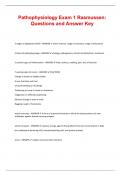
Pathophysiology Exam 1 Rasmussen:
Questions and Answer Key


3 stages of adaptation (GAS) - ANSWER ✔ alarm reaction, stage of resistance, stage of exhaustion


4 topics of pathophysiology - ANSWER ✔ etiology, pathogenesis, clinical manifestations, treatment


5 cardinal signs of inflammation - ANSWER ✔ heat, redness, swelling, pain, loss of function


7 warning signs of cancer - ANSWER ✔ (CAUTION)

Change in bowel or bladder habits

A sore that does not heal

Unusual bleeding or discharge

Thickening or lump in breast or elsewhere

Indigestion or difficulty swallowing

Obvious change in wart or mole

Nagging cough or hoarseness


active immunity - ANSWER ✔ A form of acquired immunity in which the body produces its own
antibodies against disease-causing antigens.


active transport - ANSWER ✔ requires energy, against the gradient from low concentration to high

(ex: endocytosis (entering cell), exocytosis(exiting cell), and protein pumps)


acute - ANSWER ✔ sudden onset and short duration

, adaptation/resistance stage - ANSWER ✔ trying to return to homeotasis


alarm stage - ANSWER ✔ fight or flight response

reduced resistance to stressors

release catecholamines (epinephrine and norepinephrine) and adrenocortical steroids (cortisol and
aldostrone)


antimicrobial resistance - ANSWER ✔ occurs when pathogens undergo changes that allow them to resist
antimicrobials (Ex: MRSA)


atopic dermatitis - ANSWER ✔ Excess inflammation; dry skin, redness, and itching from allergies and
irritants. (eczema)


Bicarbonate value normal range (second most abundant anion in blood) - ANSWER ✔ 23-30 mEq/L


Calcium value normal range - ANSWER ✔ 9-11 mg/dL OR 4.5-5.5 mEq/L


causes of edema - ANSWER ✔ increased capillary hydrostatic pressure, loss of plasma proteins,
obstruction of lymphatic circulation, increased capillary permeability


Causes of extracellular fluid deficits - ANSWER ✔ loss of total body sodium-Vomiting, diarrhea, excessive
sweating, burns, diuretics or kidney failure.


chronic - ANSWER ✔ long term


clinical manifestation - ANSWER ✔ signs and symptoms or evidence of disease


Components of the Immune System - ANSWER ✔ (1) skin and mucous membranes; (2) the mononuclear
phagocyte system; (3) the lymphoid system, including spleen, thymus gland, and lymph nodes; and (4)
bone marrow. AND B cells; T cells

Written for

Institution
Pathophysiology
Course
Pathophysiology

Document information

Uploaded on
June 15, 2025
Number of pages
13
Written in
2024/2025
Type
Exam (elaborations)
Contains
Questions & answers

Subjects

Get to know the seller

Seller avatar
Reputation scores are based on the amount of documents a seller has sold for a fee and the reviews they have received for those documents. There are three levels: Bronze, Silver and Gold. The better the reputation, the more your can rely on the quality of the sellers work.
AnswersCOM Chamberlain School Of Nursing
View profile
Follow You need to be logged in order to follow users or courses
Sold
1319
Member since
2 year
Number of followers
354
Documents
26758
Last sold
19 hours ago
Academic Guru

In my profile, you'll find a range of study resources, including detailed lecture notes, comprehensive summaries, and challenging practice exams. These materials are designed to help you grasp key concepts, review efficiently, and perform your best during assessments.I'm here not just to share but also to learn. Feel free to connect, ask questions, and share your insights. Together, we can make the learning journey more enriching. Browse through my materials, and I hope you find them beneficial for your academic success. Happy studying!

Read more Read less
3.6

238 reviews

5
103
4
29
3
47
2
15
1
44

Trending documents

Recently viewed by you

Why students choose Stuvia

Created by fellow students, verified by reviews

Quality you can trust: written by students who passed their tests and reviewed by others who've used these notes.

Didn't get what you expected? Choose another document

No worries! You can instantly pick a different document that better fits what you're looking for.

Pay as you like, start learning right away

No subscription, no commitments. Pay the way you're used to via credit card and download your PDF document instantly.

Student with book image

“Bought, downloaded, and aced it. It really can be that simple.”

Alisha Student

Frequently asked questions