

100% satisfaction guarantee Immediately available after payment Both online and in PDF No strings attached 4.6 TrustPilot
logo-home
Exam (elaborations)

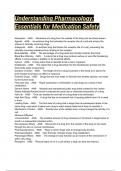
Understanding Pharmacology: Essentials for Medication Safety

Rating
-
Sold
-
Pages
4
Grade
A+
Uploaded on
14-06-2025
Written in
2024/2025

Absorption -ANS- Movement of a drug from the outside of the body into the blood stream. Agonist -ANS- An extrinsic drug that activates the receptor site of a cell and mimics the actions of naturally occurring drugs. Antagonist -ANS- An extrinsic drug that blocks the receptor site of a cell, preventing the naturally occurring substance from binding to the receptor. Bioavailability -ANS- The percentage of a drug dose that actually reaches the blood. Black Box Warning -ANS- A notice that a drug may produce serious or even life threatening effects in some people in addition to its beneficial effects. Cytoxic -ANS- A drug action that is intended to kill a cell or organism. Distribution -ANS- The extent that a drug absorbed into the bloodstream spreads into the three body water components. Duration of Action -ANS- The length of time a drug is present in the blood at or above the level needed to produce an effect or response. Extrinsic Drugs -ANS- Drugs that are man made or derived from another species; not made by the human body. First pass loss -ANS- Rapid inactivation or elimination of oral drugs as a result of liver metabolism. Generic Name -ANS- National and international public drug name created by the United States Adopted NamesCouncil to indicate the usual use or chemical composition of a drug. Half Life -ANS- Time san needed for one half of a drug dose to be eliminated. High Alert Drug -ANS- A drug that has an increased risk of causing patient harm if it is used in error. Loading Dose -ANS- The first dose of a drug that is larger than all subsequent doses of the same drug; used when it takes more drug to reach steady state that it does to maintain it. Mechanism of Action -ANS- Exactly how, at the cellular level, a drug changes the activity of a cell. Minimum Effective Concentration -ANS- The smallest amount of drug necessary in the blood or target tissue to result in a measurable intended action. Percutaneous Route -ANS- Movement of a drug from the outside of the body to the inside through the skin or mucous membranes. Pharmacodynamics -ANS- Ways in which drugs work to change body function. Pharmacokinetics -ANS- How the body changes drugs; drug metabolism. Physiologic Effects -ANS- The change in body function as an income of the mechanism of action off a drug. Receptors -ANS- Physical place on or in a cell where a drug can bind and interact. Sequestration -ANS- The trapping of drugs within certain body tissues, delaying their elimination and extending their duration of action. Steady State -ANS- Point at which drug elimination is balance with drug entry, resulting in a constant effective blood level of the drug. Target Tissue -ANS- The actual cells or tissues affected by the mechanism of action or intended actions of a specific drug. Transdermal -ANS- Type of percutaneous drug delivery in which the drug is applied to the skin, passes through the skin and enters the bloodstream. Vaporized -ANS- Changing of a drug from a liquid form to a gas that can be absorbed into the body by inhalation. A plan to improve or prevent a health problem that includes the use of drugs. -ANS- Drug therapy. What factors does drug therapy involve? -ANS- 1. Identifying the specific health problem. 2. Determining what drug or drugs would be the best treatment for the problem. 3. Deciding the best delivery method and schedule. 4. Ensuring that the proper amount of the drug is given. 5. Helping the patient become an active participant in his or her drug therapy. What is the prescriber's role in drug therapy? -ANS- To select and order specific drugs. What are examples of state approved prescribers? -ANS- Physicians, dentists, podiatrists, advanced practice nurses, and physician's assistants. What is the pharmacists role in drug therapy? -ANS- To mix and dispense prescribed drugs. What is the nurse's role in drug therapy? -ANS- To administer drugs. A desired effect of a drug. -ANS- Intended action or therapeutic response. Which name of a drug is commonly used by physicians, pharmacists, nurses, and other healthcare professionals? -ANS- Generic Who creates the generic names for all drugs? -ANS- United States Adopted Names (USAN) Prefix that indicates lipid lowering effect in generic drugs. -ANS- -statin Prefix that indicates a beta-blocker. -ANS- -olol Give some examples of OTC drugs. -ANS- Aspirin, antacids, vitamins, and antihistamines. Which drugs have been reclassified as OTC? -ANS- Benadryl, Zantac, and Prilosec True or false, always ask a patient if they are taking an OTC drug daily. -ANS- True True or false, each state has the ability to determine who writes drug orders. -ANS- True. What does PINCH stand for? -ANS- Potassium Insulin Narcotics Chemotherapy Heparin If a person who is taking warfarin (Coumadin) also ingests white willow or gingko biloba, what will happen? -ANS- Increases risk for brain hemorrhage. True or false, herbal medicines are always safe. -ANS- False, herbal products can interfere with prescribed medications and produce adverse effects. Stinging nettle can cause what when taken with digoxin? -ANS- Makes a normal dose of digoxin toxic. Stinging nettle can cause dehydration, lowering cardiac output and BP. What is your responsibility in regards to herbal medication? -ANS- To obtain the correct information and to educate the patient about potential health problems of specific herbal therapies. Responsible for developing standards for drug manufacturing, including purity, strength, packaging, and labeling. -ANS- The United States Pharmacopoeia (USP) An agency of the U.S government responsible for enforcing the standards of the USP. -ANS- The FDA Works together with the U.S congress and Supreme Court to ensure public protection and drug safety. -ANS- The FDA and USP What is a consequence of a cell having more than one receptor? -ANS- Means a drug can affect a cell in multiple ways. What is the target for morphine? -ANS- Neurons that receive pain impulses. True or false, some cells can act as both agonist and antagonists. -ANS- True; epinephrine is an example. It acts as an agonist when biding to the heart muscle cells, and acts like an antagonists when attaching to muscle cells in the airways. Other names for adverse effect. -ANS- Toxic effect; toxicity. What are symptoms of Adverse Drug Reactions? -ANS- 1. Muscle breakdown with cholesterol lowering drugs (statin). 2. Lung Fibrosis with the use f amiodarone (drug to correct heart rate) 3. Pseudomembranous colitis with antibacterial drugs. 4. Seizures and heart rhytm problems with the use of a bronchodilator (theophylline) What are common allergic responses? -ANS- 1. Tightness in chest. 2. Difficulty breathing. 3. Low blood pressure. 4. Hives on skin. 5. Swelling of face, mouth, and throat. 6. Weak and thready pulse. 7. A sense that something bad is happening. Another name for idiosyncratic response. -ANS- Personal response. Drugs given via parenteral route must be ___ while drugs given via enteral route must be _____. -ANS- Sterile; Clean Only what kind of drugs can be absorbed percutaneously? -ANS- Lipid soluble drugs. What drugs can be given transdermally? -ANS- Nitroglycerin in the form of a transdermal patch, pain medications, and continuous hormone treatments. The most commonly used route of administration. -ANS- Enteral Drugs given via the enteral route have ____ bioavailablity. -ANS- Less. What are the advantages/disadvantages of percutaneous administration? -ANS- Advantages: Convenient. Disadvantages: Absorption dependent on circulation. What are the advantages/disadvantages of transdermal administration? -ANS- Advantages: Bypasses gastrointestinal tract. Offers large selection of body areas. Disadvantages: Absorption is less predictable. Can lead to skin breakdown. What are the advantages/disadvantages of sublinguals? -ANS- Advantages: Less invasive. Rapid absorption. Disadvantages: Effect is reduced when a patient eats or drinks. What are the advantages/disadvantages of buccal administration? -ANS- Advantages: Less invasive/obtrusive. Disadvantages: Effect is reduced when patient eats or drinks. What are the advantages/disadvantages of rectal administration? -ANS- Advantages: Usually painless. Disadvantages: Embarassing. What are the advantages/Disadvantages of enteral administration? -ANS- Advantages: Convenient, high patient acceptance, least expensive route, large surface area for absorption. Disadvantages: Can cause gastrointestinal disturbance, first pass loss, can bind to other substances in the tract and not get absorbed, absorption dependent on motility; has great individual variation. What are the advantages/disadvantages of parenteral administration? -ANS- Advantages: Speed, 100 percent bioavailibility, decreased first pass loss. Disadvantages: Speed, invasive administration, increased cost, discomfort. True or false, rectal delivery may be enteral or percutaneous. -ANS- True; Drugs placed within the lowest 1.5 inches of the rectum can be considered percutaneous, whereas drugs placed higher can be considered enteral. What does the paraenteral route bypass? -ANS- The intestinal organs as well as the liver. Which paraenteral structures can drugs be administered in? -ANS- 1. Intra-arterial injection. (artery) 2. intravenous (IV, vein) 3. intradermal (skin) 4. subcutaneous (adipose/connective) 5. Intramuscular (IM) 6. Intracavity (Body cavity) 7. intra-articular (joint) 8. intra-osseous (bone) 9. Directly into specific organs. The watery body spaces between all body cells. -ANS- Interstitial space. The largest drug compartment that includes the blood volume, the watery spaces between cells, and the space inside the cells. -ANS- Intracellular space Most drugs are sent to where? -ANS- The interstitial spaces. What is the smallest drug? -ANS- Lithium Smaller drugs that are water seeking. -ANS- Hydrophilic Where do hydrophilic drugs distribute to? -ANS- The plasma volume and the watery spaces. What conditions reduce drug distribution? -ANS- Dehydration and hypotension.

Show more Read less
Institution
Understanding Pharmacology
Course
Understanding Pharmacology


Whoops! We can’t load your doc right now. Try again or contact support.

Written for

Institution
Understanding Pharmacology
Course
Understanding Pharmacology

Document information

Uploaded on
June 14, 2025
Number of pages
4
Written in
2024/2025
Type
Exam (elaborations)
Contains
Questions & answers

Subjects

Content preview

Understanding Pharmacology:
Essentials for Medication Safety
Absorption -ANS- Movement of a drug from the outside of the body into the blood stream.
Agonist -ANS- An extrinsic drug that activates the receptor site of a cell and mimics the
actions of naturally occurring drugs.
Antagonist -ANS- An extrinsic drug that blocks the receptor site of a cell, preventing the
naturally occurring substance from binding to the receptor.
Bioavailability -ANS- The percentage of a drug dose that actually reaches the blood.
Black Box Warning -ANS- A notice that a drug may produce serious or even life threatening
effects in some people in addition to its beneficial effects.
Cytoxic -ANS- A drug action that is intended to kill a cell or organism.
Distribution -ANS- The extent that a drug absorbed into the bloodstream spreads into the
three body water components.
Duration of Action -ANS- The length of time a drug is present in the blood at or above the
level needed to produce an effect or response.
Extrinsic Drugs -ANS- Drugs that are man made or derived from another species; not made
by the human body.
First pass loss -ANS- Rapid inactivation or elimination of oral drugs as a result of liver
metabolism.
Generic Name -ANS- National and international public drug name created by the United
States Adopted NamesCouncil to indicate the usual use or chemical composition of a drug.
Half Life -ANS- Time san needed for one half of a drug dose to be eliminated.
High Alert Drug -ANS- A drug that has an increased risk of causing patient harm if it is used
in error.
Loading Dose -ANS- The first dose of a drug that is larger than all subsequent doses of the
same drug; used when it takes more drug to reach steady state that it does to maintain it.
Mechanism of Action -ANS- Exactly how, at the cellular level, a drug changes the activity of a
cell.
Minimum Effective
Concentration -ANS- The smallest amount of drug necessary in the blood or target tissue to
result in a measurable intended action.
Percutaneous Route -ANS- Movement of a drug from the outside of the body to the inside
through the skin or mucous membranes.
Pharmacodynamics -ANS- Ways in which drugs work to change body function.
Pharmacokinetics -ANS- How the body changes drugs; drug metabolism.
Physiologic Effects -ANS- The change in body function as an income of the mechanism of
action off a drug.
Receptors -ANS- Physical place on or in a cell where a drug can bind and interact.
$9.49
Get access to the full document:

100% satisfaction guarantee
Immediately available after payment
Both online and in PDF
No strings attached

Get to know the seller
Seller avatar
CalebSTUVIA
3.0
(2)

Get to know the seller

Seller avatar
CalebSTUVIA Chamberlain College Of Nursing
View profile
Follow You need to be logged in order to follow users or courses
Sold
5
Member since
1 year
Number of followers
2
Documents
139
Last sold
1 week ago
Caleb's STUVIA

3.0

2 reviews

5
0
4
0
3
2
2
0
1
0

Recently viewed by you

Why students choose Stuvia

Created by fellow students, verified by reviews

Quality you can trust: written by students who passed their tests and reviewed by others who've used these notes.

Didn't get what you expected? Choose another document

No worries! You can instantly pick a different document that better fits what you're looking for.

Pay as you like, start learning right away

No subscription, no commitments. Pay the way you're used to via credit card and download your PDF document instantly.

Student with book image

“Bought, downloaded, and aced it. It really can be that simple.”

Alisha Student

Frequently asked questions

