

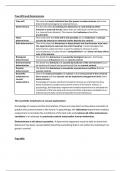
Free Will and Determinism
Free will The view that each individual has the power to make choices and is not
determined by biological or external forces.
Determinism It is the view that an individual’s behaviour is controlled by either
internal or external forces rather than an individual’s will to do something
(i.e. free will is an illusion). This means that behaviour should be
predictable.
Hard This is the view that free will is not possible as our behaviour is always
determinism caused by internal or external events beyond our control.
Soft determinism This is the idea that behaviour is determined, but that humans also have
the opportunity to exercise free will if need be. It acknowledges that
determinism exists but there is also the ability to choose in some
circumstances. It is also named ‘compatibilism’ as it does not deny either
side of the debate.
Biological The belief that behaviour is caused by biological (genetic, hormonal,
determinism evolutionary) influences that we cannot control.
Environmental The belief that behaviour is caused by features of the environment (such
determinism as systems of reward and punishment) that we cannot control.
Psychic The belief that behaviour is caused be unconscious conflicts that we
determinism cannot control.
Scientific One of the basic principles of science is that every event in the universe
emphasis on has a cause and that causes can be explained using general laws (hard
causal determinism).
explanations Knowledge of causes and the formulation of laws are important as they
allow scientists to predict and control events in the future. Hence, in
psychology, the laboratory experiment enables researchers to simulate the
conditions of the test tube and remove all other extraneous variables in an
attempt to precisely control and predict human behaviour.
The scientific emphasis on causal explanation
Knowledge of causes and the formulation of laws are important as they allow scientists to
predict and control events in the future. In psychology, the laboratory experiment enables
researchers to simulate the conditions of the test tube and remove all other extraneous
variables in an attempt to precisely control and predict human behaviour.
Determinism is all about causation. A determinist argument must be able to show that
behaviour has been caused (determined) by something that is not within the individual’s or
group’s control.
Free Will
, Free will is the ability to behave in the way we want. This means our actions are voluntary
and we have freedom of choice. Free will means there are no restraints on choice from
the options available – we may decide not to choose any of the presented options.
A03
Example:
Humanistic approach – only approach to fully advocate for the existence of free will –
argues humans have ‘personal agency’ - personal control over the choices they make, the
directions in life they take and the consequences they lead to. Higher levels of Maslow’s
hierarchy of needs require us to have the ability to choose our actions + Roger’s client-
centred therapy involves helping the client to decide their own best course of action by
reflecting on the possibilities + consequences
Determinism
The opposing view to free will – the idea that there is no control or choice on our course
of action. Determinants of our behaviour come from a combination of sources – biology,
learning and thought. Over the years, determinism has altered from an extreme stance to
varying degrees of determinism: hard and soft
Free will + hard determinism = soft determinism
Hard This is the view that free will is not possible as our behaviour is always
determinism caused by internal or external events beyond our control.
Soft determinism This is the idea that behaviour is determined, but that humans also have
the opportunity to exercise free will if need be. It acknowledges that
determinism exists but there is also the ability to choose in some
circumstances. It is also named ‘compatibilism’ as it does not deny either
side of the debate.
Hard determinism
- Sometimes referred to as ‘fatalism’
- Suggests all human behaviour has a cause
- Compatible with the aims of science – to uncover the causal laws that govern
thought and action
- Assumes that everything we think and do is dictated by internal and external
forces that we cannot control
A03
Free will The view that each individual has the power to make choices and is not
determined by biological or external forces.
Determinism It is the view that an individual’s behaviour is controlled by either
internal or external forces rather than an individual’s will to do something
(i.e. free will is an illusion). This means that behaviour should be
predictable.
Hard This is the view that free will is not possible as our behaviour is always
determinism caused by internal or external events beyond our control.
Soft determinism This is the idea that behaviour is determined, but that humans also have
the opportunity to exercise free will if need be. It acknowledges that
determinism exists but there is also the ability to choose in some
circumstances. It is also named ‘compatibilism’ as it does not deny either
side of the debate.
Biological The belief that behaviour is caused by biological (genetic, hormonal,
determinism evolutionary) influences that we cannot control.
Environmental The belief that behaviour is caused by features of the environment (such
determinism as systems of reward and punishment) that we cannot control.
Psychic The belief that behaviour is caused be unconscious conflicts that we
determinism cannot control.
Scientific One of the basic principles of science is that every event in the universe
emphasis on has a cause and that causes can be explained using general laws (hard
causal determinism).
explanations Knowledge of causes and the formulation of laws are important as they
allow scientists to predict and control events in the future. Hence, in
psychology, the laboratory experiment enables researchers to simulate the
conditions of the test tube and remove all other extraneous variables in an
attempt to precisely control and predict human behaviour.
The scientific emphasis on causal explanation
Knowledge of causes and the formulation of laws are important as they allow scientists to
predict and control events in the future. In psychology, the laboratory experiment enables
researchers to simulate the conditions of the test tube and remove all other extraneous
variables in an attempt to precisely control and predict human behaviour.
Determinism is all about causation. A determinist argument must be able to show that
behaviour has been caused (determined) by something that is not within the individual’s or
group’s control.
Free Will
, Free will is the ability to behave in the way we want. This means our actions are voluntary
and we have freedom of choice. Free will means there are no restraints on choice from
the options available – we may decide not to choose any of the presented options.
A03
Example:
Humanistic approach – only approach to fully advocate for the existence of free will –
argues humans have ‘personal agency’ - personal control over the choices they make, the
directions in life they take and the consequences they lead to. Higher levels of Maslow’s
hierarchy of needs require us to have the ability to choose our actions + Roger’s client-
centred therapy involves helping the client to decide their own best course of action by
reflecting on the possibilities + consequences
Determinism
The opposing view to free will – the idea that there is no control or choice on our course
of action. Determinants of our behaviour come from a combination of sources – biology,
learning and thought. Over the years, determinism has altered from an extreme stance to
varying degrees of determinism: hard and soft
Free will + hard determinism = soft determinism
Hard This is the view that free will is not possible as our behaviour is always
determinism caused by internal or external events beyond our control.
Soft determinism This is the idea that behaviour is determined, but that humans also have
the opportunity to exercise free will if need be. It acknowledges that
determinism exists but there is also the ability to choose in some
circumstances. It is also named ‘compatibilism’ as it does not deny either
side of the debate.
Hard determinism
- Sometimes referred to as ‘fatalism’
- Suggests all human behaviour has a cause
- Compatible with the aims of science – to uncover the causal laws that govern
thought and action
- Assumes that everything we think and do is dictated by internal and external
forces that we cannot control
A03


