

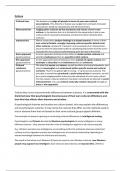
Culture
Cultural bias The tendency to judge all people in terms of your own cultural
assumptions. This distorts or biases your judgement and leads to biased
conclusions. (leads to imposed etic and ethnocentrism).
Ethnocentrism Judging other cultures by the standards and values of one’s own
culture. In its extreme form it is the belief in the superiority of one’s own
culture which may lead to prejudice and discrimination towards other
cultures.
Imposed etic Where researchers analyse findings in a biased manner in terms of their
own cultural beliefs, wrongly imposing cultural-specific beliefs onto
other cultures. Ainsworth’s research is one example of an imposed etic –
assumes that the US based model of classifying attachment was the norm –
imposed her own cultural understanding upon the rest of the world.
Emic approach An emic approach functions from within or inside certain cultures and
(good practice) identifies behaviours that are specific to that culture.
Etic approach An etic approach looks at behaviour from outside of a given culture and
(good practice) attempts to describe those behaviours that are universal.
Cultural The idea that norms and values, as well as ethics and moral standards, can
relativism only be meaningful and understood within specific social and cultural
(good practice) contexts. There is no global right or wrong – it varies across cultures. The
principle is sometimes practiced to avoid cultural bias in research, as well
as to avoid judging another culture by the standards of one’s own culture.
For this reason, cultural relativism has been considered an attempt to avoid
ethnocentrism. You can achieve culturally relative research through an
emic or etic approach.
Culture bias is not concerned with differences between cultures, it is concerned with the
distorted view that psychologists have because of their own cultural affiliations and
how this bias affects their theories and studies.
If psychological theories and studies are culture-biased, this may explain why differences
are found between cultures. It may not be the cultures that differ, but the methods used to
test or observe them that are biased so that some cultural groups appear different.
One example of research ignoring or minimising cultural differences is intelligence testing.
Psychologists use IQ tests devised by Western psychologists to study intelligence in many
different cultures – they assume that their view of intelligence applies to all cultures equally
E.g., Western societies see intelligence as something within the individual whereas collectivist
cultures such as Ugandan society see intelligence as a functional relationship depending on
shared knowledge between the individual and society.
The result is that when such Western IQ tests are used on non-Western cultures, non-Western
people may appear less intelligent. Such tests are described as an imposed etic, where a
, research method or psychological test that is developed by one group is imposed on other
groups of people.
A03
Examples:
Aggression – evolutionary explanations – imply that reasons behind aggression are
universal/cross-cultural (i.e. aggression is an innate behaviour that every culture should
display equally because of a shared ancestral experience of evolution in the EEA).
However, not the case in all cultures/can be affected by social norms – Yanomamo
display high levels of aggression vs !Kung San believe it causes reputational damage/are
rarely aggressive – evolutionary explanations of aggression are guilty of imposing an etic
approach (arguing that their theory is universal when it came about through emic
research)
Attachment – Ainsworth’s strange situation – an example of ethnocentrism – only
reflects norms and values of American culture – secure attachment = moderate amounts
of separation anxiety – misinterpreted in other cultures e.g. German mothers seen as
cold and rejecting – Ainsworth imposed her own cultural understanding upon the rest of
the world/example of an imposed etic
Psychopathology – definitions of abnormality – deviation from social norms – one
cultural group may label someone from another culture as behaving abnormally
according to their standards rather than the standards of the person behaving that way –
e.g. diagnosis of schizophrenia – hallucinations seen as a sign of powers in other cultures
– not indicative of mental illness in those cultures – diagnosis is relative to our culture
General:
Point Evidence Conclusion
Researchers in psychology This means that they have This means that there is a
travel much more now an increased much greater exchange of
than they did 50 years ago. understanding of other ideas, which should
cultures at a personal level reduce ethnocentrism in
but also at a professional psychology, enable an
level. Academics hold understanding of cultural
international conferences relativism and mean that
where researchers from real differences are
many different countries identified and valued.
and cultures regularly meet
to discuss and exchange
ideas.
Cultural bias The tendency to judge all people in terms of your own cultural
assumptions. This distorts or biases your judgement and leads to biased
conclusions. (leads to imposed etic and ethnocentrism).
Ethnocentrism Judging other cultures by the standards and values of one’s own
culture. In its extreme form it is the belief in the superiority of one’s own
culture which may lead to prejudice and discrimination towards other
cultures.
Imposed etic Where researchers analyse findings in a biased manner in terms of their
own cultural beliefs, wrongly imposing cultural-specific beliefs onto
other cultures. Ainsworth’s research is one example of an imposed etic –
assumes that the US based model of classifying attachment was the norm –
imposed her own cultural understanding upon the rest of the world.
Emic approach An emic approach functions from within or inside certain cultures and
(good practice) identifies behaviours that are specific to that culture.
Etic approach An etic approach looks at behaviour from outside of a given culture and
(good practice) attempts to describe those behaviours that are universal.
Cultural The idea that norms and values, as well as ethics and moral standards, can
relativism only be meaningful and understood within specific social and cultural
(good practice) contexts. There is no global right or wrong – it varies across cultures. The
principle is sometimes practiced to avoid cultural bias in research, as well
as to avoid judging another culture by the standards of one’s own culture.
For this reason, cultural relativism has been considered an attempt to avoid
ethnocentrism. You can achieve culturally relative research through an
emic or etic approach.
Culture bias is not concerned with differences between cultures, it is concerned with the
distorted view that psychologists have because of their own cultural affiliations and
how this bias affects their theories and studies.
If psychological theories and studies are culture-biased, this may explain why differences
are found between cultures. It may not be the cultures that differ, but the methods used to
test or observe them that are biased so that some cultural groups appear different.
One example of research ignoring or minimising cultural differences is intelligence testing.
Psychologists use IQ tests devised by Western psychologists to study intelligence in many
different cultures – they assume that their view of intelligence applies to all cultures equally
E.g., Western societies see intelligence as something within the individual whereas collectivist
cultures such as Ugandan society see intelligence as a functional relationship depending on
shared knowledge between the individual and society.
The result is that when such Western IQ tests are used on non-Western cultures, non-Western
people may appear less intelligent. Such tests are described as an imposed etic, where a
, research method or psychological test that is developed by one group is imposed on other
groups of people.
A03
Examples:
Aggression – evolutionary explanations – imply that reasons behind aggression are
universal/cross-cultural (i.e. aggression is an innate behaviour that every culture should
display equally because of a shared ancestral experience of evolution in the EEA).
However, not the case in all cultures/can be affected by social norms – Yanomamo
display high levels of aggression vs !Kung San believe it causes reputational damage/are
rarely aggressive – evolutionary explanations of aggression are guilty of imposing an etic
approach (arguing that their theory is universal when it came about through emic
research)
Attachment – Ainsworth’s strange situation – an example of ethnocentrism – only
reflects norms and values of American culture – secure attachment = moderate amounts
of separation anxiety – misinterpreted in other cultures e.g. German mothers seen as
cold and rejecting – Ainsworth imposed her own cultural understanding upon the rest of
the world/example of an imposed etic
Psychopathology – definitions of abnormality – deviation from social norms – one
cultural group may label someone from another culture as behaving abnormally
according to their standards rather than the standards of the person behaving that way –
e.g. diagnosis of schizophrenia – hallucinations seen as a sign of powers in other cultures
– not indicative of mental illness in those cultures – diagnosis is relative to our culture
General:
Point Evidence Conclusion
Researchers in psychology This means that they have This means that there is a
travel much more now an increased much greater exchange of
than they did 50 years ago. understanding of other ideas, which should
cultures at a personal level reduce ethnocentrism in
but also at a professional psychology, enable an
level. Academics hold understanding of cultural
international conferences relativism and mean that
where researchers from real differences are
many different countries identified and valued.
and cultures regularly meet
to discuss and exchange
ideas.


