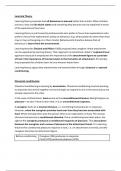
Learning Theory
Learning theory proposes that all behaviour is learned rather than innate. When children
are born, they are like blank slates and everything they become can be explained in terms
of the experiences they have.
Learning theory is put forward by behaviourists who prefer to focus their explanations who
prefer to focus their explanations solely on behaviour (e.g. what people do rather than what
may or may not be going on in their minds). Behaviourists therefore believe that all
behaviour is learnt from the environment.
Learning theorists Dollard and Miller (1950) proposed that caregiver-infant attachment
can be explained by learning theory. Their approach is sometimes called a ‘cupboard love’
approach because it emphasises the importance of the attachment figure as a provider
of food / the importance of food provision in the formation of attachment. Put simply,
they proposed that children learn to love whoever feeds them.
Learning theory argues that attachments are learned either through classical or operant
conditioning.
Classical conditioning
Classical conditioning is learning by association. Classical conditioning involves learning
to associate two stimuli together so that we begin to respond to one in the same way as we
already respond to the other.
In the case of attachment, food serves as the unconditioned stimulus. Being fed gives us
pleasure – we don’t have to learn that, it is an unconditioned response.
A caregiver starts as a neutral stimulus, i.e. something that produces no response.
However, when the caregiver provides food over time they become associated with
food. When the baby then sees this person there is an expectation of food. The neutral
stimulus has become a conditioned stimulus. Once conditioning has taken place, the
sight of the caregiver produces a conditioned response of pleasure. This association
between the caregiver and a sense of pleasure is the attachment bond. To a learning
theorist this conditioned pleasure response is love, i.e. an attachment is formed, and the
caregiver becomes an attachment figure.
Before conditioning Caregiver (NS) produces no response
Food (UCS) produces pleasure (UCR)
, During conditioning Infant makes an association between food (UCS) and caregiver
(NS) which produces pleasure (UCR)
After conditioning Caregiver (CS) now produces pleasure (CR)
Operant conditioning
Operant conditioning involves learning from the consequences of behaviour. If a
behaviour produces a pleasant consequence, that behaviour is likely to be repeated
again. The behaviour is said to be reinforced. If a behaviour produces an unpleasant
consequence (punishment) it is less likely to be repeated.
Dollard and Miller (1950) offered an explanation of attachment based on operant
conditioning and drive reduction theory:
- A ‘drive’ is something that motivates behaviour. A new-born baby will cry in
response to feelings of discomfort, which comes from being hungry. The feeling of
hunger creates a drive to reduce the discomfort (known as drive reduction). The
sound of a baby crying is uncomfortable to a caregiver who will attempt to
console the child by feeding them.
- When the baby is fed by the caregiver, the drive is reduced, and this produces a
feeling of pleasure. This is rewarding for the baby (called positive reinforcement)
who is likely to settle down and stop crying. As the crying has produced a reward
and has been positively reinforced, the baby is likely to repeat the crying
behaviour. The baby also receives negative reinforcement as the unpleasant
feeling of hunger has been switched off. At the same time as the baby is
reinforced for crying, the caregiver receives negative reinforcement because the
crying has stopped – escaping from something unpleasant is reinforcing. As the
feeding behaviour switches off the unpleasant crying, the parent learns to instantly
feed the baby in order to stop the ear-splitting crying. It is a two-way process and
perfect system.
- Thus, it is the relief from discomfort or the pleasure of feeding that is rewarding for
the baby. Attachment occurs because the baby seeks the person who can supply
the reward (e.g., the primary caregiver).
Attachment as a secondary drive
As well as conditioning, learning theory draws on the concept of drive reduction. Hunger
can be thought of as a primary drive – it's an innate, biological motivator. We are
motivated to eat in order to reduce the hunger drive.
Learning theory proposes that all behaviour is learned rather than innate. When children
are born, they are like blank slates and everything they become can be explained in terms
of the experiences they have.
Learning theory is put forward by behaviourists who prefer to focus their explanations who
prefer to focus their explanations solely on behaviour (e.g. what people do rather than what
may or may not be going on in their minds). Behaviourists therefore believe that all
behaviour is learnt from the environment.
Learning theorists Dollard and Miller (1950) proposed that caregiver-infant attachment
can be explained by learning theory. Their approach is sometimes called a ‘cupboard love’
approach because it emphasises the importance of the attachment figure as a provider
of food / the importance of food provision in the formation of attachment. Put simply,
they proposed that children learn to love whoever feeds them.
Learning theory argues that attachments are learned either through classical or operant
conditioning.
Classical conditioning
Classical conditioning is learning by association. Classical conditioning involves learning
to associate two stimuli together so that we begin to respond to one in the same way as we
already respond to the other.
In the case of attachment, food serves as the unconditioned stimulus. Being fed gives us
pleasure – we don’t have to learn that, it is an unconditioned response.
A caregiver starts as a neutral stimulus, i.e. something that produces no response.
However, when the caregiver provides food over time they become associated with
food. When the baby then sees this person there is an expectation of food. The neutral
stimulus has become a conditioned stimulus. Once conditioning has taken place, the
sight of the caregiver produces a conditioned response of pleasure. This association
between the caregiver and a sense of pleasure is the attachment bond. To a learning
theorist this conditioned pleasure response is love, i.e. an attachment is formed, and the
caregiver becomes an attachment figure.
Before conditioning Caregiver (NS) produces no response
Food (UCS) produces pleasure (UCR)
, During conditioning Infant makes an association between food (UCS) and caregiver
(NS) which produces pleasure (UCR)
After conditioning Caregiver (CS) now produces pleasure (CR)
Operant conditioning
Operant conditioning involves learning from the consequences of behaviour. If a
behaviour produces a pleasant consequence, that behaviour is likely to be repeated
again. The behaviour is said to be reinforced. If a behaviour produces an unpleasant
consequence (punishment) it is less likely to be repeated.
Dollard and Miller (1950) offered an explanation of attachment based on operant
conditioning and drive reduction theory:
- A ‘drive’ is something that motivates behaviour. A new-born baby will cry in
response to feelings of discomfort, which comes from being hungry. The feeling of
hunger creates a drive to reduce the discomfort (known as drive reduction). The
sound of a baby crying is uncomfortable to a caregiver who will attempt to
console the child by feeding them.
- When the baby is fed by the caregiver, the drive is reduced, and this produces a
feeling of pleasure. This is rewarding for the baby (called positive reinforcement)
who is likely to settle down and stop crying. As the crying has produced a reward
and has been positively reinforced, the baby is likely to repeat the crying
behaviour. The baby also receives negative reinforcement as the unpleasant
feeling of hunger has been switched off. At the same time as the baby is
reinforced for crying, the caregiver receives negative reinforcement because the
crying has stopped – escaping from something unpleasant is reinforcing. As the
feeding behaviour switches off the unpleasant crying, the parent learns to instantly
feed the baby in order to stop the ear-splitting crying. It is a two-way process and
perfect system.
- Thus, it is the relief from discomfort or the pleasure of feeding that is rewarding for
the baby. Attachment occurs because the baby seeks the person who can supply
the reward (e.g., the primary caregiver).
Attachment as a secondary drive
As well as conditioning, learning theory draws on the concept of drive reduction. Hunger
can be thought of as a primary drive – it's an innate, biological motivator. We are
motivated to eat in order to reduce the hunger drive.