Aneesa Ahmed
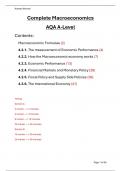
Complete Macroeconomics
AQA A-Level
Contents:
Macroeconomic Formulae (2)
4.2.1. The measurement of Economic Performance (4)
4.2.2. How the Macroeconomic economy works (7)
4.2.3. Economic Performance (13)
4.2.4. Financial Markets and Monetary Policy (28)
4.2.5. Fiscal Policy and Supply Side Policies (36)
4.3.6. The International Economy (41)
Timing:
Section A
2 marker —> 2 minutes
4 marker —> 4 minutes
9 marker —> 12 minutes
25 marker —> 40 minutes
Section B
15 marker —> 20 minutes
25 marker —> 40 minutes
Page 1 of 59
,Aneesa Ahmed
Macroeconomic Formulae
Aggregate demand —> AD = C+I+G+ (X-M)
Nominal GDP—> output: final value of all G+S, income: final value of
all income, expenditure: final value of all spending (AD equation)
Real GDP—> NGDP/ price index x 100
GDP deflator —> nominal GDP/ real GDP x 100
Nominal GDP—> real GDP x price index/ 100 or AD = C+G+I (X-M)
Gross national income (GNI) —> GDP + net factor income
Green GDP —> GDP - environmental costs
Circular flow equilibrium —> injections (I+G+X) = Withdrawals
(S+T+M)
Multiplier —> 1/ 1-MPC or 1/ MPW (MPS+MPT+MPM)
Change in national income —> initial injection x multiplier
Accelerator —> inc rate of GDP growth LINKS to higher investment
and further growth
Budget deficit —> G>T in a year
Budget surplus —> T>G in year
Unemployment rate —> unemployed/ economically active x 100
Index number —> raw number/ raw number of base year x 100
Percentage change —> difference/ original x 100
Weighted price index —> 1) convert prices to index 2) multiply by
weights 3) add up weight prices 4) divide by total weights
Real interest rate —> nominal interest rate- inflation rate
Taxable income —> income - tax free allowance (UK- £12,00)
Average rate of tax —> tax paid/ total income earns x 100
Marginal rate of tax—> change in tax paid / change in total income
earns x 100
Page 2 of 59
,Aneesa Ahmed
Gini coefficient—> area between Lorenz curve and LOPE/ total area
under LOPE
Absolute poverty —> income < $2.15 a day
Relative poverty —> income < 60% of median income
Current account deficit —> financial + capital = account surplus
Current account surplus —> financial and capital = account deficit
Marshall Lerner condition —> PEDx + PEDm > 1
Terms of trade —> index of export prices/ index of import prices x 100
HDI —> literacy rate + GDP + life expectancy (0-1 —> 1 highest) (0.55
is very low)
Bond yield —> coupon rate/ interest rate/ market price x 100
Money multiplier —> 1/ reserve requirement
Fisher equation (quantity theory of money) —> Money supply x
velocity of circulation (MV) = average price level x value of goods and
services in the economy (classical economics believe V and Q are
fixed SOOO a change in money supply will cause a change in price
level = inflation)
Liquidity ratio —> SR current assets/ SR current liabilities x 100
Capital ratio —> capital/ loans x 100
Page 3 of 59
,Aneesa Ahmed
4.2.1 The measurement of economic performance
4.2.1.1 The objectives of government economic policy
Main objectives of government macroeconomic policies:
- Economic growth
- Price stability (inflation)
- Minimising unemployment
- Stable balance of payments on the current account
Other objectives include:
- Balancing the budget
- Equitable distribution of income
BUT objectives change over time AND conflict may arise in the short run when
attempting to achieve these objectives (e.g. if growth is rising, so may demand, therfore
demand-pull elasticity = unstable price)
4.2.1.2 Macroeconomic indicators
Data used to measure performance in the economy:
- Real GDP- value of output we produce in one year, accounting for inflation
(measures economic growth)
- GDP per capita- value of output we produce in one year/ population
- GNI (GDP+ net income from abroad)
- GNP (total output of citizens of a country regardless of if they are a resident or
not)
- Consumer price index- price of weighted average basket of consumer goods
(measures inflation)
- Measures of unemployment e.g. Labour force survey
- Productivity (measures economic growth)
- Balance of payments
4.2.1.3 Uses of Index numbers
Index numbers: used to measure change in price level/ other economic variables
- Base year = 100, changes according to changes in price each year
Index Calculation:
(Value of year x/ value of base year (100)) = index for year x
Weighted index calculation:
1. Work out index for both years
Page 4 of 59
, Aneesa Ahmed
2. Multiply each index by each weight
3. ANSWER/ total index
4.2.1.4. Uses of national income data
National income: total amount of money earned within a year
Measuring national income:
A) Output method: total value added
B) Expenditure method: total expenditure on G+ S in the economy
C) Income method: total income from producing G+S in the economy
A=B=C
Nominal value: raw value unadjusted for inflation
Real value: value adjusted for inflation
Uses for NI:
- Compare data with other countries
- See how well the country/ economy is doing
- See how well the economy is growing
Issues with NI statistics:
- Too much data = statistical inaccuracies
- Hidden economy is not included i.e. illegal markets
- Home produced services not included e.g. chores
- Difficult to place value on public sector output e.g. teachers
Issues with GDP
- Fails to realise tax burden is different in different countries
- Ignores deep-rooted inequality
- Not a reliable guide to well-being
- Doesn’t consider unpaid work/ free services
Ignored middle income people (use median disposable income instead)
Problems caused with overtime use of NI:
- Changes in population
- Quality of goods and services
- Different levels of NI devoted to defence, consumption and investment
- Questionable accuracy of statistics
- Possible externalities
Comparing National income with other countries
Page 5 of 59
Complete Macroeconomics
AQA A-Level
Contents:
Macroeconomic Formulae (2)
4.2.1. The measurement of Economic Performance (4)
4.2.2. How the Macroeconomic economy works (7)
4.2.3. Economic Performance (13)
4.2.4. Financial Markets and Monetary Policy (28)
4.2.5. Fiscal Policy and Supply Side Policies (36)
4.3.6. The International Economy (41)
Timing:
Section A
2 marker —> 2 minutes
4 marker —> 4 minutes
9 marker —> 12 minutes
25 marker —> 40 minutes
Section B
15 marker —> 20 minutes
25 marker —> 40 minutes
Page 1 of 59
,Aneesa Ahmed
Macroeconomic Formulae
Aggregate demand —> AD = C+I+G+ (X-M)
Nominal GDP—> output: final value of all G+S, income: final value of
all income, expenditure: final value of all spending (AD equation)
Real GDP—> NGDP/ price index x 100
GDP deflator —> nominal GDP/ real GDP x 100
Nominal GDP—> real GDP x price index/ 100 or AD = C+G+I (X-M)
Gross national income (GNI) —> GDP + net factor income
Green GDP —> GDP - environmental costs
Circular flow equilibrium —> injections (I+G+X) = Withdrawals
(S+T+M)
Multiplier —> 1/ 1-MPC or 1/ MPW (MPS+MPT+MPM)
Change in national income —> initial injection x multiplier
Accelerator —> inc rate of GDP growth LINKS to higher investment
and further growth
Budget deficit —> G>T in a year
Budget surplus —> T>G in year
Unemployment rate —> unemployed/ economically active x 100
Index number —> raw number/ raw number of base year x 100
Percentage change —> difference/ original x 100
Weighted price index —> 1) convert prices to index 2) multiply by
weights 3) add up weight prices 4) divide by total weights
Real interest rate —> nominal interest rate- inflation rate
Taxable income —> income - tax free allowance (UK- £12,00)
Average rate of tax —> tax paid/ total income earns x 100
Marginal rate of tax—> change in tax paid / change in total income
earns x 100
Page 2 of 59
,Aneesa Ahmed
Gini coefficient—> area between Lorenz curve and LOPE/ total area
under LOPE
Absolute poverty —> income < $2.15 a day
Relative poverty —> income < 60% of median income
Current account deficit —> financial + capital = account surplus
Current account surplus —> financial and capital = account deficit
Marshall Lerner condition —> PEDx + PEDm > 1
Terms of trade —> index of export prices/ index of import prices x 100
HDI —> literacy rate + GDP + life expectancy (0-1 —> 1 highest) (0.55
is very low)
Bond yield —> coupon rate/ interest rate/ market price x 100
Money multiplier —> 1/ reserve requirement
Fisher equation (quantity theory of money) —> Money supply x
velocity of circulation (MV) = average price level x value of goods and
services in the economy (classical economics believe V and Q are
fixed SOOO a change in money supply will cause a change in price
level = inflation)
Liquidity ratio —> SR current assets/ SR current liabilities x 100
Capital ratio —> capital/ loans x 100
Page 3 of 59
,Aneesa Ahmed
4.2.1 The measurement of economic performance
4.2.1.1 The objectives of government economic policy
Main objectives of government macroeconomic policies:
- Economic growth
- Price stability (inflation)
- Minimising unemployment
- Stable balance of payments on the current account
Other objectives include:
- Balancing the budget
- Equitable distribution of income
BUT objectives change over time AND conflict may arise in the short run when
attempting to achieve these objectives (e.g. if growth is rising, so may demand, therfore
demand-pull elasticity = unstable price)
4.2.1.2 Macroeconomic indicators
Data used to measure performance in the economy:
- Real GDP- value of output we produce in one year, accounting for inflation
(measures economic growth)
- GDP per capita- value of output we produce in one year/ population
- GNI (GDP+ net income from abroad)
- GNP (total output of citizens of a country regardless of if they are a resident or
not)
- Consumer price index- price of weighted average basket of consumer goods
(measures inflation)
- Measures of unemployment e.g. Labour force survey
- Productivity (measures economic growth)
- Balance of payments
4.2.1.3 Uses of Index numbers
Index numbers: used to measure change in price level/ other economic variables
- Base year = 100, changes according to changes in price each year
Index Calculation:
(Value of year x/ value of base year (100)) = index for year x
Weighted index calculation:
1. Work out index for both years
Page 4 of 59
, Aneesa Ahmed
2. Multiply each index by each weight
3. ANSWER/ total index
4.2.1.4. Uses of national income data
National income: total amount of money earned within a year
Measuring national income:
A) Output method: total value added
B) Expenditure method: total expenditure on G+ S in the economy
C) Income method: total income from producing G+S in the economy
A=B=C
Nominal value: raw value unadjusted for inflation
Real value: value adjusted for inflation
Uses for NI:
- Compare data with other countries
- See how well the country/ economy is doing
- See how well the economy is growing
Issues with NI statistics:
- Too much data = statistical inaccuracies
- Hidden economy is not included i.e. illegal markets
- Home produced services not included e.g. chores
- Difficult to place value on public sector output e.g. teachers
Issues with GDP
- Fails to realise tax burden is different in different countries
- Ignores deep-rooted inequality
- Not a reliable guide to well-being
- Doesn’t consider unpaid work/ free services
Ignored middle income people (use median disposable income instead)
Problems caused with overtime use of NI:
- Changes in population
- Quality of goods and services
- Different levels of NI devoted to defence, consumption and investment
- Questionable accuracy of statistics
- Possible externalities
Comparing National income with other countries
Page 5 of 59