
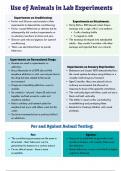
Use of Animals in Lab Experiments
Experiments on Conditioning:
Pavlov and Skinner used animals in their Experiments on Attachment:
experiments to demonstrate conditioning. Harry Harlow 1959 placed infant rhesus
Pavlov caused little harm or distress but he monkeys into a cage with 2 wire mothers:
subsequently did conduct experiments on 1 with a feeding bottle
involuntary reactions to stress and pain. 1 wrapped in cloth
Skinner used rats and pigeons for operant The monkeys developed into maladjusted
conditioning. adults - they couldn’t socialise with other
There was electrified floors to punish monkeys and rejected their own infants.
behaviour.
Experiments on Recreational Drugs:
Animals are used in experiments on
addiction. Experiments on Sensory Deprivation:
Bruce Alexander et al 1978 showed that Blakemore and Cooper 1970 demonstrated how
morphine addiction in rats was not just due to the visual system develops using kittens in a
the drug but also related to the social visually-restricting environment.
environment. Aged 5 months, they were placed into an
Drugs are irresistibly addictive, even to ordinary environment but showed no
animals. response to lines of the opposite orientation.
He created a ‘rat park’ where 20 rats lived The vertically deprived kitten could not see a
together and had access to water and black rod held vertically.
morphine solution. The kitten’s visual cortex was tested by
Rats in solitary confinement opted for anaesthetising and paralysing them.
morphine but once with others went for the Benefits for treating children with visual
water. problems.
Social environments have a profound effect
on addiction.
For and Against Animal Testing:
For: Against:
The conditioning processes are the same in Many not be justifiable to generalise from
all animals - their behaviour can be animals to humans with complex behaviours
generalised to humans to a certain extent. like addiction.
Fewer ethical issues - harm is more Human behaviour is more controlled by higher
acceptable. cognitive thinking.
Experiments on Conditioning:
Pavlov and Skinner used animals in their Experiments on Attachment:
experiments to demonstrate conditioning. Harry Harlow 1959 placed infant rhesus
Pavlov caused little harm or distress but he monkeys into a cage with 2 wire mothers:
subsequently did conduct experiments on 1 with a feeding bottle
involuntary reactions to stress and pain. 1 wrapped in cloth
Skinner used rats and pigeons for operant The monkeys developed into maladjusted
conditioning. adults - they couldn’t socialise with other
There was electrified floors to punish monkeys and rejected their own infants.
behaviour.
Experiments on Recreational Drugs:
Animals are used in experiments on
addiction. Experiments on Sensory Deprivation:
Bruce Alexander et al 1978 showed that Blakemore and Cooper 1970 demonstrated how
morphine addiction in rats was not just due to the visual system develops using kittens in a
the drug but also related to the social visually-restricting environment.
environment. Aged 5 months, they were placed into an
Drugs are irresistibly addictive, even to ordinary environment but showed no
animals. response to lines of the opposite orientation.
He created a ‘rat park’ where 20 rats lived The vertically deprived kitten could not see a
together and had access to water and black rod held vertically.
morphine solution. The kitten’s visual cortex was tested by
Rats in solitary confinement opted for anaesthetising and paralysing them.
morphine but once with others went for the Benefits for treating children with visual
water. problems.
Social environments have a profound effect
on addiction.
For and Against Animal Testing:
For: Against:
The conditioning processes are the same in Many not be justifiable to generalise from
all animals - their behaviour can be animals to humans with complex behaviours
generalised to humans to a certain extent. like addiction.
Fewer ethical issues - harm is more Human behaviour is more controlled by higher
acceptable. cognitive thinking.


