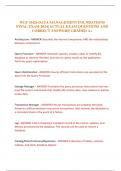
Court Interpreter Certification | written Exam
Prep 2025/2026 Questions and Answers (Verified
Answers)
Define working language - Answer- Languages in which an interpreter is fluent and can use in
his/her work
Define source language - Answer- Language that will be interpreted to a target language
Define target language - Answer- Language into which you interpret
List the three stages of the encounter - Answer- Pre-encounter, The encounter, Post encounter
rap sheet - Answer- Before conveying an offer, a district attorney will first check a defendant's
formal probation - Answer- A person must report to a probation officer on a regular basis if he
or she is on
recidivist - Answer- a repeat offender is also known as a
peremptory challenge - Answer- a defense counsel who rejects a potential juror without having
to give any reason is making use of a
writ - Answer- a judicial order directing a person to do something is a
witness - Answer- a person who testifies regarding what he or she has seen, heard, or otherwise
experienced is a
,warrant - Answer- a court order authorizing law enforcement officers to make an arrest or
conduct a search is known as a
voir dire - Answer- the process of questioning potential jurors so that each side may accept or
reject them is called
venire - Answer- a writ summoning persons to court to act as jurors is known as
germane - Answer- relevant
pandering - Answer- procuring
quash - Answer- nullify
Identify seven steps of the encounter - Answer- Preparation, Briefing (Optional), Professional
introduction, Interpreting, Intervening, Debriefing (Optional), Analysis
Identify four interpreting protocols - Answer- Positioning (appropriate place to sit or stand to
Promote direct communication), Professional introduction (Brief and clear), Direct speech (
speaking in first person), Turn taking (managing the flow)
What is the goal of effective positioning? - Answer- The goal is to promote direct
communication between service provider and patient.
Which guideline principle will help decide which position to take? - Answer- The principle of
role boundaries helps decide position.
Write down the four elements of an interpreter's introduction that come after the interpreter states
his or her name/organization? - Answer- 1) I will be interpreting everything that is said.
2) I will keep everything confidential.
3) Please speak to each other, not to me.
, 4) If I need to pause I will make this gesture.
What are some exceptions to using first person/direct speech? - Answer- 1) Service user is a
child, elderly or mentally disable person.
2) Interpreting for multiple parties.
3) When the content is horrific.
4) In emergency situations when summarizing is needed.
5) Intervening as interpreter
What should you do if a provider keeps speaking in third person/indirect speech? - Answer- 1)
Try to direct communication to patient .
2) Remind provider to speak to each other.
Why do memory skills matter for interpreters? - Answer- Memory skills allow the interpreter to
interpret longer segments accurately, thereby supporting direct [uninterrupted] communication.
What is chunking? - Answer- Process of taking information and breaking it into parts.
Organizing information into smaller meaningful wholes.
List some message transfer skills for interpreters - Answer- Anticipating, Multitasking, Message
Analysis, Parroting, Paraphrasing
strike - Answer- violent felony
disaffected - Answer- malcontent
judicious - Answer- wise
grievous - Answer- grave
Prep 2025/2026 Questions and Answers (Verified
Answers)
Define working language - Answer- Languages in which an interpreter is fluent and can use in
his/her work
Define source language - Answer- Language that will be interpreted to a target language
Define target language - Answer- Language into which you interpret
List the three stages of the encounter - Answer- Pre-encounter, The encounter, Post encounter
rap sheet - Answer- Before conveying an offer, a district attorney will first check a defendant's
formal probation - Answer- A person must report to a probation officer on a regular basis if he
or she is on
recidivist - Answer- a repeat offender is also known as a
peremptory challenge - Answer- a defense counsel who rejects a potential juror without having
to give any reason is making use of a
writ - Answer- a judicial order directing a person to do something is a
witness - Answer- a person who testifies regarding what he or she has seen, heard, or otherwise
experienced is a
,warrant - Answer- a court order authorizing law enforcement officers to make an arrest or
conduct a search is known as a
voir dire - Answer- the process of questioning potential jurors so that each side may accept or
reject them is called
venire - Answer- a writ summoning persons to court to act as jurors is known as
germane - Answer- relevant
pandering - Answer- procuring
quash - Answer- nullify
Identify seven steps of the encounter - Answer- Preparation, Briefing (Optional), Professional
introduction, Interpreting, Intervening, Debriefing (Optional), Analysis
Identify four interpreting protocols - Answer- Positioning (appropriate place to sit or stand to
Promote direct communication), Professional introduction (Brief and clear), Direct speech (
speaking in first person), Turn taking (managing the flow)
What is the goal of effective positioning? - Answer- The goal is to promote direct
communication between service provider and patient.
Which guideline principle will help decide which position to take? - Answer- The principle of
role boundaries helps decide position.
Write down the four elements of an interpreter's introduction that come after the interpreter states
his or her name/organization? - Answer- 1) I will be interpreting everything that is said.
2) I will keep everything confidential.
3) Please speak to each other, not to me.
, 4) If I need to pause I will make this gesture.
What are some exceptions to using first person/direct speech? - Answer- 1) Service user is a
child, elderly or mentally disable person.
2) Interpreting for multiple parties.
3) When the content is horrific.
4) In emergency situations when summarizing is needed.
5) Intervening as interpreter
What should you do if a provider keeps speaking in third person/indirect speech? - Answer- 1)
Try to direct communication to patient .
2) Remind provider to speak to each other.
Why do memory skills matter for interpreters? - Answer- Memory skills allow the interpreter to
interpret longer segments accurately, thereby supporting direct [uninterrupted] communication.
What is chunking? - Answer- Process of taking information and breaking it into parts.
Organizing information into smaller meaningful wholes.
List some message transfer skills for interpreters - Answer- Anticipating, Multitasking, Message
Analysis, Parroting, Paraphrasing
strike - Answer- violent felony
disaffected - Answer- malcontent
judicious - Answer- wise
grievous - Answer- grave