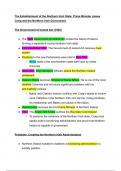
The Establishment of the Northern Irish State: Prime Minister James
Craig and the Northern Irish Government
The Government of Ireland Act (1920)
● The 1920 Government of Ireland Act divided the island of Ireland,
forming a separate 6-county Northern Irish state.
● 23rd December 1920: The Government of Ireland Act receives royal
assent
● Elections to the new Parliaments were held in May 1921.
○ 40/52 seats in the new Northern state were won by Ulster
Unionists
● June 1921: King George V officially opens the Northern Ireland
parliament.
● Dawson Bates becomes Minister of Home Affairs. He is one of the most
hardline Unionists and will cause significant problems with his
anti-Catholic policies.
○ Bates’ anti-Catholic rhetoric conflicts with Craig’s desire to involve
more Catholics in the Northern Irish civil service. Craig prioritises
his relationship with Bates over peace in the nation.
● James Craig becomes the first Prime Minister of Northern Ireland
● 1921: The Anglo-Irish Treaty outlines the Boundary Commission.
○ To preserve the existence of the Northern Irish state, Craig must
rapidly build a functioning administration and prove that Northern
Ireland is capable of government.
Problems: Creating the Northern Irish Administration
● Northern Ireland needed to establish a functioning administration to
solidify partition.
, Evaluation
● Success
○ 300 civil service volunteers moved from Dublin Castle to Belfast
to help in establishing the new government.
○ 20 administrative experts from Westminster assisted Craig in the
early years of Northern Irelands’ existence.
○ 1925: The Boundary Commission does not make any major
changes to the border. The little changes that are suggested are
so polarising that the original border is preserved instead.
○ In relation to the establishment of the Northern Irish judiciary,
Justice Moore commented “the various parts of a great legal
machine have been assembled and it is now running smoothly” in
1925.
● Failure
○ Ministers were “competent but limited, lacking imagination and
adaptability” (Buckland)
○ Bates’ position as Minister of Home Affairs worsened
Unionist/nationalist relations.
Problems: Security Threats
● A period of intense sectarian violence (“The Troubles”) lasted from June
1920 to June 1922.
● Craig had “inherited an explosive security situation” (Rees)
● Unionists were aware that nationalists within Northern Ireland and IRA
men from the Irish Free State wanted to end partition, leading to the
adoption of a “siege mentality” (Buckland). This fear leads to violence.
Craig and the Northern Irish Government
The Government of Ireland Act (1920)
● The 1920 Government of Ireland Act divided the island of Ireland,
forming a separate 6-county Northern Irish state.
● 23rd December 1920: The Government of Ireland Act receives royal
assent
● Elections to the new Parliaments were held in May 1921.
○ 40/52 seats in the new Northern state were won by Ulster
Unionists
● June 1921: King George V officially opens the Northern Ireland
parliament.
● Dawson Bates becomes Minister of Home Affairs. He is one of the most
hardline Unionists and will cause significant problems with his
anti-Catholic policies.
○ Bates’ anti-Catholic rhetoric conflicts with Craig’s desire to involve
more Catholics in the Northern Irish civil service. Craig prioritises
his relationship with Bates over peace in the nation.
● James Craig becomes the first Prime Minister of Northern Ireland
● 1921: The Anglo-Irish Treaty outlines the Boundary Commission.
○ To preserve the existence of the Northern Irish state, Craig must
rapidly build a functioning administration and prove that Northern
Ireland is capable of government.
Problems: Creating the Northern Irish Administration
● Northern Ireland needed to establish a functioning administration to
solidify partition.
, Evaluation
● Success
○ 300 civil service volunteers moved from Dublin Castle to Belfast
to help in establishing the new government.
○ 20 administrative experts from Westminster assisted Craig in the
early years of Northern Irelands’ existence.
○ 1925: The Boundary Commission does not make any major
changes to the border. The little changes that are suggested are
so polarising that the original border is preserved instead.
○ In relation to the establishment of the Northern Irish judiciary,
Justice Moore commented “the various parts of a great legal
machine have been assembled and it is now running smoothly” in
1925.
● Failure
○ Ministers were “competent but limited, lacking imagination and
adaptability” (Buckland)
○ Bates’ position as Minister of Home Affairs worsened
Unionist/nationalist relations.
Problems: Security Threats
● A period of intense sectarian violence (“The Troubles”) lasted from June
1920 to June 1922.
● Craig had “inherited an explosive security situation” (Rees)
● Unionists were aware that nationalists within Northern Ireland and IRA
men from the Irish Free State wanted to end partition, leading to the
adoption of a “siege mentality” (Buckland). This fear leads to violence.