REMEMBER-Christina Rossetti
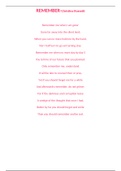
Remember me when I am gone’
Gone far away into the silent land;
When you can no more hold me by the hand,
Nor I half turn to go yet turning stay.
Remember me when no more day by day 5
You tell me of our future that you planned:
Only remember me; understand
It will be late to counsel then or pray.
Yet if you should forget me for a while
And afterwards remember, do not grieve:
For if the darkness and corruption leave
A vestige of the thought that once I had,
Better by far you should forget and smile
Than you should remember and be sad.
, REMEMBER
Questions and answers
1. Refer to line 2: ‘gone far away into the silent land’.’
What do you understand by this line in the context of the poem?
The speaker is asking to be remembered when she is gone away. We realise that she
is referring to her death, when she will be far out of reach, and no longer occupy the
same world of the person she is addressing.
She will have 'gone far way to the silent land (line 2), a euphemism for the after-life,
which she envisages as being silent and still.
2. Describe the nature of the relationship as revealed by the speaker in lines 3-6.
The relationship was a close one; They were physically close, evident in her being
‘held by the hand’ (line 3).
They spent ‘day by day’ (line5) together and believed that their relationship would
last for many years as they discussed plans for the future. She seemed reluctant to
leave his presence as she would turn to go but then turning stay (line 4).
3. Explain how the structure of the poem is mirrored by the change in tone of the
poem.
As this is a Petrarchan sonnet, which is clear from the rhyme scheme, there is a
natural division between the octave and the sestet.
The tone of the octave is sad, nostalgic and filled with regret.
The sestet, however, begins with ‘Yet’, alerting the reader to the shift in content and
tone, and moves to a more comforting, consoling and forgiving tone as the speaker
urges her loved one to forget and smile (line 13).
4. Consider the speaker’s message in lines 9-14. In your view does this message
contradict the poem’s title?
The octave focuses on reminders and pleas for him to ‘remember' her and the special
times they shared. The message of the sestet, however, is for the loved one to move
on with his life and not to wallow in grief at her passing. She selflessly wants him to
be happy rather than miserable in remembering her. This seems to contradict the
title, but as the speaker’s feelings are reflected in the octave and echoed in the final
line, this seems appropriate. The message is for him to remember her and be happy.
5. Provide a different euphemism that Rossetti could have used in place of “gone away”
‘passed on’ OR 'no more' (OR any other gentle way of stating dead).
Remember me when I am gone’
Gone far away into the silent land;
When you can no more hold me by the hand,
Nor I half turn to go yet turning stay.
Remember me when no more day by day 5
You tell me of our future that you planned:
Only remember me; understand
It will be late to counsel then or pray.
Yet if you should forget me for a while
And afterwards remember, do not grieve:
For if the darkness and corruption leave
A vestige of the thought that once I had,
Better by far you should forget and smile
Than you should remember and be sad.
, REMEMBER
Questions and answers
1. Refer to line 2: ‘gone far away into the silent land’.’
What do you understand by this line in the context of the poem?
The speaker is asking to be remembered when she is gone away. We realise that she
is referring to her death, when she will be far out of reach, and no longer occupy the
same world of the person she is addressing.
She will have 'gone far way to the silent land (line 2), a euphemism for the after-life,
which she envisages as being silent and still.
2. Describe the nature of the relationship as revealed by the speaker in lines 3-6.
The relationship was a close one; They were physically close, evident in her being
‘held by the hand’ (line 3).
They spent ‘day by day’ (line5) together and believed that their relationship would
last for many years as they discussed plans for the future. She seemed reluctant to
leave his presence as she would turn to go but then turning stay (line 4).
3. Explain how the structure of the poem is mirrored by the change in tone of the
poem.
As this is a Petrarchan sonnet, which is clear from the rhyme scheme, there is a
natural division between the octave and the sestet.
The tone of the octave is sad, nostalgic and filled with regret.
The sestet, however, begins with ‘Yet’, alerting the reader to the shift in content and
tone, and moves to a more comforting, consoling and forgiving tone as the speaker
urges her loved one to forget and smile (line 13).
4. Consider the speaker’s message in lines 9-14. In your view does this message
contradict the poem’s title?
The octave focuses on reminders and pleas for him to ‘remember' her and the special
times they shared. The message of the sestet, however, is for the loved one to move
on with his life and not to wallow in grief at her passing. She selflessly wants him to
be happy rather than miserable in remembering her. This seems to contradict the
title, but as the speaker’s feelings are reflected in the octave and echoed in the final
line, this seems appropriate. The message is for him to remember her and be happy.
5. Provide a different euphemism that Rossetti could have used in place of “gone away”
‘passed on’ OR 'no more' (OR any other gentle way of stating dead).