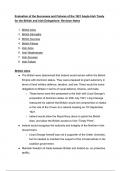
Evaluation of the Successes and Failures of the 1921 Anglo-Irish Treaty
for the British and Irish Delegations- Revision Notes
1. British Aims
2. British Strengths
3. British Success
4. British Failure
5. Irish Aims
6. Irish Weaknesses
7. Irish Success
8. Irish Failure
British Aims
● The British were determined that Ireland would remain within the British
Empire with dominion status. They were prepared to grant autonomy in
terms of land military defence, taxation, and law. There would be some
obligations to Britain in terms of naval defence, finance, and trade.
○ These terms were first presented to the Irish with Lloyd George’s
proposition of dominion status on 20th July 1921. Lloyd George
reassured his cabinet that Britain would not compromise on status
or the role of the Crown at a cabinet meeting on 7th September
1921.
○ Ireland would allow the Royal Navy alone to patrol the British
Isles, and allow the British access to Irish “Treaty Ports”.
● Ireland would recognise the authority and integrity of the Northern Irish
Government.
○ Lloyd George himself was not a supporter of the Ulster Unionists,
but he needed to maintain the support of the Conservatives in his
coalition government.
● Maintain freedom of trade between Britain and Ireland (ie. no protective
tariffs).
,British Strengths
Preliminary Discussions
● 20th July 1921: Lloyd George proposes dominion status to the 26
counties.
○ 21st July 1921: De Valera rejects this and leaves. However, he
later sends a messenger to collect the proposition, indicating a
willingness to negotiate (hence giving up the Republic).
○ Lloyd George warns De Valera six times that status within the
Empire will not be considered, so a willingness to negotiate is a
willingness to concede.
● 7th September 1921: Lloyd George assures the cabinet that he will not
compromise on status at a cabinet meeting in Inverness
(consistency/strength).
● 29th September 1921: Lloyd George backs down and extends an
unconditional offer to negotiate. Whilst this is good news to the Irish, it
shows that Lloyd George had the initiative.
○ They were meeting to discuss “how the association of Ireland
within the community of nations known as the British Empire may
best be reconciled with Irish National Aspirations”. In accepting,
De Valera had already conceded the Republic. This weakened his
position considerably.
● By this stage, “the notion of an isolated republic was dead” (Pakenham)
The British Delegation
● Lloyd George (Prime Minister), Chamberlain, Birkenhead, Churchill,
Greenwood, Jones
○ They were “incredibly impressive” (Geoghegan)
● Extensive negotiation experience
● United on status (unlike the Irish delegation)
, ● Had the support of the press and public in regards to status (they did
not have support to go to war over Ulster, but Lloyd George resolved
this through the Boundary Commission).
○ The British had a superior military, and public support to continue
the Anglo-Irish War if talks broke down over status. The IRA,
however, was down to “counting bullets” (Collins). Lloyd George
was prepared to use this threat against the Irish delegation.
● Lloyd George was a clear and involved leader, so the British didn’t
suffer from the same confusion as the Irish.
● Lloyd George’s sympathy to the nationalist cause (and lack of
commitment to the Ulster unionists) won Griffith’s trust. This allowed
Lloyd George to host productive talks and manipulate the Irish into
signing the Treaty.
● Birkenhead had a particularly productive rapport with Collins.
The Beginning of Negotiations and Sub-Conferences
● 11th October 1921: British seize the initiative.
○ Lloyd George proposes an offer based on dominion status
(minimal difference from 20th July 1921).
○ “The Irish had allowed the PM to seize the initiative” (Rees)
● Lloyd George suggested sub-conferences to sideline the hardline
Barton, Childers, and Duffy. By negotiating with the moderates (Griffith
and Collins), a compromise was more likely (and it was more likely to be
amenable to British tastes).
○ Lloyd George added a “personal touch” (Pakenham) to
negotiations in the sub-conferences.
Lloyd George, Griffith, and the Boundary Commissions
● 30th October 1921: Lloyd George meets with Griffith, saying that he is
to face a censure motion from the “Diehard” Conservatives which would
threaten his position as PM.
for the British and Irish Delegations- Revision Notes
1. British Aims
2. British Strengths
3. British Success
4. British Failure
5. Irish Aims
6. Irish Weaknesses
7. Irish Success
8. Irish Failure
British Aims
● The British were determined that Ireland would remain within the British
Empire with dominion status. They were prepared to grant autonomy in
terms of land military defence, taxation, and law. There would be some
obligations to Britain in terms of naval defence, finance, and trade.
○ These terms were first presented to the Irish with Lloyd George’s
proposition of dominion status on 20th July 1921. Lloyd George
reassured his cabinet that Britain would not compromise on status
or the role of the Crown at a cabinet meeting on 7th September
1921.
○ Ireland would allow the Royal Navy alone to patrol the British
Isles, and allow the British access to Irish “Treaty Ports”.
● Ireland would recognise the authority and integrity of the Northern Irish
Government.
○ Lloyd George himself was not a supporter of the Ulster Unionists,
but he needed to maintain the support of the Conservatives in his
coalition government.
● Maintain freedom of trade between Britain and Ireland (ie. no protective
tariffs).
,British Strengths
Preliminary Discussions
● 20th July 1921: Lloyd George proposes dominion status to the 26
counties.
○ 21st July 1921: De Valera rejects this and leaves. However, he
later sends a messenger to collect the proposition, indicating a
willingness to negotiate (hence giving up the Republic).
○ Lloyd George warns De Valera six times that status within the
Empire will not be considered, so a willingness to negotiate is a
willingness to concede.
● 7th September 1921: Lloyd George assures the cabinet that he will not
compromise on status at a cabinet meeting in Inverness
(consistency/strength).
● 29th September 1921: Lloyd George backs down and extends an
unconditional offer to negotiate. Whilst this is good news to the Irish, it
shows that Lloyd George had the initiative.
○ They were meeting to discuss “how the association of Ireland
within the community of nations known as the British Empire may
best be reconciled with Irish National Aspirations”. In accepting,
De Valera had already conceded the Republic. This weakened his
position considerably.
● By this stage, “the notion of an isolated republic was dead” (Pakenham)
The British Delegation
● Lloyd George (Prime Minister), Chamberlain, Birkenhead, Churchill,
Greenwood, Jones
○ They were “incredibly impressive” (Geoghegan)
● Extensive negotiation experience
● United on status (unlike the Irish delegation)
, ● Had the support of the press and public in regards to status (they did
not have support to go to war over Ulster, but Lloyd George resolved
this through the Boundary Commission).
○ The British had a superior military, and public support to continue
the Anglo-Irish War if talks broke down over status. The IRA,
however, was down to “counting bullets” (Collins). Lloyd George
was prepared to use this threat against the Irish delegation.
● Lloyd George was a clear and involved leader, so the British didn’t
suffer from the same confusion as the Irish.
● Lloyd George’s sympathy to the nationalist cause (and lack of
commitment to the Ulster unionists) won Griffith’s trust. This allowed
Lloyd George to host productive talks and manipulate the Irish into
signing the Treaty.
● Birkenhead had a particularly productive rapport with Collins.
The Beginning of Negotiations and Sub-Conferences
● 11th October 1921: British seize the initiative.
○ Lloyd George proposes an offer based on dominion status
(minimal difference from 20th July 1921).
○ “The Irish had allowed the PM to seize the initiative” (Rees)
● Lloyd George suggested sub-conferences to sideline the hardline
Barton, Childers, and Duffy. By negotiating with the moderates (Griffith
and Collins), a compromise was more likely (and it was more likely to be
amenable to British tastes).
○ Lloyd George added a “personal touch” (Pakenham) to
negotiations in the sub-conferences.
Lloyd George, Griffith, and the Boundary Commissions
● 30th October 1921: Lloyd George meets with Griffith, saying that he is
to face a censure motion from the “Diehard” Conservatives which would
threaten his position as PM.