

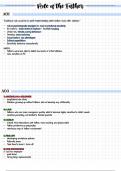
Role of e Faer
AO1
Traditional role would be to work + earn money whilst mother looks after children '
• not as psychologically equipped bc lack of emotional sensitivity
• Bio factors : lower levels of oxytocin - facilitate bonding
• Under lies, female, caring behaviour
• Females, more nurturing
• Social factors: sex, stereotypes
• Cultural expectations
• Sensitivity feminine characteristic
HARDY:
• fathers were less able to detect low levels of infant distress
• Less sensitive as PC
AO3
S: MACCASLLUM + GOLOMBOK
• longitudinal obs study
• Children growing up without fathers, did not develop any differently
W: LAMB
• fathers, who are main caregivers quickly able to become highly sensitive to child's needs
• sensitive parenting, not limited to female parents
W: BOWLBY
• infants find interactions with father, more exciting and pleasurable
• Father preferred as playmates
• reinforces imp of father involvement
S: PRAC APP
• developing workplace policies
• Paternity leave
• Take time to bond + form att
W: ECO IMPLICATIONS
// cost for employer
• paid leave
• Hiring temp replacements
, Multiple Attachments
AO1
• explore age + onset of attachment
• 60 babies from working class area of Glasgow visited monthly for 12 months, then at 18 months
• stranger, anxiety
• When researchers approached baby
• separation, anxiety
• Interviews with mother
• Response to every day situation
• 0 no protest -> 3 cries loudly every time
• 65% mother as first attachment
• 30% mother joint first attachment figure >
- 27 % father joint att figure
• 3% father 1st attachment
• Asocial 0-6 weeks
• start to bond with carers
• Biased to human like stimuli
• indiscriminate 6 weeks - 7 months
• More sociable, no fear of strangers, but prefers familiar adults
• specific 7-10 months
• Separation anxiety when primary attachment fig leaves
• Mutliple 10 months onwards
• Attachment towards multiple people, especially those spend time with (sec atts )
AO3
S: HIGH ECO VAL
• longitudinal, observational study
• Families own homes, and most observations done by parents
S: HIGH INT VAL
• very young baby
• Unlikely affected by observer present
• Reliable
W: INTERVIEWS
• social desirability
• Children in good light
• reduces internal validity
W: VAN IJERNDOORN
• babies for multiple attachments from the unset in some cultures
• // only after 10 months
W: 1964
• children more used to separation now
• Parents return to work - less separation, anxiety
• Lacks temporal validity
AO1
Traditional role would be to work + earn money whilst mother looks after children '
• not as psychologically equipped bc lack of emotional sensitivity
• Bio factors : lower levels of oxytocin - facilitate bonding
• Under lies, female, caring behaviour
• Females, more nurturing
• Social factors: sex, stereotypes
• Cultural expectations
• Sensitivity feminine characteristic
HARDY:
• fathers were less able to detect low levels of infant distress
• Less sensitive as PC
AO3
S: MACCASLLUM + GOLOMBOK
• longitudinal obs study
• Children growing up without fathers, did not develop any differently
W: LAMB
• fathers, who are main caregivers quickly able to become highly sensitive to child's needs
• sensitive parenting, not limited to female parents
W: BOWLBY
• infants find interactions with father, more exciting and pleasurable
• Father preferred as playmates
• reinforces imp of father involvement
S: PRAC APP
• developing workplace policies
• Paternity leave
• Take time to bond + form att
W: ECO IMPLICATIONS
// cost for employer
• paid leave
• Hiring temp replacements
, Multiple Attachments
AO1
• explore age + onset of attachment
• 60 babies from working class area of Glasgow visited monthly for 12 months, then at 18 months
• stranger, anxiety
• When researchers approached baby
• separation, anxiety
• Interviews with mother
• Response to every day situation
• 0 no protest -> 3 cries loudly every time
• 65% mother as first attachment
• 30% mother joint first attachment figure >
- 27 % father joint att figure
• 3% father 1st attachment
• Asocial 0-6 weeks
• start to bond with carers
• Biased to human like stimuli
• indiscriminate 6 weeks - 7 months
• More sociable, no fear of strangers, but prefers familiar adults
• specific 7-10 months
• Separation anxiety when primary attachment fig leaves
• Mutliple 10 months onwards
• Attachment towards multiple people, especially those spend time with (sec atts )
AO3
S: HIGH ECO VAL
• longitudinal, observational study
• Families own homes, and most observations done by parents
S: HIGH INT VAL
• very young baby
• Unlikely affected by observer present
• Reliable
W: INTERVIEWS
• social desirability
• Children in good light
• reduces internal validity
W: VAN IJERNDOORN
• babies for multiple attachments from the unset in some cultures
• // only after 10 months
W: 1964
• children more used to separation now
• Parents return to work - less separation, anxiety
• Lacks temporal validity


