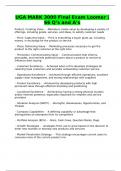
UGA MARK 3000 Final Exam Loomer |
66 Q’s and A’s
Product: Creating Value - -Marketers create value by developing a variety of
offerings, including goods, services, and ideas, to satisfy customer needs
- Price: Capturing Value - -Price is everything a buyer gives up, including
money, in exchange for the product or service
- Place: Delivering Value - -Marketing processes necessary to get the
product to the right customer at the right time
- Promotion: Communicating Value - -Communication that informs,
persuades, and reminds potential buyers about a product or service to
influence their buying
- Customer Excellence - -Achieved when a firm develops strategies for
retaining loyal customers and provides outstanding customer service
- Operational Excellence - -Achieved through efficient operations, excellent
supply chain management, and strong relationships with suppliers
- Product Excellence - -Achieved by developing products with high
perceived value through effective branding and positioning
- Locational Excellence - -Achieved by having a strong physical location
and/or Internet presence; especially important for retailers and service
providers
- Situation Analysis (SWOT) - -Strengths, Weaknesses, Opportunities, and
Threats
- Company Capabilities - -A defining capability or advantage that
distinguishes an enterprise from its competitors
- Portfolio Analysis (BCG) - -Stars, Cash Cows, Question Marks, Dogs
- Growth Strategies - -strategies firms use to grow based on the decision to
enter new markets or develop new products and services
- Market Penetration Strategy - -This strategy encourages current users to
consume more of the current product mix
, - Market Development Strategy - -This strategy might include targeting
different consumers in the home market or seeking global expansion
- Product Development Strategy - -The third growth strategy option involves
innovative product and service offerings to meet changing needs of existing
consumers
- Diversification Strategy - -This is the riskiest of all growth strategies,
requires extensive research into emerging markets and firm capabilities
- Consumer Decision Process - -need recognition, information search,
alternative evaluation, purchase, post purchase
- Need Recognition - -Functional needs, Psychological needs
- Generate Consumer Segments - -Geographic, Demographics,
Psychographic, Benefit, Behavioral
- Geographic Segmentation - -organizes customers into groups based on
where they live
- Demographic Segmentation - -groups consumers according to easily
measured, objective characteristics such as age, gender, income, and
education
- Psychographic Segmentation - -how consumers describe themselves, how
they choose to spend their time, and what motivates them
- Benefit Segmentation - -groups consumers based on the benefits they
derive from products or services
- Behavioral Segmentation - -divides consumers based on their previous
purchases of goods or services
- Primary Data - -Collected to address specific research needs through
methods such as focus groups, in-depth interviews, surveys, etc.
- Secondary Data - -Collected prior to the start of the research project,
Sourced both internally and externally
- Quantitative Data - -Involves structured responses that can be statistically
tested
- Qualitative Data - -Uses broad, open-ended questions to understand a
phenomenon
66 Q’s and A’s
Product: Creating Value - -Marketers create value by developing a variety of
offerings, including goods, services, and ideas, to satisfy customer needs
- Price: Capturing Value - -Price is everything a buyer gives up, including
money, in exchange for the product or service
- Place: Delivering Value - -Marketing processes necessary to get the
product to the right customer at the right time
- Promotion: Communicating Value - -Communication that informs,
persuades, and reminds potential buyers about a product or service to
influence their buying
- Customer Excellence - -Achieved when a firm develops strategies for
retaining loyal customers and provides outstanding customer service
- Operational Excellence - -Achieved through efficient operations, excellent
supply chain management, and strong relationships with suppliers
- Product Excellence - -Achieved by developing products with high
perceived value through effective branding and positioning
- Locational Excellence - -Achieved by having a strong physical location
and/or Internet presence; especially important for retailers and service
providers
- Situation Analysis (SWOT) - -Strengths, Weaknesses, Opportunities, and
Threats
- Company Capabilities - -A defining capability or advantage that
distinguishes an enterprise from its competitors
- Portfolio Analysis (BCG) - -Stars, Cash Cows, Question Marks, Dogs
- Growth Strategies - -strategies firms use to grow based on the decision to
enter new markets or develop new products and services
- Market Penetration Strategy - -This strategy encourages current users to
consume more of the current product mix
, - Market Development Strategy - -This strategy might include targeting
different consumers in the home market or seeking global expansion
- Product Development Strategy - -The third growth strategy option involves
innovative product and service offerings to meet changing needs of existing
consumers
- Diversification Strategy - -This is the riskiest of all growth strategies,
requires extensive research into emerging markets and firm capabilities
- Consumer Decision Process - -need recognition, information search,
alternative evaluation, purchase, post purchase
- Need Recognition - -Functional needs, Psychological needs
- Generate Consumer Segments - -Geographic, Demographics,
Psychographic, Benefit, Behavioral
- Geographic Segmentation - -organizes customers into groups based on
where they live
- Demographic Segmentation - -groups consumers according to easily
measured, objective characteristics such as age, gender, income, and
education
- Psychographic Segmentation - -how consumers describe themselves, how
they choose to spend their time, and what motivates them
- Benefit Segmentation - -groups consumers based on the benefits they
derive from products or services
- Behavioral Segmentation - -divides consumers based on their previous
purchases of goods or services
- Primary Data - -Collected to address specific research needs through
methods such as focus groups, in-depth interviews, surveys, etc.
- Secondary Data - -Collected prior to the start of the research project,
Sourced both internally and externally
- Quantitative Data - -Involves structured responses that can be statistically
tested
- Qualitative Data - -Uses broad, open-ended questions to understand a
phenomenon