

Entrepreneurial Finance
Chapter 0: Access to finance
Financial constraints/ credit rationing
A firm is financially constrained i fit has a need for external finance, but is
unable to obtain it.
Financial constraints = frictions that prevent the firm from funding all
desired investments.
These constraints variate across industry, time,…
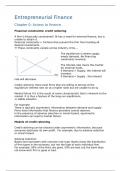
The equilibrium is where supply
meets demand. No financing
constraints involved.
The interest rate clears the market
for external funds.
If Demand > Supply, the interest will
increase.
If Demand < Supply , the interest
rate will decrease.
Credit rationing: there exist firms that are willing to borrow at the
equilibrium interest rate (or at a higher rate) but are unable to do so.
Market failure if it is the result of some characteristic that is inherent to the
market. It is thus a feature of the long-run equilibrium.
stable situation
For example:
There is typically asymmetric information between demand and supply.
Firms have information that finance providers cannot observe.
In the presence of adverse selection or moral hazard, asymmetric
information can lead to market failure.
Models of credit rationing
Credit rationing can be rational under asymmetric information, because
everyone optimizes its own profit. For example, due to adverse selection
or moral hazard.
Adverse selection:
Banks face borrowers with unknown risk type. Banks know the distribution
of firm types in the economy, but not the type of each individual firm.
For example: 50% of the firms are good, 50% are bad, but the bank does
not know wich firm is good or bad.
,Firms with risky projects have a low chance of success and thus of
repayment, but when they are successful, the return is very high.
Firms with safe projects have a high chance of success and thus of
repayment, but when they succeed, the return is not particularly high.
Banks choose their supply (and thus implicitly set the interest rate) such
that they maximize their profits.
Ceteris paribus, higher interest rates lead to higher profits.
Twist in the model: safe firms will not accept high interest rates. Only risky
firms accept high interest rates.
This lead to adverse selection if the interest rate is too high.
Safe firms repay with high certainty, but their returns are low
high interest rates = high borrowing costs > return if successful
Risky firms repay with low certainty, but their return is very high
high interest rate = high borrowing cost < return if successful
Banks profits no longer monotonically increase with interest rate.
Banks profits increase with the interest rate, up to the point when
safe firms start to drop out. From that point onwards bank profits
decrease with the interest rate.
It is thus rational for banks not to lend beyond a certain interest
rate. Even though there are firms with positive demand for external
funding at higher interest rates.
The unserved firms are credit rationed in equilibrium.
Moral hazard:
Bank face borrowers with same risk type, but different assetssame
riskiness of firms/ projects, but different amounts of ex-ante collateral.
Chance of project success does not depend on firm’s collateral.
Chance of project success depends on effort on the entrepreneurial.
high effort high likelihood of project success
low effort low likelihood of project success
Banks choose their supply or external funding to maximize profits. Profits
depend on the success of the entrepreneurs and thus on the effort of the
entrepreneurs.
Twist in the model: Entrepreneurs also benefit from leisure (=free time).
The more effort they exert, the less time they have for leisure.
Entrepreneurs might promise to exert high effort but change their
effort once they have received funding.
Banks cannot observe the effort of entrepreneurs. So, firms will need to
pledge a minimum level of assets to the bank. This way, firms incur some
of investment risk themselves.
,Only if firms have sufficient “skin in the game” (resources in stake), the
bank can be sure that entrepreneurs exert the necessary effort.
Firms with inefficient assets cannot convince the bank that they will exert
effort. They are credit rationed and their projects will not get funded.
Due to moral hazard under asymmetric information, it is rational for
banks not to lend to some firms.
Implications of financial constraints
Financial constraints have important consequences for:
Exports
Investments
Asset growth
Sales growth
Employment growth
Startup growth
Zie voorbeelden in slides
Chapter 1: introduction to Entrepreneurial Finance
What is entrepreneurial finance?
Entrepreneurial finance is the intersection from entrepreneurship and
corporate finance techniques.
Funding providers: VCs, angels, crowd, family and friends, banks,
government
Entrepreneurships: young innovative companies (this is not the same as
SMEs)
Typically < 10 years
Technology or business model is innovative
Growth oriented
Entrepreneurial finance process is long and risky. We need to understand
actors and steps.
Entrepreneurship can be characterized by 3 fundamental principles:
1. Gathering and recombining resources:
Entrepreneuship as a recombination of existing resources to create
new souces of vaue.
Entrepreneurs need to convince resource owners to provide the
resources
Financing is key resource because money allows entrepreneurs to
acquire other resources such as emploeeys, equipment,…
2. Uncertainty
The entrepreneurial process is inherently uncertain.
, Once outcomes are well understood, business opportunities are no
longer entrepreneurial but managerial.
3. Experimentation
Entrepreneurship consists of experimentation and dynamic flexibility.
The organizational structure matters for incentives and ability to
“pivot”.
Why is it challenging?
Entrepreneurial perspective: getting funded is often hard. Bewildering
diversity of investors with different characteristics often difficult to reach
out to
Investor perspective: swamped with proposals, most of them bad or a poor
fit. + long and costly investment process.
Why is it important?
Entrepreneurial perspective: money is a key resource
investor perspective: search for returns, portfolio diversification or
strategic objectives = pass on knowledge
Broader economic and social perspective: market driven selection system
+ create jobs, innovation, and economic growth
What drives economic growth?
Once labor and capital are fully employed, the key driver of economic
growth is technological progress or “total factor productivity” (TFP)
Economist have investigated the links of corporate innovation and
entrepreneurship with TFP.
If we know what drives TFP, we know what drives economic growth.
Results:
Start-ups that have received VC funding, have significantly higher
TFP than a control group start-ups without it.
VC generates more innovative outputs than corporate R&D spending
Increases in local VC funding increase the local start-up rate,
employment and aggregate income
Entrepreneurial finance contributes to economic growth.
Young firms make a significant contribution to net job creation.
THIS IS NOT TRUE FOR SME FIRMS!!!
Only a few gazelles (fast growing start-ups) eventually become large
companies, as many die out during growth.
A key fact of entrepreneurships is that “death is the rule”. Only a few start-
ups survive.
,After 10 years from funding, the failure rate of US VC-backed start-ups is
about 32%. For comparable non-VC backed start-ups it is about 62%.
Working with an experienced investor significantly increases the
survival rate. But still 32% does not survive.
In the long-run VC backed companies account for 0,1% of US start-ups,
but for 5,5% of US employment.
Zie grafieken in slides
How can we understand it?
FRAMEWORKS
Why frameworks? Frameworks are simplified models of reality that help to
understand it.
FIRE framework:
Describes the entrepreneurial finance process from funding to the exit
event. It should help to structure the whole entrepreneurial process.
4 steps:
Fit: matching process between entrepreneurs and investors
Search challenge: who are the potentially relevant partners?
Involves networking, information gathering, processing
Selection challenge: screening and signaling by both parties
involves deep due diligence: track records, credibility,…
Invest: deciding on an investment
There are 4 forces that typically affect a deal:
1. Needs of the entrepreneur: company requirements and own
preferences
2. Needs of the investor own preferences (see FUEL
framework later)
3. Expectations: about the venture’s future
4. Market conditions: because they affect bargaining power
Ride: the path forward, with all the surprises and pivots that are
endemic to the entrepreneurial process
The entrepreneur and the investor jointly grow the company. The
process requires:
Learning about the company, the market, and about each
other involves adjusting the strategy, building/destroying
trust
Governance: who decides when there is disagreement?
Exit: process by which investors sell some or all of their shares to
obtain a return on their investment.
in a VC context this would be +/-10 years after the initial
investment.
Key decisions include:
, When to exit? Timing constraints of different parties matter
and may lead to conflicts
How to exit?
Successful exit: via IPO, acquisitions, sales to financial buyers
Unsuccessful exit: closing down with or without bankruptcy
Staged financing:
You don’t get all the funding upfront. The FIRE framework encompasses
stage financing.
Money is provided over several rounds.
The provision is milestone-based
Staging involves costs and benefits for entrepreneurs and investors but is
often mutually advantageous.
For the entrepreneur:
+ staging reduces fundraising cost and dilution can be cheaper
+ staging introduces refinancing risk
For the investor:
+ staging creates “option value of waiting”
+ staging increases control though the “power of the purse”
FUEL framework:
Should help to categories the funding opportunities. It reflects the
investor’s nature and approach to the deal.
Fundamental structure: who is the investor?
What is the investor’s identity? How much money do they
have? Is it a good fit at the stage in the lifecycle?
What are the organizational structures and financial resources?
Who’s money does she invest and how much?
Who makes decisions and how? What are the governance
structure?
Structure differences between angel
investor and VC funder.
In a VC fund you have limited partners, who
do not interact with the company (the general
partner does), but they have the
requirements in terms of return and can put
pressure on these funds.
Underlying motivation: What does she want?
What does the investor want?
How does she value financial and non-financial returns?
Personal, social, strategic objectives may drive decisions
Chapter 0: Access to finance
Financial constraints/ credit rationing
A firm is financially constrained i fit has a need for external finance, but is
unable to obtain it.
Financial constraints = frictions that prevent the firm from funding all
desired investments.
These constraints variate across industry, time,…
The equilibrium is where supply
meets demand. No financing
constraints involved.
The interest rate clears the market
for external funds.
If Demand > Supply, the interest will
increase.
If Demand < Supply , the interest
rate will decrease.
Credit rationing: there exist firms that are willing to borrow at the
equilibrium interest rate (or at a higher rate) but are unable to do so.
Market failure if it is the result of some characteristic that is inherent to the
market. It is thus a feature of the long-run equilibrium.
stable situation
For example:
There is typically asymmetric information between demand and supply.
Firms have information that finance providers cannot observe.
In the presence of adverse selection or moral hazard, asymmetric
information can lead to market failure.
Models of credit rationing
Credit rationing can be rational under asymmetric information, because
everyone optimizes its own profit. For example, due to adverse selection
or moral hazard.
Adverse selection:
Banks face borrowers with unknown risk type. Banks know the distribution
of firm types in the economy, but not the type of each individual firm.
For example: 50% of the firms are good, 50% are bad, but the bank does
not know wich firm is good or bad.
,Firms with risky projects have a low chance of success and thus of
repayment, but when they are successful, the return is very high.
Firms with safe projects have a high chance of success and thus of
repayment, but when they succeed, the return is not particularly high.
Banks choose their supply (and thus implicitly set the interest rate) such
that they maximize their profits.
Ceteris paribus, higher interest rates lead to higher profits.
Twist in the model: safe firms will not accept high interest rates. Only risky
firms accept high interest rates.
This lead to adverse selection if the interest rate is too high.
Safe firms repay with high certainty, but their returns are low
high interest rates = high borrowing costs > return if successful
Risky firms repay with low certainty, but their return is very high
high interest rate = high borrowing cost < return if successful
Banks profits no longer monotonically increase with interest rate.
Banks profits increase with the interest rate, up to the point when
safe firms start to drop out. From that point onwards bank profits
decrease with the interest rate.
It is thus rational for banks not to lend beyond a certain interest
rate. Even though there are firms with positive demand for external
funding at higher interest rates.
The unserved firms are credit rationed in equilibrium.
Moral hazard:
Bank face borrowers with same risk type, but different assetssame
riskiness of firms/ projects, but different amounts of ex-ante collateral.
Chance of project success does not depend on firm’s collateral.
Chance of project success depends on effort on the entrepreneurial.
high effort high likelihood of project success
low effort low likelihood of project success
Banks choose their supply or external funding to maximize profits. Profits
depend on the success of the entrepreneurs and thus on the effort of the
entrepreneurs.
Twist in the model: Entrepreneurs also benefit from leisure (=free time).
The more effort they exert, the less time they have for leisure.
Entrepreneurs might promise to exert high effort but change their
effort once they have received funding.
Banks cannot observe the effort of entrepreneurs. So, firms will need to
pledge a minimum level of assets to the bank. This way, firms incur some
of investment risk themselves.
,Only if firms have sufficient “skin in the game” (resources in stake), the
bank can be sure that entrepreneurs exert the necessary effort.
Firms with inefficient assets cannot convince the bank that they will exert
effort. They are credit rationed and their projects will not get funded.
Due to moral hazard under asymmetric information, it is rational for
banks not to lend to some firms.
Implications of financial constraints
Financial constraints have important consequences for:
Exports
Investments
Asset growth
Sales growth
Employment growth
Startup growth
Zie voorbeelden in slides
Chapter 1: introduction to Entrepreneurial Finance
What is entrepreneurial finance?
Entrepreneurial finance is the intersection from entrepreneurship and
corporate finance techniques.
Funding providers: VCs, angels, crowd, family and friends, banks,
government
Entrepreneurships: young innovative companies (this is not the same as
SMEs)
Typically < 10 years
Technology or business model is innovative
Growth oriented
Entrepreneurial finance process is long and risky. We need to understand
actors and steps.
Entrepreneurship can be characterized by 3 fundamental principles:
1. Gathering and recombining resources:
Entrepreneuship as a recombination of existing resources to create
new souces of vaue.
Entrepreneurs need to convince resource owners to provide the
resources
Financing is key resource because money allows entrepreneurs to
acquire other resources such as emploeeys, equipment,…
2. Uncertainty
The entrepreneurial process is inherently uncertain.
, Once outcomes are well understood, business opportunities are no
longer entrepreneurial but managerial.
3. Experimentation
Entrepreneurship consists of experimentation and dynamic flexibility.
The organizational structure matters for incentives and ability to
“pivot”.
Why is it challenging?
Entrepreneurial perspective: getting funded is often hard. Bewildering
diversity of investors with different characteristics often difficult to reach
out to
Investor perspective: swamped with proposals, most of them bad or a poor
fit. + long and costly investment process.
Why is it important?
Entrepreneurial perspective: money is a key resource
investor perspective: search for returns, portfolio diversification or
strategic objectives = pass on knowledge
Broader economic and social perspective: market driven selection system
+ create jobs, innovation, and economic growth
What drives economic growth?
Once labor and capital are fully employed, the key driver of economic
growth is technological progress or “total factor productivity” (TFP)
Economist have investigated the links of corporate innovation and
entrepreneurship with TFP.
If we know what drives TFP, we know what drives economic growth.
Results:
Start-ups that have received VC funding, have significantly higher
TFP than a control group start-ups without it.
VC generates more innovative outputs than corporate R&D spending
Increases in local VC funding increase the local start-up rate,
employment and aggregate income
Entrepreneurial finance contributes to economic growth.
Young firms make a significant contribution to net job creation.
THIS IS NOT TRUE FOR SME FIRMS!!!
Only a few gazelles (fast growing start-ups) eventually become large
companies, as many die out during growth.
A key fact of entrepreneurships is that “death is the rule”. Only a few start-
ups survive.
,After 10 years from funding, the failure rate of US VC-backed start-ups is
about 32%. For comparable non-VC backed start-ups it is about 62%.
Working with an experienced investor significantly increases the
survival rate. But still 32% does not survive.
In the long-run VC backed companies account for 0,1% of US start-ups,
but for 5,5% of US employment.
Zie grafieken in slides
How can we understand it?
FRAMEWORKS
Why frameworks? Frameworks are simplified models of reality that help to
understand it.
FIRE framework:
Describes the entrepreneurial finance process from funding to the exit
event. It should help to structure the whole entrepreneurial process.
4 steps:
Fit: matching process between entrepreneurs and investors
Search challenge: who are the potentially relevant partners?
Involves networking, information gathering, processing
Selection challenge: screening and signaling by both parties
involves deep due diligence: track records, credibility,…
Invest: deciding on an investment
There are 4 forces that typically affect a deal:
1. Needs of the entrepreneur: company requirements and own
preferences
2. Needs of the investor own preferences (see FUEL
framework later)
3. Expectations: about the venture’s future
4. Market conditions: because they affect bargaining power
Ride: the path forward, with all the surprises and pivots that are
endemic to the entrepreneurial process
The entrepreneur and the investor jointly grow the company. The
process requires:
Learning about the company, the market, and about each
other involves adjusting the strategy, building/destroying
trust
Governance: who decides when there is disagreement?
Exit: process by which investors sell some or all of their shares to
obtain a return on their investment.
in a VC context this would be +/-10 years after the initial
investment.
Key decisions include:
, When to exit? Timing constraints of different parties matter
and may lead to conflicts
How to exit?
Successful exit: via IPO, acquisitions, sales to financial buyers
Unsuccessful exit: closing down with or without bankruptcy
Staged financing:
You don’t get all the funding upfront. The FIRE framework encompasses
stage financing.
Money is provided over several rounds.
The provision is milestone-based
Staging involves costs and benefits for entrepreneurs and investors but is
often mutually advantageous.
For the entrepreneur:
+ staging reduces fundraising cost and dilution can be cheaper
+ staging introduces refinancing risk
For the investor:
+ staging creates “option value of waiting”
+ staging increases control though the “power of the purse”
FUEL framework:
Should help to categories the funding opportunities. It reflects the
investor’s nature and approach to the deal.
Fundamental structure: who is the investor?
What is the investor’s identity? How much money do they
have? Is it a good fit at the stage in the lifecycle?
What are the organizational structures and financial resources?
Who’s money does she invest and how much?
Who makes decisions and how? What are the governance
structure?
Structure differences between angel
investor and VC funder.
In a VC fund you have limited partners, who
do not interact with the company (the general
partner does), but they have the
requirements in terms of return and can put
pressure on these funds.
Underlying motivation: What does she want?
What does the investor want?
How does she value financial and non-financial returns?
Personal, social, strategic objectives may drive decisions


