

HYDROCARBONS
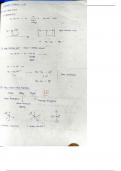
This document comprises extensive handwritten notes on Hydrocarbons, a fundamental topic in Organic Chemistry. It appears to be a comprehensive study material, likely for advanced high school or early undergraduate level chemistry courses. The notes are structured into preparations, properties, and reactions of three main classes of hydrocarbons: Alkanes, Alkenes, and Alkynes, followed by a section on Electrophilic Aromatic Substitution. Key Topics Covered: 1. Alkanes: Preparation Methods: From alkyl halides via reduction using various reagents like metals with protonic solvents (e.g., Zn + dil. HCl), complex metal hydrides (LiAlH 4 , NaBH 4 ), and triphenyltin hydride. Reduction of alkyl iodides and alcohols using HI and Red Phosphorus. Mechanisms and stoichiometry for these reductions are discussed, including for polyfunctional compounds. Wurtz reaction, including its ionic and radical mechanisms, and its suitability for symmetric alkane synthesis. Frankland reaction (using Zn). Using organometallic reagents like Grignard reagents (RMgX) and their reaction with polar protic substances. Corey-House synthesis using Gilman reagents (R 2 CuLi). Hydrogenation of unsaturated hydrocarbons (alkenes/alkynes) using catalysts like Ni, Pt, or Pd, noting syn-addition. Hydroboration-reduction of alkenes. Clemmensen reduction (acidic medium) and Wolff-Kishner reduction (basic medium) for converting carbonyl compounds to alkanes, with a comparison based on acid/base sensitivity of other functional groups. Properties: Boiling point trends (effect of molar mass and branching). Melting point trends (even-odd carbon number effect, packing efficiency, and branching). General chemical properties: relatively unreactive (paraffins), undergo free-radical substitution reactions at high temperatures (homolysis of C-C and C-H bonds). Reactions: Halogenation (free radical mechanism: initiation, propagation, termination), including selectivity of chlorination vs. bromination. Nitration. Combustion (complete and incomplete). Catalytic oxidation to form alcohols, aldehydes, or carboxylic acids. Oxidation of tertiary carbons by KMnO 4 . Isomerization. Aromatization (e.g., n-hexane to benzene). Pyrolysis or Cracking. 2. Alkenes: Preparation Methods (Elimination Reactions): General concepts of E1, E2, and E1cb mechanisms, including rate laws, molecularity, stereochemistry, and factors like leaving group ability. Dehydrohalogenation of alkyl halides using alcoholic KOH (Saytzeff's rule for major product, Hofmann elimination with bulky bases). Dehydration of alcohols using acid catalysts. Cope elimination of tertiary amine oxides (syn-elimination, Hofmann product). Pyrolysis of esters (syn-elimination, Hofmann product). Dehalogenation of vicinal dihalides using Zn (anti-elimination). Partial reduction of alkynes using Lindlar's catalyst (cis-alkene) or Birch reduction (trans-alkene), or P-2 catalyst (cis-alkene). Wittig reaction. Properties and Reactions: More reactive than alkanes due to the presence of pi electrons; primarily undergo electrophilic addition reactions. Electrophilic Addition Reactions: Addition of halogen acids (HX): Markovnikov's rule, peroxide effect (anti-Markovnikov addition of HBr via free radical mechanism). Allylic bromination using N-Bromosuccinimide (NBS). Halogenation (X 2 addition, e.g., Br 2 in CCl 4 ): anti-addition via cyclic halonium ion, stereochemistry (cis to racemic, trans to meso). Halohydrin formation (e.g., alkene + X 2 /H 2 O). Hydration: acid-catalyzed (Markovnikov), oxymercuration-demercuration (Markovnikov, no rearrangement), hydroboration-oxidation (anti-Markovnikov, syn-addition). Oxidation Reactions: Syn-dihydroxylation using cold alkaline KMnO 4 (Baeyer's reagent) or OsO 4 . Anti-dihydroxylation using peroxyacids (e.g., m-CPBA) followed by hydrolysis, or Ag 2 O followed by hydrolysis. Oxidative cleavage with hot/acidified KMnO 4 . Ozonolysis: reductive (e.g., O 3 then Zn/H 2 O or DMS) and oxidative (e.g., O 3 then H 2 O 2 ), including mechanisms and retrosynthetic applications. 3. Alkynes: Preparation Methods: Hydrolysis of calcium carbide (CaC 2 ) or magnesium carbide (Mg 2 C 3 ). Dehydrohalogenation of vicinal or geminal dihalides. Dehalogenation of tetrahalides using Zn. Alkylation of terminal alkynes. Properties and Reactions: Acidity of terminal alkynes (formation of acetylides). Hydrogenation: complete to alkanes, or partial to cis-alkenes (Lindlar's catalyst) or trans-alkenes (Birch reduction). Addition of halogens (X 2 ) and halogen acids (HX), including Markovnikov and anti-Markovnikov additions. Hydration: using HgSO 4 /H 2 SO 4 (Markovnikov, tautomerization of enol to ketone/aldehyde) or hydroboration-oxidation (anti-Markovnikov, to aldehydes). Oxidation with KMnO 4 or ozonolysis. Tests for terminal alkynes using Tollens' reagent (white ppt) or ammoniacal cuprous chloride (red ppt). Polymerization (e.g., acetylene to benzene, propyne to mesitylene). Isomerization. 4. Aromatic Hydrocarbons (Electrophilic Aromatic Substitution - EAS): General mechanism of EAS: formation of arenium ion (sigma complex), resonance stabilization, rate-determining step, deprotonation, and energy profile diagrams. Effect of substituents on reactivity and orientation: Electron Donating Groups (EDGs): activate the ring, ortho/para directing (e.g., -OCH 3 , -CH 3 , -NH 2 , -OH). Detailed resonance structures for o, p, m attack are shown for anisole and toluene. Electron Withdrawing Groups (EWGs): deactivate the ring, meta directing (e.g., -NO 2 , -CN, -COR, -SO 3 H). Detailed resonance structures for nitrobenzene. Halogens (-F, -Cl, -Br, -I): deactivate the ring but are ortho/para directing. Directing effects in disubstituted benzenes. Limitations of Friedel-Crafts reactions (e.g., with strongly deactivated rings or amines). Specific EAS reactions: Gattermann-Koch synthesis and Gattermann aldehyde synthesis for formylation of aromatic rings.

Document information
- School year
- 1
- Uploaded on
- June 3, 2025
- Number of pages
- 53
- Written in
- 2024/2025
- Type
- Class notes
- Professor(s)
- Cvb
- Contains
- All classes


